
Most guides on this topic open with sponsorships, as if landing an advertiser is the goal. For the large majority of podcasts, that is exactly backwards, and chasing it is why so many shows decide podcasting "does not pay."
Here is the math nobody leads with. Industry rate guides for 2026 put a host-read mid-roll ad at roughly $15 to $30 per thousand downloads. So a show with 1,000 downloads an episode, running one mid-roll, earns about $25 for that episode. Add a pre-roll and you might reach $45. Publish weekly and that is somewhere near $180 a month, before the sponsor even exists, which most will not until you clear several thousand downloads.
That number is not a failure. It is the honest ceiling of the ad model at a normal audience size, and it is why this guide treats ads as one option among nine, not the headline. Because the same show, monetized through its own offer, can earn many times that from a single client or a handful of product sales.
So this is the complete, honest version: every realistic way to make money from a podcast in 2026, what each actually pays, and which ones fit your show. I run Podcast Growth Studio. I spent 7 years in radio, hosted a 200-episode show, and our team has turned client episodes into more than 350 million views and real pipeline. The thread through all of it: money follows the right audience and the right offer, not raw download counts.
What this guide covers
- The monetization reality: value follows the audience, not the download count
- Sponsorships and ads (and the real CPM math)
- Affiliate marketing
- Memberships and premium feeds
- Your own products: courses, digital products, merch
- Services and consulting: the model most podcasters miss
- Listener support and crowdfunding
- Live events and workshops
- Licensing, syndication, and network deals
- Which model fits your show
- Frequently asked questions
- Resources for further reading
The monetization reality: value follows the audience, not the download count
One idea decides almost everything about how you should monetize: a podcast is worth what its audience is worth, not what its download number looks like.
A true-crime show with 50,000 casual listeners is an ad business. A show with 400 listeners who are all VPs of finance is a pipeline business. The second one can out-earn the first by a wide margin, because the money does not come from the count, it comes from who is in the room and what you can offer them.
That splits every model below into two camps. Audience-rented models (ads, sponsorships, programmatic) pay you a small amount per listener, so they only work at scale. Audience-owned models (your products, services, memberships) pay you a large amount per buyer, so they work at almost any size, as long as the right people are listening.
Before you pick a model, you need to know roughly how big and how engaged your audience is. If you have not gotten that base growing yet, start with how to grow a podcast, because monetization is far easier once the audience is real. With that context, here are the nine models.
Sponsorships and ads (and the real CPM math)
This is the model everyone pictures, so let us put real numbers on it. Podcast ads are usually priced on CPM, the rate per thousand downloads.
For 2026, the typical ranges look like this:
- Host-read mid-roll (most valuable): about $15 to $30 per thousand downloads.
- Pre-roll (at the start): around $18 to $25.
- Post-roll (at the end): lowest, about $10 to $20.
- Business, finance, and health niches sit at the higher end, because the listener is worth more to advertisers.
Smaller shows often skip CPM and charge a flat rate, commonly $100 to $500 per episode for a sponsored read. To see what your own numbers come to across pre-roll, mid-roll, and post-roll, run them through our free podcast sponsorship calculator, it does the per-episode, per-month, and per-year math for you.
Two honest caveats. First, access: niche direct sponsors may consider you around 1,000 downloads an episode, but most ad networks will not take you on until 5,000 to 10,000. Second, a trend worth knowing: engagement-based pricing is gaining ground in 2026, where retention and audience quality matter as much as raw downloads. A smaller, highly engaged show can command a better rate than a bigger, shallower one. That rewards exactly the kind of loyal audience the other models below also depend on.
When it makes sense: once you are reliably above a few thousand downloads an episode, and your show is not better used to sell your own offer.
Affiliate marketing
Affiliate income means recommending products you genuinely use and earning a commission on sales through your link or code. Unlike CPM ads, it does not require a big audience, it requires a trusting one.
It works because a podcast is an intimacy medium. When a host they trust recommends a tool, listeners act on it at rates display ads never reach. A show with a few hundred engaged listeners in a specific niche can earn meaningfully from three or four well-chosen affiliate partners.
The rule that keeps it working: only recommend things you would recommend for free. The moment your affiliate picks feel like ads, you spend the trust that made them convert in the first place.
When it makes sense: almost any size, especially niche shows with an engaged audience and natural product fit (gear, software, books, services).
Memberships and premium feeds
Memberships turn your most devoted listeners into recurring supporters in exchange for something extra: ad-free episodes, bonus content, a private community, early access, or a premium feed. Platforms like Patreon and Apple's subscriptions make the mechanics easy.
The opportunity is real: research suggests roughly a quarter of podcast listeners are willing to pay for a show they value. You do not need all of them. A few hundred true fans at a few dollars a month is a stable income base that does not depend on any advertiser.
The catch is that memberships reward depth, not reach. They work best for shows with a strong identity and a community feel, where belonging is worth paying for. If your audience is passionate about the topic or about you, this is one of the most durable models there is.
When it makes sense: shows with a devoted niche audience and content or community worth gating, at almost any size.
Your own products: courses, digital products, merch
If you have expertise, a podcast is a long-form trust engine that makes selling your own products natural. A course, a template pack, an ebook, a paid workshop, or branded merch all turn listener attention into owned revenue you keep nearly all of.
The advantage over ads is the margin and the control. You are not earning cents per listener, you are earning real money per buyer, and you own the customer relationship. A single course at a few hundred dollars, sold to a small fraction of a modest audience, can dwarf a year of CPM income.
The work is in the product itself and in making the offer clearly, repeatedly, without feeling like a constant pitch. One clear call to action per episode, pointing to one product, beats scattering five.
When it makes sense: any show whose host has knowledge or a brand listeners want more of. Especially strong for educators, creators, and experts.
Services and consulting: the model most podcasters miss
This is the model the ad-first guides skip, and for a coach, consultant, CPA, agency, or B2B founder it is almost always the highest-return option by a wide margin.
The logic is simple. If one client is worth $5,000, $20,000, or more to your business, you do not need 50,000 downloads. You need a few hundred of the right people to hear you sound like the obvious expert, and a clear path from the episode to a conversation. The podcast is not the product. It is the thing that makes the sale easier.
This is exactly why so many B2B operators podcast at all, and why measuring the show in downloads misses the point. The right metric is booked calls and pipeline. We wrote the full system for this in how to get clients from your podcast: the three conversion pathways, how to attribute deals back to episodes, and the realistic conversion math by audience size.
One honest comparison to sit with: at 1,000 downloads an episode, the ad model might pay you $25. The services model, from that same episode, might book a call that becomes a $15,000 client. Same audience, two completely different ceilings.
When it makes sense: any host who sells a service or high-value offer. For B2B specifically, start here before you consider any other model.
Listener support and crowdfunding
Closely related to memberships, but simpler: listeners give directly because they value the show and want it to continue. Tip jars, one-off donations, and crowdfunding campaigns all fit here.
This rarely becomes a primary income, but for community-driven, mission-driven, or independent shows it can be a meaningful supplement, and a strong signal of how much your audience cares. The key is to ask clearly and to connect the support to something concrete: covering production costs, funding a new season, keeping the show ad-free.
When it makes sense: mission-driven, community, and hobbyist shows with a loyal base, usually as a supplement rather than the core.
Live events and workshops
An engaged audience will often pay to go deeper in person or live: a paid workshop, a virtual masterclass, a live recording, a small summit, or a cohort program. Events carry high perceived value and can generate significant revenue from a relatively small number of attendees.
They also do something the feed cannot: they turn passive listeners into a real community and into case studies, testimonials, and relationships that feed every other model. The cost is effort and logistics, so events tend to work best as a periodic high-value offer rather than a constant.
When it makes sense: shows with an engaged audience and a host comfortable teaching or convening, often layered on top of a services or product model.
Licensing, syndication, and network deals
At the larger end, your content or your show itself can become the asset: licensing episodes or clips, syndication deals, joining a podcast network that sells ads on your behalf, or in rarer cases a format or catalog acquisition. Networks can open up ad rates and sponsors that are hard to reach alone, usually in exchange for a cut and some control.
This is the least relevant model for most independent and B2B shows, and it generally only comes into play once you have real scale or a distinctive format. Worth knowing it exists, not worth planning your first year around.
When it makes sense: established shows with scale, a distinctive format, or a back catalog worth packaging.
Which model fits your show
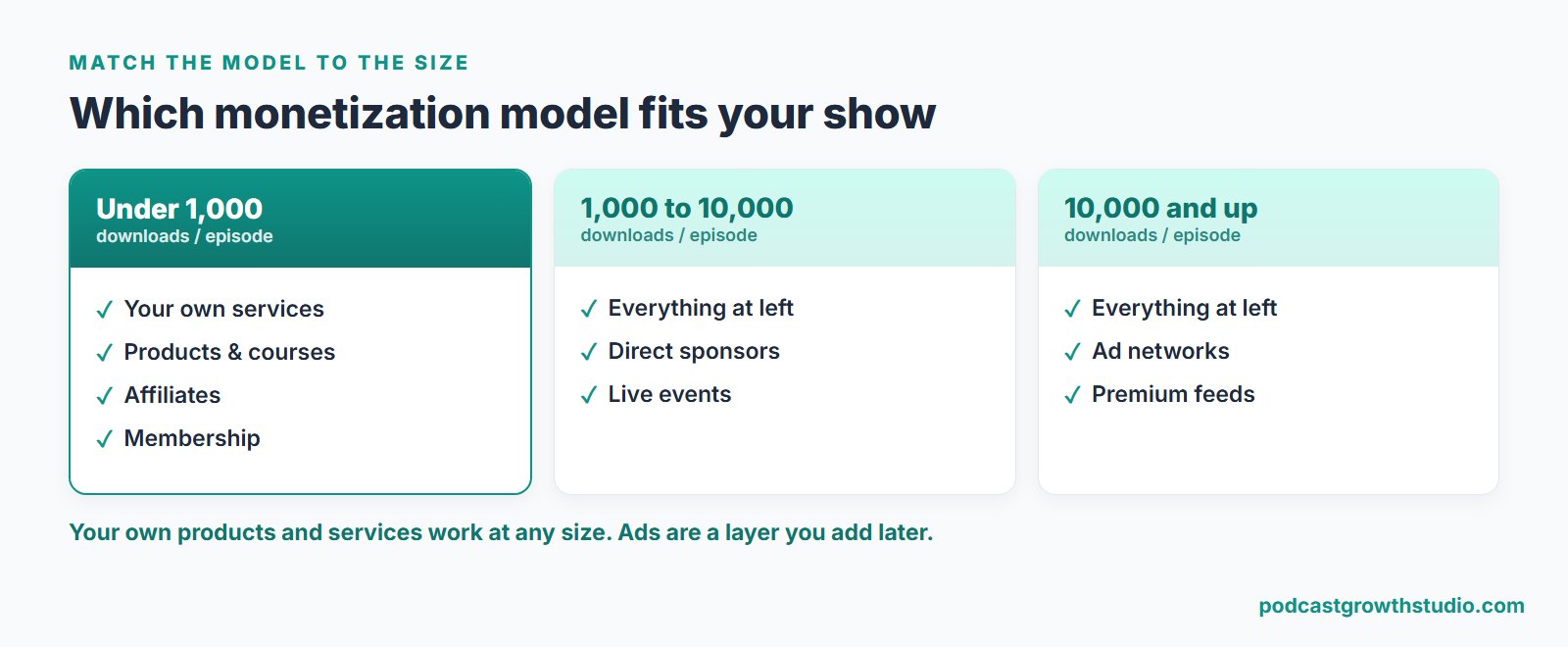
You do not pick one model forever. Most sustainable podcasts stack two or three. But the right starting point depends almost entirely on your audience size and what you sell. Here is the honest map.
Under 1,000 downloads an episode. Ads are not worth chasing yet. Your money is in audience-owned models: your own services or products, affiliates, and a membership if you have a devoted core. For a B2B host, this is not a limitation at all, services income does not care that the audience is small.
1,000 to 10,000 downloads. Direct niche sponsors become possible, and they pair well with everything from the tier below. This is the sweet spot to add a product or formalize a membership, while your own offer (if you have one) is still doing the heaviest lifting.
10,000 and above. Ad networks, programmatic, and premium feeds all open up, and the audience-rented models finally pay real money. Even here, the shows that earn the most usually still run their own products or services alongside the ads, not instead of them.
The throughline: build the audience with a real growth system, get it in front of the right people with distribution, and monetize first through what you own. Ads are the layer you add once you have scale, not the foundation you start on.
And if the reason you have not monetized yet is simply that the show is not consistent enough to build the audience, that is a production problem, not a money problem. The fix is a system that turns each recording into a month of content so the show keeps compounding, which is the exact gap our Content Engine closes.
Frequently asked questions
How many downloads do you need to monetize a podcast?
For ad and sponsor income, niche direct sponsors start to bite around 1,000 downloads per episode, and most ad networks want 5,000 to 10,000 before they take you on. But that is only the ad path. If you monetize through your own offer (services, a product, a membership), you can earn from a show with a few hundred listeners, because you are selling to the right people, not renting your audience to a brand. Audience size gates ads, not money.
How much do podcasts make per 1,000 downloads?
Industry rate guides for 2026 put host-read mid-roll ads at roughly $15 to $30 per thousand downloads, pre-roll around $18 to $25, and post-roll lowest at $10 to $20, with business and finance niches at the higher end. So a show with 1,000 downloads running one mid-roll ad earns roughly $25 an episode. That math is why ads are a weak primary income for small shows and why most podcasters stack other models on top.
What is the best way to monetize a small podcast?
Sell your own offer, not ad space. At a small audience, ads pay almost nothing, but a single client, course sale, or membership can be worth more than a year of sponsorships. For coaches, consultants, and B2B founders, the highest-return model by far is using the show to book calls and win clients. The podcast builds trust at scale, and one good client can be worth thousands.
Can you monetize a podcast with few listeners?
Yes, as long as you monetize through your own products or services rather than ads. A show with 300 of exactly the right listeners can out-earn a show with 30,000 casual ones, because value depends on who is listening, not just how many. Affiliate income, a paid community, a digital product, or consulting all work at small scale. Only ad and sponsor revenue truly requires a large audience.
How much do podcast ads pay in 2026?
Typical podcast ad CPMs in 2026 range from about $15 to $50 per thousand downloads depending on niche and placement. Host-read mid-roll ads (the most valuable) average $15 to $30, pre-roll sits around $18 to $25, and post-roll is lowest at $10 to $20. Smaller shows sometimes charge a flat rate of $100 to $500 per episode instead of a CPM. You can estimate your own numbers with our free sponsorship calculator.
Do you need sponsors to make money from a podcast?
No. Sponsors are just one of many models, and for most shows they are not the best one. Memberships, premium feeds, digital products, affiliate deals, live events, and selling your own services all generate income without a single sponsor. For business podcasts especially, your own offer almost always out-earns sponsorships at any realistic audience size.
Resources for further reading
The rate ranges in this guide reflect current 2026 podcast advertising rate guides. A few worth reading in full:
- The Podosphere, Podcast Sponsorship Rates 2026. A current breakdown of CPM rates by placement and niche. thepodosphere.com
- Content Allies, Advanced Podcast Monetization Strategies. A B2B-focused look at stacking revenue beyond ads. contentallies.com
- Transistor, Make Money Podcasting. A practical overview of the main monetization paths. transistor.fm
From the PGS blog and tools: estimate ad income with the free podcast sponsorship calculator. For the model most B2B hosts should start with, read how to get clients from your podcast. To build the audience that makes any of this possible, see how to grow a podcast and how to promote a podcast in 2026.
Closing: monetize what you own first
The fastest way to decide podcasting "does not pay" is to measure it by ad revenue at a small audience. The fastest way to make it pay is to flip the order: monetize what you own, your products, your services, your community, first, and treat ads as a layer you add once you genuinely have scale.
Pick the one model that fits your audience size and what you sell today. Make one clear offer, consistently. Then let the show keep compounding, because every model here gets easier as the audience grows.
If the thing standing between you and that compounding is the work after recording, the clips, the posts, the distribution that actually grows the audience you would monetize, that is what we do. You can see how one episode becomes a month of content on the Content Engine page.