
Making the episode is the easy part. You already know that, or you would not be reading a guide about promotion. The hard part, the part that decides whether your show grows or quietly dies at episode twelve, is everything that happens after you hit publish.
Here is the good news and the hard news in one sentence: more people listen to podcasts than ever, and more shows compete for them than ever. Edison Research found that 73% of Americans age 12 and up have now listened to or watched a podcast, an estimated 210 million people, with 40% listening every week. At the same time, Listen Notes counted over 605,000 active podcasts in late 2025, a new all-time high. The audience is enormous. So is the noise.
That gap, huge audience and huge competition, is exactly why a real promotion system beats a pile of random tactics. This guide is that system. Not a listicle of twenty things to maybe try, but a sequenced, current playbook for getting your show in front of the right people and keeping them.
It is also genuinely built for 2026, which most guides are not. The single biggest shift, the one that should change how you promote starting today, is that YouTube is now the number one podcast platform. Not a place to dump your audio. The main place people listen and, more importantly, the main place they discover. We will come back to that hard.
I run Podcast Growth Studio. I spent years in live radio, hosted a 200-episode show, and our team has produced content that generated more than 350 million views for clients. Promotion is the work we do every day. The chapters below are the parts that actually move the needle, in the order I would do them.
What this guide covers
- The 2026 reframe: promotion is the product, and video changed everything
- Before you promote: the five things that make promotion work
- Your owned channels: website, podcast SEO, and email
- Get listed everywhere, and treat YouTube as your home base
- The repurposing engine: one episode into a week of content
- Short-form video: the number one discovery channel in 2026
- Borrowed audiences: guesting, cross-promotion, and your guests
- Community and word of mouth: CTAs, reviews, and showing up
- Paid promotion: when it is worth it and what it costs
- The B2B playbook: promote a show that generates leads
- AI and discovery in 2026: clips, show notes, and AI search
- Measurement: how to know what is actually working
- Your 30/60/90-day promotion plan
- The mistakes that quietly waste your promotion
- Do it yourself or hand it off
- Frequently asked questions
- Resources for further reading
The 2026 reframe: promotion is the product, and video changed everything
Most people picture promotion as something you bolt on after the episode is done. Record, edit, publish, then go tell people about it. That order is exactly backward, and it is why so much promotion feels like shouting into a void.
Reframe it like this: the episode is raw material, and promotion is the product your audience actually meets first. Almost nobody discovers you by pressing play on a 45-minute episode from a stranger. They meet a 40-second clip, a carousel, a search result, or a thumbnail. Those are the front door. The episode is the room they enter only after the front door does its job.
This is not a mindset trick. It changes what you make and when. If promotion is an afterthought, you record for the listener you already have. If promotion is the product, you record in a way that produces great clips, quotable moments, and searchable answers, because those are the assets that go find new listeners for you.
Why YouTube changed the game
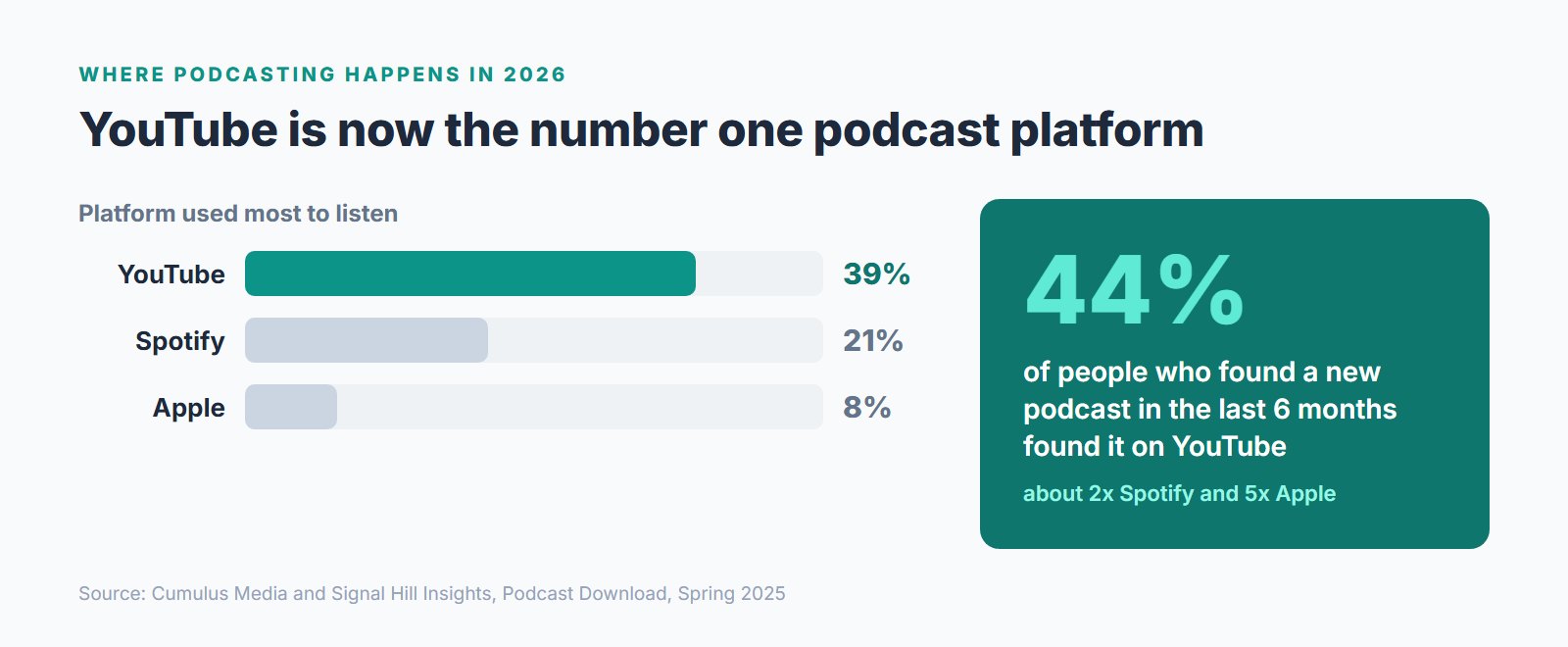
For a decade, "podcast" meant audio in Apple Podcasts. That era is over. Two independent research firms now agree on the headline: YouTube is the platform people use most for podcasts. Edison Research found YouTube is the service US weekly listeners turn to most often, ahead of Spotify and Apple. Cumulus Media and Signal Hill Insights put YouTube even higher, at 39% of people naming it the service they "listen most" on, up from 15% in 2019. That is a two-and-a-half-times jump in six years.
Discovery is the part that should change your plan. In that same Cumulus and Signal Hill research, 44% of people who found a new podcast in the last six months found it on YouTube. That is roughly twice the rate of Spotify and five times Apple. YouTube is not just where a lot of people listen. It is where they go looking, and where the algorithm hands your show to people who have never heard of you.
One honest caveat so you do not overcorrect. When listeners are given the choice, most still say audio is their primary mode of consumption. Plenty of people watch a few minutes on YouTube to decide, then subscribe in a pure audio app and listen on their commute. So the move is not "abandon audio for video." The move is "use video and clips to get discovered, and keep audio excellent so they stay." Promote where people find you. Serve where people listen.
What this means for the rest of the guide
Every chapter that follows sits inside this reframe. Your owned channels exist to be found in search. Your clips exist to get discovered on video platforms. Your guesting exists to borrow audiences who do not know you yet. The episode sits in the middle, and the promotion system is the thing that actually reaches people. Build the system, not just the show.
Before you promote: the five things that make promotion work
You can pour effort into clips and posts and ads, and still get nowhere, if the show itself is hard to find, hard to understand, or hard to share. Promotion amplifies what is already there. Fix these five things first, because they multiply everything you do afterward.
1. A title and description a stranger understands in three seconds
Your show title is doing search and clarity work at the same time. "The Growth Mindset Hour" tells a new listener nothing. A title that names the audience or the problem ("The Bootstrapped SaaS Show," "Beyond the Balance Sheet") tells the exact right person to click and helps you show up when they search. Write a description that leads with who the show is for and what they will get, not your life story. If you are still naming the show, our free podcast name generator is a fast way to react to options.
2. Cover art that survives a thumbnail
Your artwork is almost always seen tiny, in a list of dozens. Big legible type, strong contrast, one clear focal point, no fine detail that turns to mush at thumbnail size. If you record video, the same rule applies to your YouTube thumbnails, which are doing more discovery work than your cover art now.
3. Episode titles written for humans and search
"Episode 47" is invisible. A title that states the benefit or the question ("How to price a service so clients say yes") gets clicked in an app and found in a search. Put the strongest, most searchable words near the front. If you want a fast way to generate options across proven styles, our free episode title generator will give you a list to sharpen.
4. A clear next step in every episode
Promotion brings people to the door. A call to action tells them what to do once they are inside. Pick one ask per episode and say it plainly: subscribe on YouTube, join the email list, grab the free resource, book a call. One clear ask beats five vague ones. We will use this hook again in the lead-generation chapter.
5. A reason to come back
The cheapest growth is the listener you already earned. A consistent schedule, a recurring segment, and a show that reliably delivers on its promise turn one-time listeners into subscribers, and subscribers into the people who recommend you. Promotion fills the top of the funnel. Retention is what makes the funnel worth filling.
Your owned channels: website, podcast SEO, and email
Social platforms rent you an audience. Your website and email list are the audience you own. They are slower to build and far more durable, and they are where search traffic and serious listeners convert. Most promotion guides rush past this. Do not.
Give every episode a real page
A podcast episode by itself almost never ranks on Google. A web page about that episode can. Build a simple page per episode with the embedded player, a short written summary, the key takeaways, and the full transcript. That transcript is the part that earns search traffic, because it turns 45 minutes of speech into indexable text full of the exact phrases people search for.
This is also where podcast SEO actually lives. Use a clear, keyword-aware page title, write a real summary instead of a one-line blurb, add timestamps or chapter markers, and link your episode pages to each other so a visitor who lands on one finds three more. Over a year, these pages become a quiet, compounding source of new listeners who arrive from search and never touch a podcast app first.
Turn the best episodes into full articles
The highest-performing episode pages are not summaries, they are full blog posts built from the episode. Take the strongest episode on a topic, expand it into a proper article, and you get a page that ranks on its own and pulls listeners back to the audio. This is repurposing in service of search, and it is one of the few promotion tactics that keeps paying off long after you publish.
Build the email list from day one
Email is unglamorous and it outperforms almost everything. It is the one channel where you reach people directly, with no algorithm deciding whether your message shows up. Put a simple signup on your site, offer a real reason to join (a resource, a behind-the-scenes note, early access), and send a short message when each episode drops. A list of 300 engaged subscribers who open your email will do more for a show than 3,000 passive followers on a platform that throttles your reach.
Get listed everywhere, and treat YouTube as your home base
Distribution is not promotion, but it is the floor promotion stands on. If your show is missing from a platform, no amount of clever marketing reaches the people who only use that platform. The fix is simple and one-time.
Submit your RSS feed to every major directory: Apple Podcasts, Spotify, Amazon Music and Audible, iHeartRadio, and the smaller players your audience might use. Most pull from the same feed, so you do this once per platform and you are done. Then publish to YouTube, which does not use your RSS feed and needs its own upload, either as full video or as an audio-with-art video.
Here is the 2026 part. Do not treat YouTube as the place you cross-post leftovers. Treat it as your home base. It is where discovery happens, where the algorithm recommends you to strangers, and increasingly where people expect to find a show before they commit. Give it a real channel, real thumbnails, real titles, and full episodes, not just clips. Apple and Spotify are the libraries where loyal listeners subscribe. YouTube is the storefront on the busy street.
Promote the back catalog, not just the new drop
Most podcasters promote an episode for 48 hours and then never mention it again. That is a waste, because a good episode is evergreen. Someone who finds you this month has never heard your best episode from last spring. Re-share strong older episodes, point new clips at the back catalog, and link related episodes to each other. Your archive is not old inventory. It is a library of front doors you already built.
The repurposing engine: one episode into a week of content
Every promotion guide tells you to "repurpose your content." Almost none of them show you the actual machine. This chapter does, because repurposing is not a tactic you do sometimes. It is the engine that produces everything you will use in the next three chapters.
The idea is simple. One recording is not one piece of content. It is the source material for a dozen. The job is to systematically pull those pieces out and route them to the places your audience already spends time. Here is the flow.
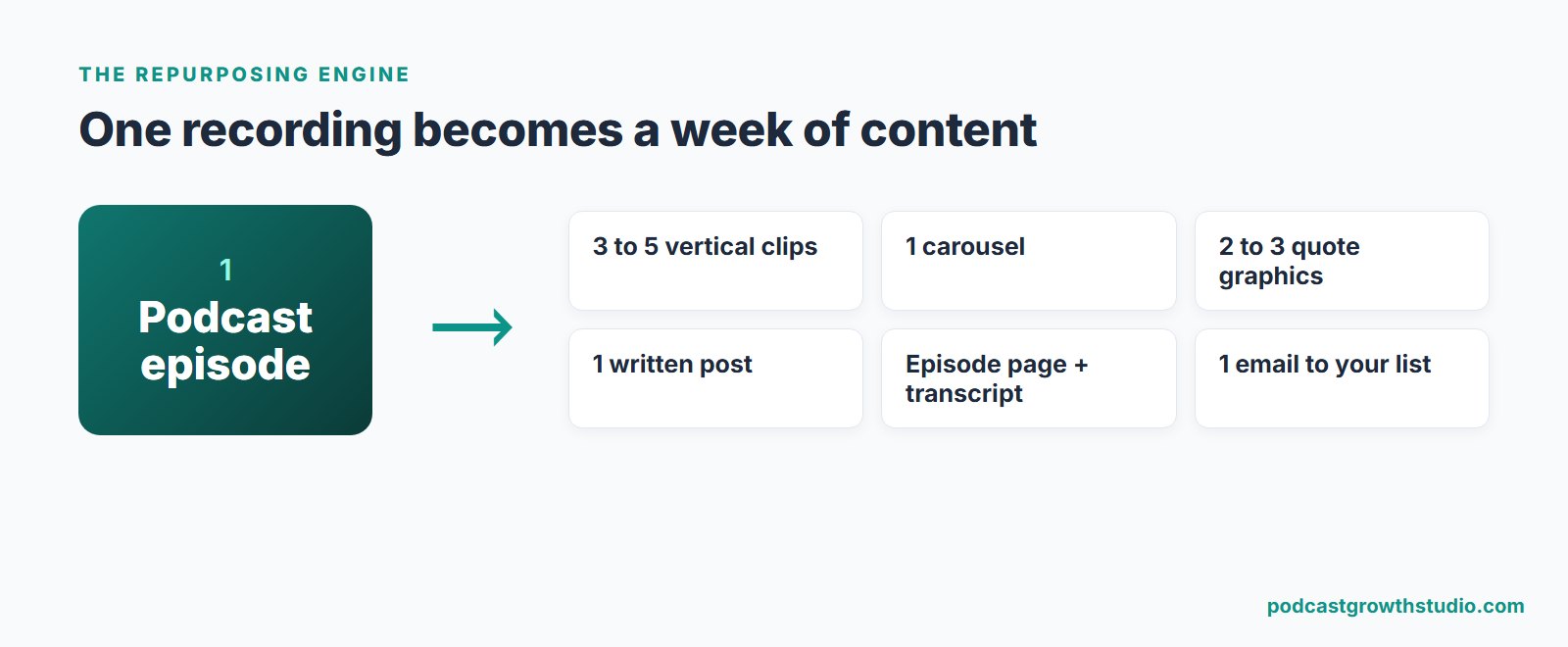
Start with the source. One episode, ideally recorded on video so you have clips. Watch it once and mark the three to five strongest moments: a sharp opinion, a surprising number, a clear how-to, a good story. Those moments are your raw clips.
Multiply into formats. From one episode you can reasonably produce three to five vertical video clips, one carousel that teaches a single idea, two or three quote graphics, one written post that expands the best point, one episode page with the full transcript, and one email to your list. That is roughly a week of content from a single recording.
Sequence it across the week. Do not dump it all on publish day. Spread the clips and posts across seven to ten days so the episode keeps surfacing while you record the next one. This is how small teams stay visible without living inside their content calendar. If you want the deeper version of this system, our complete guide to podcast content repurposing walks through it format by format, and the LinkedIn-specific workflow shows exactly how one 45-minute recording becomes a month of LinkedIn posts.
The reason this matters for promotion specifically: every other channel in this guide is hungry for assets. Short-form video needs clips. Email needs something to say. Your website needs pages. The repurposing engine is what feeds all of them from one recording, instead of you inventing new content for each platform from scratch. To see roughly how many pieces your show could be producing, and how much you are leaving unpublished, run our free podcast repurposing calculator.
Short-form video: the number one discovery channel in 2026
If you only add one new promotion habit this year, make it short-form vertical video. Clips are how strangers meet you now, on YouTube Shorts, LinkedIn, Instagram Reels, and TikTok. They are the single most effective top-of-funnel format available to a podcaster, and they are produced from work you already did.
What makes a clip actually travel
Most clips fail for the same few reasons. Fix these and your hit rate climbs.
- Hook in the first three seconds. Open on the most interesting sentence, not the intro music or "welcome back to the show." If the first line is not a reason to keep watching, nothing after it matters.
- Add captions. Most people watch with the sound off at first. Burned-in captions are not optional, they are the difference between a clip that holds and one that gets scrolled past.
- Make one point. A good clip teaches or provokes one idea. If it needs context from the full episode to make sense, it is a bad clip, even if it was a great moment live.
- Upload natively. Post the video file directly to each platform rather than linking out. Every platform suppresses links that send people away, and rewards content that keeps people on the app.
- End with a soft pointer, not a hard sell. "Full episode on YouTube" works. A pushy call to action on a discovery clip does not.
Pick the platforms where your audience actually is
You do not need to be everywhere. You need to be where your specific audience scrolls. For B2B and professional audiences, LinkedIn and YouTube do the heavy lifting. For broader consumer topics, Instagram and TikTok. Choose one or two, post consistently, and go deep, rather than spreading thin across five platforms you cannot keep up with. Consistency on two platforms beats sporadic posting on five.
Borrowed audiences: guesting, cross-promotion, and your guests
The fastest way to reach people who have never heard of you is to borrow an audience that already trusts someone else. Three tactics do this well, and all three are free.
Be a guest on other podcasts
Guesting puts you in front of a warm, relevant audience for 45 minutes, with the host vouching for you by inviting you. It is the highest-trust introduction you can get. Target shows your ideal listener already follows, pitch a specific angle rather than "I would love to come on," and always give the host an easy way to send their audience back to you. One good guest spot can outperform a month of your own posting.
Use your own guests as a distribution channel
When you interview someone, you are not just making an episode, you are gaining a promoter. Most guests will happily share an episode they are featured in, especially if you do the work for them. Send them a ready-to-post clip, a quote graphic with their name on it, and pre-written copy they can paste. Do not just ask them to "share when it is live." Hand them the assets. The easier you make it, the more they spread you to their audience.
Cross-promote with shows your size
Find podcasts with an audience similar to yours but not identical, and trade. Run each other's trailers, mention each other's shows, or do a clip swap. You are both reaching a relevant audience that has already proven it listens to shows like yours. Trailer and promo swaps are one of the oldest growth tactics in podcasting because they still work.
Community and word of mouth: CTAs, reviews, and showing up
Word of mouth is still the most trusted way people find new shows, and you can nudge it on purpose instead of hoping for it.
Ask, clearly and once
The simplest growth lever is a direct ask in the episode itself. "If this was useful, send it to one person who needs it" turns a listener into a distributor. "Follow on YouTube so you do not miss the next one" turns a viewer into a subscriber. People share and subscribe far more when you actually ask, as long as you ask for one thing, not five.
Ratings and reviews still matter
Reviews on Apple and Spotify are social proof for the next person deciding whether to try you, and they feed the platforms' sense that your show is worth surfacing. Ask for them by name, occasionally, and make it specific: "a rating on Spotify takes ten seconds and genuinely helps the show." A short, focused push every couple of months beats a constant nagging that listeners tune out.
Show up where your audience already gathers
Communities, whether a subreddit, a LinkedIn group, a Slack, or a Discord, are full of people interested in your topic. The rule is to add value first and promote second. Answer questions, share genuinely useful takes, and link to a specific episode only when it actually answers what someone asked. Spamming your link gets you ignored or removed. Being consistently helpful gets you known as the person who makes the show on that topic.
Paid promotion: when it is worth it and what it costs
Almost every promotion guide says "run ads" and stops there. Paid promotion can work, but only after the free system is humming. If your clips do not land organically and your episodes do not retain listeners, paying to send more people into a leaky funnel just burns money faster. Earn organic traction first, then pay to amplify what already works.
When you are ready, the two highest-leverage paid plays for a podcast are promoting your best-performing clips as video ads (on YouTube, Meta, or LinkedIn, targeting interests that match your audience) and podcast-to-podcast advertising, where you pay to run a spot on a show your ideal listener already hears. Promote the clip that already proved it can hold attention organically, not a generic "check out my podcast" ad.
It also helps to understand the going rates, because the same numbers tell you what your own show could eventually charge. Industry rate analyses put host-read pre-roll spots around 15 to 25 dollars per thousand listeners, and mid-roll spots, the most valuable slot, around 25 to 50 dollars per thousand, higher in premium niches like finance and B2B. If you want to model what your show could earn or what a sponsorship is worth, our free podcast sponsorship calculator does the math from your download numbers.
The B2B playbook: promote a show that generates leads
If you are a coach, consultant, agency, or founder, your podcast has a different job than a hobby show. Downloads are not the goal. Booked calls and pipeline are. That changes how you promote, and it is the part general guides skip entirely.
Promote to your buyers, not to "an audience"
A B2B show with 200 of the right listeners can out-earn a hobby show with 20,000 of the wrong ones. So aim your promotion at the specific people who could become clients. For most B2B, that means LinkedIn and YouTube, where your clips and posts reach decision-makers, rather than chasing raw download volume on platforms where your buyers do not gather.
Make the interview itself business development
Inviting an ideal client or referral partner as a guest is one of the most effective promotion moves a B2B host has. You get a relevant episode, the guest shares it to their network, and you have spent an hour building a relationship with someone in your buyer's world. The episode is promotion, and the invitation is sales, at the same time.
Turn episodes into sales collateral
Your best episodes are assets your sales process can use directly. A prospect asks a tough question? Send them the episode where you answered it. Repurpose episodes into one-page summaries, clips, and posts your team can send to deals in progress. This is promotion that reaches people who are already close to buying, which is the most valuable audience you have.
Attribute conversations back to the show
The reason most people think their podcast "is not working" is that they never set up a way to see that it is. Add a how did you hear about us field to your booking form. Use tracked links when you point listeners to your offer. We cover the full mechanics in how to get clients from your podcast, and the production system behind it in the Content Engine Method. If you are still setting the show up for this from the start, how to start a B2B podcast that generates leads builds it in from episode one.
AI and discovery in 2026: clips, show notes, and AI search
AI changed podcast promotion in two ways that matter, one obvious and one almost nobody is talking about yet.
AI collapses the cost of repurposing
The biggest reason people do not promote consistently is that turning an episode into clips, posts, and pages takes hours. AI removes most of that friction. Tools can auto-cut vertical clips and pick the strong moments, add captions automatically, transcribe a full episode in minutes, and draft titles, chapters, and show notes for you to edit. The point is not to hand your judgment to a machine. It is to remove the production bottleneck so the repurposing engine from chapter five actually runs every week instead of stalling.
The part people are missing: AI search discovery
More and more people now ask an AI assistant for recommendations instead of typing into a search box. "What is a good podcast about pricing strategy?" gets answered by an AI that read the web, not by ten blue links. That is a new discovery channel, and you can be the answer it gives.
The way you show up there is the same hygiene that helps with normal search, done well: a clean episode page with a full transcript, a real written summary, clear question-and-answer formatting, and structured data that tells machines what the show and episode are about. Episodes that exist only as audio are invisible to this. Episodes that live on a well-built page, in text, with structure, are readable, quotable, and recommendable by AI. This is the freshest, least-crowded promotion opportunity in 2026, and it costs nothing but the page you should already be building.
Measurement: how to know what is actually working
You cannot improve what you do not measure, and you will burn out chasing the wrong number if you measure the wrong thing. Here is a measurement setup that takes an afternoon and saves you a year of guessing.
Pick one north-star metric
Choose the single number that defines success for your show, based on your goal. If the goal is audience, it is new weekly listeners or follower growth. If the goal is business, it is booked calls or pipeline created. Name it, write it down, and judge everything against it. Total downloads since launch is a vanity number. Direction and source are what matter.
Track the inputs, not just the outcome
Your north-star moves because of inputs you control: clips published, guest spots done, emails sent. Track those weekly. When the outcome moves, you want to know which input moved it. This is also how you find your winners, the clip style or topic that consistently outperforms, so you can do more of it.
Use the three free tools that close the attribution gap
- UTM links. Put a tracked link on everything you share, using a free tool like the Google Campaign URL Builder, so your analytics show which channel actually drove traffic to your site or offer.
- Your hosting analytics. Watch new versus returning listeners, where downloads come from, and your completion rate. A high completion rate on a low-download episode is a better sign than the reverse.
- A how did you hear about us field. The single most useful line on any booking or contact form. It connects a real conversation back to the content that created it, which download charts never will.
If your downloads have stalled and you cannot tell why, the diagnosis usually lives in distribution, not content. Our post on why your podcast is not growing walks through finding and fixing the real bottleneck.
Your 30/60/90-day promotion plan
A list of tactics is useless without an order. Here is how to sequence everything above, so you are not trying to do all of it at once and doing none of it well. The right tactics also change with your audience size, so the plan is staged.
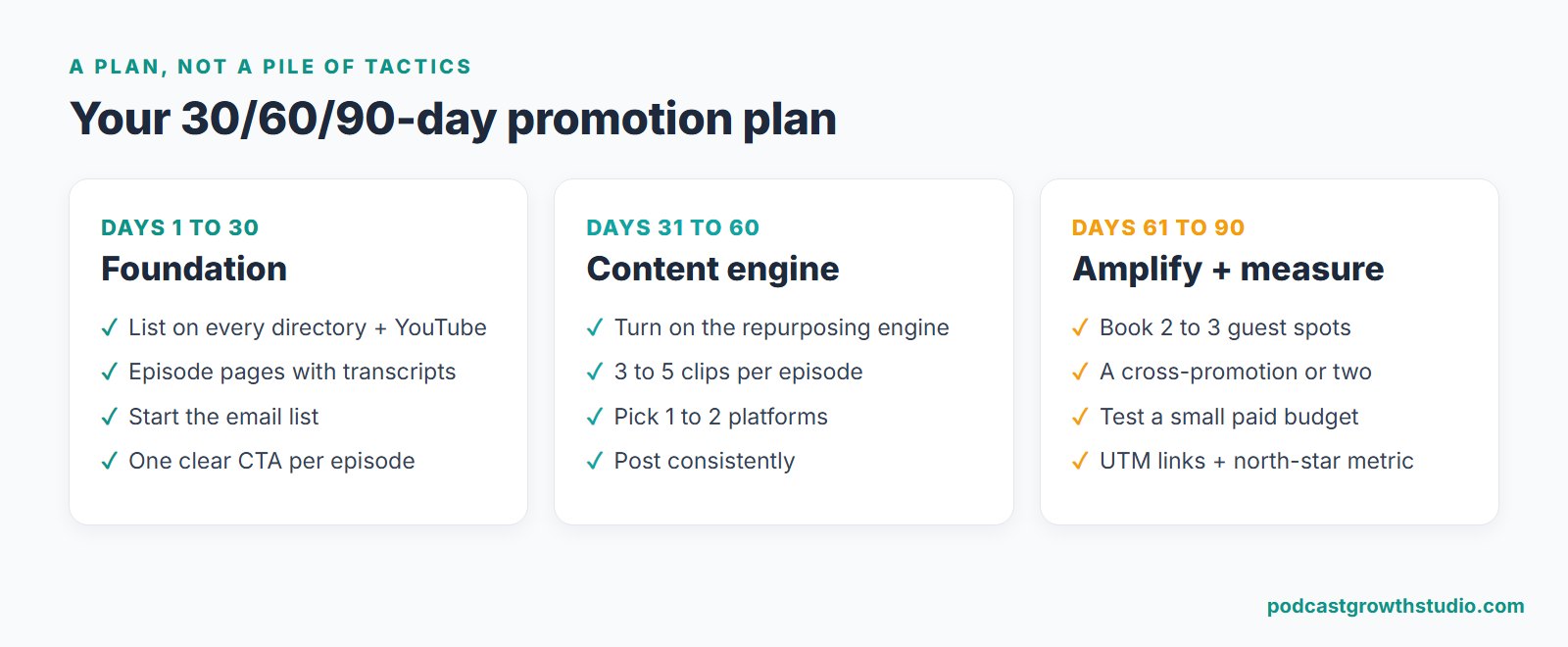
Days 1 to 30: foundation and owned channels
Fix the five foundations from chapter two. Get listed on every directory and stand up a real YouTube channel. Build a simple episode page with a transcript for each episode. Start the email list and send the first episode note. Add one clear call to action to every episode. Do not worry about volume yet. Worry about the front doors being solid.
Days 31 to 60: the content engine
Now turn on the repurposing engine. For each new episode, produce three to five clips, a carousel, a written post, and an email, and sequence them across the week. Pick the one or two social platforms where your audience actually is and post consistently. This is the stretch where most shows either build a real habit or quietly let promotion slide. Protect this time.
Days 61 to 90: borrowed audiences, paid, and measurement
With your own engine running, start borrowing audiences. Book two or three guest spots, set up a cross-promotion or two, and make it easy for your guests to share. If clips are landing organically, test a small paid budget behind your best one. And turn on measurement: UTM links, the how did you hear about us field, and a weekly look at your north-star metric. By day 90 you have a complete, running system, not a pile of one-off attempts.
One note on staging by size. In your first hundred listeners, personal outreach and your existing network matter most. From a hundred toward a thousand, the clip-and-guest engine does the work. Past that, paid amplification and back-catalog promotion start to compound. Do the stage you are in, not the stage you wish you were in.
The mistakes that quietly waste your promotion
These are the patterns I see drain the most effort for the least return.
- Promoting for 48 hours, then going silent. An episode is evergreen. Re-share it, point new clips at it, and keep the back catalog working.
- Spreading thin across five platforms. Pick one or two, go deep, and be consistent. Sporadic everywhere loses to reliable somewhere.
- Treating YouTube as a dumping ground. It is your biggest discovery channel now. Give it real titles, thumbnails, and a real channel, not leftover uploads.
- Posting clips with no hook and no captions. The first three seconds and the on-screen text decide whether a clip travels at all.
- Never asking. Listeners share and subscribe far more when you ask them to, clearly, for one thing.
- Measuring nothing, then deciding it "is not working." Without attribution you cannot see the wins that are actually happening, so you quit on a show that was starting to work.
- Quitting at day 60. Growth compounds. Most shows that fail do so right before the back catalog and clips start carrying the load.
Do it yourself or hand it off
You can run this entire system yourself. The tactics are learnable and most of the tools are cheap or free. The real constraint is not knowledge or money. It is the recurring weekly time the repurposing and posting demand, on top of running your business.
Run it yourself if you have genuine slack in your week, you enjoy the production craft, and you are early enough that doing the work teaches you what your show should be. Hand off the production and distribution if your billable time is worth more than the hours it eats, or if you have tried before and the recordings keep stacking up while the posting never happens.
That gap is exactly what we close at Podcast Growth Studio. We turn one recording into a 30-day buyer-facing content system, the clips, carousels, quote graphics, captions, and posting plan from this guide, delivered within 7 days, so the promotion keeps running without the production landing on you. You can see the current offer on the Content Engine page.
Frequently asked questions
How do I promote my podcast for free?
The highest-leverage free promotion in 2026 is short-form video clips published natively on YouTube, LinkedIn, Instagram, and TikTok, plus a clear call to action in every episode and an email to your existing list. None of those cost money. They cost the time to turn each recording into clips and posts. Add free directory submissions, a transcript on a simple episode page for search, and being a guest on other shows in your niche, and you have a complete promotion system with a budget of zero.
Where should I promote my podcast in 2026, and which platform is best?
YouTube. As of 2025, YouTube is the service US podcast listeners use most often, ahead of Spotify and Apple, and it is the single biggest place people discover new shows. Cumulus Media and Signal Hill Insights found 44% of people who found a new podcast in the last six months did it on YouTube, about twice Spotify and five times Apple. Publish to YouTube, then use short-form vertical clips on LinkedIn, Instagram, and TikTok as your top of funnel. Apple and Spotify are still essential libraries, but they are where people subscribe, not where they discover.
Do I need video to grow a podcast in 2026?
You do not strictly need it, but going video-first is the biggest single lever you have. More than half of Americans 12 and up have now watched a podcast, YouTube leads discovery, and video gives you vertical clips, the format that drives the most reach on every social platform. If recording video is the thing stopping you from publishing at all, start audio-only and add a camera later. Just know that audio-only gives up your strongest discovery channel.
How long does it take to grow a podcast audience?
Plan in quarters, not weeks. With consistent publishing and real distribution, most shows take roughly five to six months to reach a stable base of recurring listeners, and growth tends to compound from there as the back catalog and clips keep working. The shows that fail almost always quit in the first 90 days, right before the work starts paying off. Set a 90-day minimum commitment before you judge results.
How do I measure whether my podcast promotion is working?
Pick one north-star metric tied to your goal, then track the inputs that move it. For an audience goal, that is new weekly listeners and follower growth. For a business goal, it is booked calls or pipeline. Use UTM links on every link you share so you can see which channel drove traffic, watch your hosting analytics for new versus returning listeners and completion rate, and add a how did you hear about us field to your booking form. Ignore vanity totals and watch direction and source instead.
How do I promote a B2B podcast to generate leads?
Treat the show as a content engine, not a media project. Turn every episode into LinkedIn clips, carousels, and written posts that reach your buyers, invite ideal-client guests so the interview itself is business development, add a clear next step in every episode, and repurpose episodes into sales collateral your team can send to prospects. Then attribute conversations back to content with UTM links and a how did you hear about us field. Downloads are not the goal. Booked calls are.
What AI tools help promote a podcast in 2026?
AI is most useful for collapsing the cost of repurposing. Tools like Opus Clip, Riverside, and Submagic auto-cut vertical clips and add captions. Transcription and show-note tools turn an episode into search-friendly text in minutes. AI can draft titles, chapters, and social copy for you to edit. Used well, AI does not replace judgment, it removes the production bottleneck that stops most people from promoting consistently. It also matters for discovery, since clean transcripts and structured episode pages help your show surface in AI search answers.
Resources for further reading
The data in this guide comes from legitimate primary sources worth reading in full.
- Edison Research, The Infinite Dial 2025. The definitive primary-source data on US podcast listening, the source for the 73% reach figure and YouTube usage data. edisonresearch.com
- Edison Research, The Podcast Consumer 2025. Monthly and weekly listening, plus the share of people who now watch podcasts. edisonresearch.com
- Edison Research, YouTube is the preferred podcast listening service. The platform-share data behind the YouTube-first argument. edisonresearch.com
- Cumulus Media and Signal Hill Insights, Podcast Download, Spring 2025. The source for the 39% "listen most" and 44% discovery figures for YouTube. signalhillinsights.com
- Listen Notes data, via Barrett Media. The count of active podcasts reaching a new all-time high in 2025. barrettmedia.com
- Google Campaign URL Builder. The free tool for generating clean UTM links so you can attribute traffic to specific content. ga-dev-tools.google
From the PGS blog: the operational system behind the repurposing engine is the Content Engine Method and the complete guide to podcast content repurposing. For diagnosing stalled growth, read why your podcast is not growing. And to turn listeners into clients, see how to get clients from your podcast.
Closing: a system beats a scramble
Promoting a podcast in 2026 is not a mystery, and it is not luck. The audience is the biggest it has ever been, the tools are cheaper than ever, and the playbook is knowable. What separates the shows that grow from the shows that stall is not talent or budget. It is whether there is a system running every week, or a scramble that happens whenever someone remembers.
Build the front doors, run the repurposing engine, lead with video and clips, borrow audiences, and measure what works. Do the stage you are in. Then keep going past the point where most people quit, because that is where it compounds.
If you want to see what the promotion engine looks like before you build it yourself, we can do it for you. We turn one episode into a month of finished, ready-to-post content. You can see how it works, and the founding price, on the Content Engine page.