
The name is the first decision you make about your podcast and the hardest one to undo. Get it right and it quietly works for you for years: people find it, remember it, and recommend it. Get it wrong and you spend the life of the show explaining what it is, or worse, rebranding at episode 40.
The good news is that naming is not a creative lottery. The shows with great names did not get lucky. They followed a small set of principles, ran their ideas through a few simple tests, and checked the boring details before falling in love. This guide walks you through exactly that, so you end up with a name that is clear, findable, and yours.
I run Podcast Growth Studio, I have hosted a 200-episode show, and I have helped plenty of founders and coaches name theirs. The patterns below are the ones that hold up.
What this guide covers
- Why the name matters more than you think
- What a great podcast name actually does
- Five naming formulas, with examples
- How to name a B2B or business podcast
- The mistakes that sink a podcast name
- Check it is actually available
- Test your shortlist before you commit
- From name to launch
- Frequently asked questions
- Resources
Why the name matters more than you think
A podcast name is not a logo or a tagline. It does real work, every single day, in places you are not watching. It is the text someone scans in a list of search results. It is the thing a listener has to remember when a friend asks "what was that show again?" It is the phrase they type to find you, or fail to.
Most new podcasters treat the name as a branding flourish and pick something clever or abstract. Then they wonder why the show is hard to find and hard to share. The name was working against them the whole time. A clear, findable name is one of the few growth levers you set once and benefit from forever.
It is also expensive to change. A rename costs you search recognition, confuses your existing audience, and forces you to redo artwork, handles, and every link that points to the old name. So the few extra days you spend now are some of the cheapest growth work you will ever do.
What a great podcast name actually does
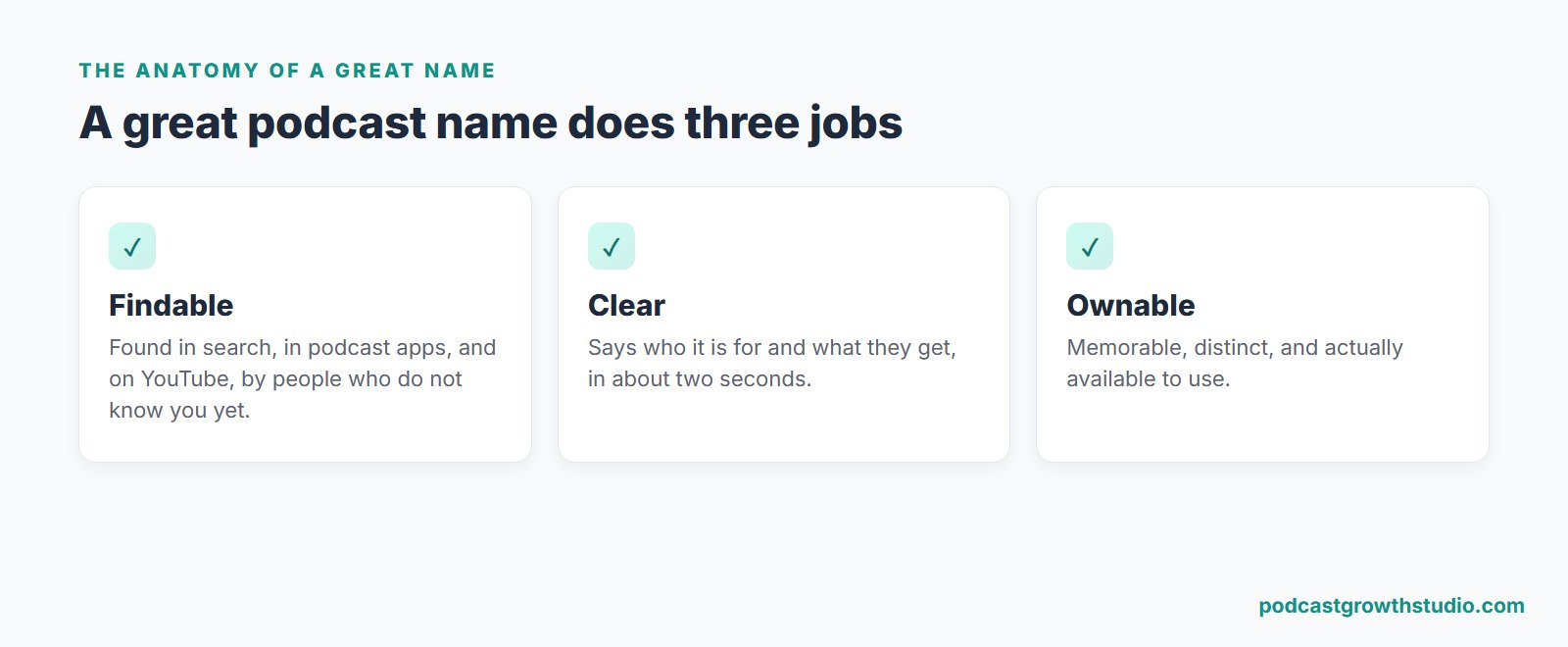
Strip away the opinions and a great podcast name does three jobs at once. Hold every idea up against these three and weak names fall away fast.
1. Findable
People discover podcasts by searching, on YouTube, in Apple and Spotify, and on Google. A name that contains a word your audience actually types gives you a quiet, permanent edge in those searches. You do not need to stuff keywords in, but a name that hints at the topic will be found by people who do not know you yet.
2. Clear
In the two seconds someone looks at your name, it should answer "is this for me?" The strongest names signal either the audience (who it is for) or the problem (what it solves). "The Bootstrapped Founder" tells a specific person this is their show. Clarity beats cleverness every time, because clever names make the listener do work, and they will not.
3. Ownable
The name has to be memorable and distinct enough that people can hold it in their head and that it is not already taken. Generic names ("The Marketing Podcast") are forgettable and impossible to rank for. A great name has a small hook, a rhythm, a twist, a vivid word, that makes it stick and makes it yours.
The art is balancing all three. A name can be findable and clear but generic. It can be ownable and clear but invisible in search. The shortlist you want sits where all three overlap.
Five naming formulas, with examples
You do not have to invent a naming approach from scratch. Almost every strong podcast name fits one of these five patterns. Use them as starting points, then make the result your own.
1. The audience name
Name the show after the exact person it is for. This is the most reliable formula for a business podcast because it answers "is this for me?" in a glance. Patterns: "The [Audience] Show," "[Audience] Stories," "For [Audience]." Examples in spirit: The Founder's Pricing Show, Notes for New Managers, The Fractional CFO.
2. The problem or promise name
Name the show after the problem you solve or the outcome you deliver. This pulls in people actively looking for that result. Patterns: "Beyond [Pain]," "The [Outcome] Playbook," "How to [Result]." Examples in spirit: Beyond the Balance Sheet, The Demand Engine, Closing Bigger.
3. The phrase or idea name
Borrow a short phrase, metaphor, or idea from your world that carries meaning for insiders. These can be the most ownable and memorable, but they lean on clarity from your subtitle. Patterns: a two or three word concept. Examples in spirit: First Principles, The Long Game, Quiet Leverage, Signal.
4. The host plus topic name
Pair your name with the subject. Works when you have, or are building, a personal brand and want the show to compound your name. Patterns: "[Name] on [Topic]," "[Topic] with [Name]." Examples in spirit: Pricing with Patrick, The Hormozi Hour. Use this only if your name adds pull, otherwise lead with the topic.
5. The category twist name
Take the obvious category word and add a twist that makes it specific and memorable. This keeps the searchability of the category while escaping the generic trap. Patterns: "[Category] Unfiltered," "The [Category] Files," "[Category], Honestly." Examples in spirit: Marketing Against the Grain, Sales Stories IRL.
Run your topic through a few of these and you will have a long list fast. If you want the list generated for you, our free podcast name generator turns a topic into dozens of options across these styles in seconds, so you have something concrete to react to.
How to name a B2B or business podcast
If the point of your show is pipeline, not downloads, the name has one extra job: it should live in the same world as what you sell. A listener who values the free thinking should naturally wonder what it would be like to hire you. When the name and the offer drift apart, the audience grows and the business does not.
So for a business podcast, lean toward the audience name or the problem name from the formulas above. Name it for the buyer you want to sign, or the problem you get paid to solve. A fractional CFO should not make "a show about finance." That is a magazine. They should make "the show for founders who just raised and have no financial model." Narrow is findable, quotable, and easy to turn into content the exact right person stops scrolling for.
One more B2B note: resist naming it purely after yourself unless your name already pulls. Early on, nobody is searching for you. They are searching for a problem. Lead with the problem or the audience, and let your name ride along in the subtitle. If you are building the whole show as a lead engine, our guide on how to start a B2B podcast that generates leads covers how the name fits the rest of the machine.
The mistakes that sink a podcast name
Most bad names fail for predictable reasons. Avoid these and you are most of the way there.
- Clever but empty. A pun or abstract phrase that means nothing to a new listener. If they cannot tell what the show is, they will not click.
- Generic and unrankable. "The Marketing Podcast" is invisible in search and impossible to own. The category word alone is not a name.
- Too long. Anything past four or five words gets cut off in apps and is hard to recommend out loud.
- Hard to say or spell. If people cannot say it confidently, they cannot tell a friend, and word of mouth is your biggest growth channel.
- Already taken. Sharing a name with another active show splits search results, confuses listeners, and risks a trademark fight.
- Boxed in. A name so specific that it traps you. If you might broaden the topic in a year, do not paint yourself into a corner with season one's exact theme.
- All about you, too early. Leading with your name before anyone knows you means leading with the one thing nobody is searching for yet.
Check it is actually available
Before you fall in love with a name, spend twenty minutes making sure you can actually use it. This is the boring step people skip and regret. Run your top two or three names through every check below.

- Podcast apps. Search the name in Apple Podcasts and Spotify. If an active show already owns it, move on.
- YouTube. Search it as a channel and a query. YouTube is now a primary place people find podcasts, so a clash here matters as much as in the audio apps.
- Domain. Check the .com, or a clean variation (adding "podcast" or "show"). You want a web home that is easy to type.
- Social handles. Check the handle on the one or two platforms you will actually use. A close, consistent handle looks professional and is easy to find.
- Trademark. Do a quick search in your country's trademark database (in the US, the USPTO search). You are not filing, you are avoiding an obvious conflict with an existing brand.
- Plain search. Google the name. Make sure it is not already strongly associated with something unrelated or unfortunate.
Test your shortlist before you commit
You should be down to two or three names that pass the availability checks. Now pressure-test them with four quick tests before you pick the winner.
The say-it-out-loud test. Say "welcome to [name]" out loud. If it feels awkward in your mouth, it will feel awkward every episode.
The friend test. Tell a few people in your target audience the name and ask them, an hour later, what the show was called and what it was about. If they cannot recall it, or they describe the wrong thing, it is not clear or sticky enough.
The search test. Imagine you are your ideal listener with the problem you solve. Would you ever type words close to this name? If not, you are relying entirely on people already knowing you.
The thumbnail test. Picture the name in a tiny app list and on a YouTube thumbnail. Does it survive at small size, and does the front of the name carry the meaning before it gets cut off? Put your strongest words first.
From name to launch
Once the name passes, lock the rest of the package around it: cover art that is legible at thumbnail size, a one-line description that says who it is for and what they get, and episode titles that are as clear and searchable as the show name. For episode titles, our free episode title generator applies the same clarity-first thinking to each episode.
And remember that the name only matters if people meet it. A great name on a show nobody distributes is still invisible. When you are ready to get the show in front of people, our guide on how to promote a podcast in 2026 is the full playbook.
Frequently asked questions
Should my podcast name include my own name?
Only if your name is the brand. If you are a known personality or your business is built on your personal brand, your name can work. For most B2B shows, a name that signals the topic or the audience will be found and clicked more often than your name alone, because new listeners are searching for a problem, not for you yet.
Should the podcast name include a keyword?
A keyword helps, but do not force it. If a relevant word fits naturally (pricing, sales, leadership), it helps people find the show when they search and tells them instantly what it is about. A clumsy keyword-stuffed name is worse than a clean, clear one. Aim for clear first, searchable second.
How long should a podcast name be?
Short enough to remember and say out loud, usually one to four words. Long names get cut off in podcast apps, are harder to recommend, and are easy to misremember. If you need a longer descriptor, put it in the subtitle or show description, not the name.
Can I change my podcast name later?
You can, but it is costly. You lose search recognition, confuse existing listeners, and have to rebuild artwork, handles, and any links pointing to the old name. It is far cheaper to spend a few extra days getting the name right than to rebrand at episode 40. Treat the name as close to permanent.
Does the podcast name need a matching domain and social handles?
A matching or close domain and handle make you easier to find and look more professional, so check them before you commit. You do not need the exact .com if a clean variation is available (adding the word podcast or show, for example), but avoid a name where every handle is already taken by something unrelated.
What if the podcast name I want is taken?
If another active podcast already uses the exact name, pick something else. Two shows with the same name split search results and confuse listeners, and you risk a trademark problem. A small twist rarely solves it. Generate a fresh list of options and choose one that is clearly your own.
Resources
The tools and databases worth using while you name and check a show.
- PGS Podcast Name Generator. Turn a topic into dozens of name ideas across the five formulas above. podcastgrowthstudio.com/tools/podcast-name-generator
- Apple Podcasts Connect and Spotify for Creators. Search both to confirm your name is not already in use, and the portals you will submit to later. podcastsconnect.apple.com and creators.spotify.com
- USPTO Trademark Search. A free way to check your name does not clash with an existing US trademark before you build a brand on it. tmsearch.uspto.gov
From the PGS blog: once the name is set, see how to start a B2B podcast that generates leads to build the show around it, and how to promote a podcast in 2026 to get it in front of people.
Closing: get the name right once
Naming a podcast is not about being clever. It is about being clear, findable, and distinct, then checking the boring details before you commit. Run your topic through the five formulas, hold every option up against the three jobs, kill the ones that fail the availability and friend tests, and you will land on a name that quietly works for you for years.
Spend the extra few days now. It is the cheapest growth decision you will make.
And once the show is named and recording, the real work is turning each episode into content your buyers actually see. If you would rather have that done for you, that is what we do: one episode becomes a month of finished content. You can see how it works on the Content Engine page.