
Most "how to start a podcast" guides teach you how to start a hobby. They walk you through microphones and cover art and hitting publish, and then they stop, right at the moment the actual work begins. You end up with a clean RSS feed, twelve episodes, and a quiet inbox.
This guide is different on purpose. It assumes you are a coach, consultant, CPA, advisor, or founder, and that you do not want a hobby. You want a show that books discovery calls and signs clients. That is a different machine, and you have to build it differently from episode one.
Podcasting is bigger than it has ever been. Edison Research found that 73% of Americans age 12 and up have now listened to or watched a podcast, an estimated 210 million people, with 55% listening in any given month. Your buyers are in that number. The question is never "is the audience there." The question is "did you build the parts that turn attention into pipeline, or just the parts that make a show."
So that is what this is: the full build. Positioning, format, gear, hosting, launch, and the distribution and attribution layers that most new podcasters never add. I run Podcast Growth Studio, I spent years in live radio, and I have produced content for an agency that has generated more than 350 million views for its clients. The parts people skip are the parts I am going to spend the most time on, because they are the parts that pay.
What this guide covers
- The premise: a B2B podcast is a lead engine, not a media project
- Positioning: the four decisions you make before you record
- Format: solo, interview, or hybrid
- Name, artwork, and description that get found and clicked
- Gear: three setups that sound professional without overspending
- Recording: video-first, audio, and remote guests
- Hosting and getting on Apple, Spotify, and YouTube
- The launch: your first five episodes
- The part everyone skips: the distribution layer
- Turning listeners into pipeline: offers and attribution
- Realistic timeline: what to expect month by month
- The mistakes that kill a B2B podcast early
- Build it yourself or hand it off
- Frequently asked questions
- Resources for further reading
The premise: a B2B podcast is a lead engine, not a media project
Here is the reframe the whole guide rests on. A B2B podcast is not a show you publish. It is a recording session that produces a month of demand.
The episode is one output. The clips, posts, carousels, and search-friendly pages built from it are the outputs that actually reach new buyers.
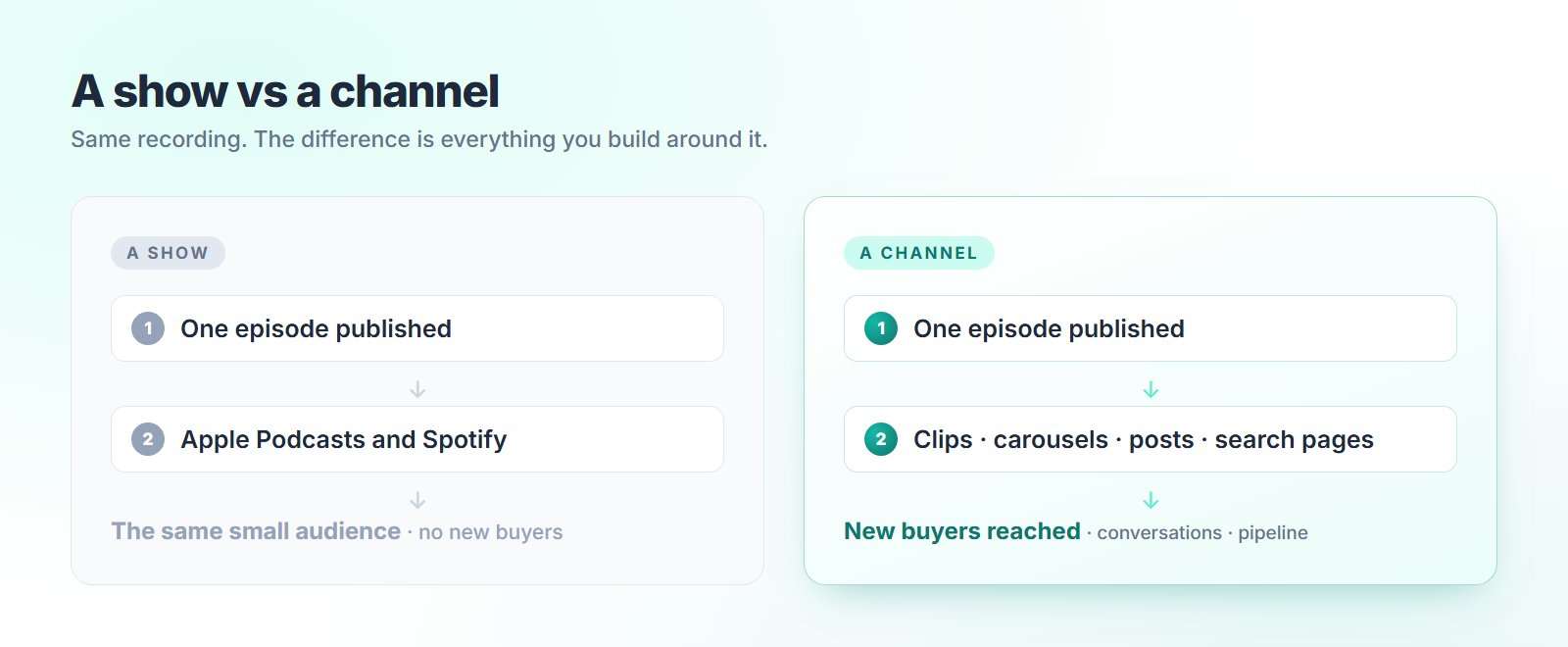
This matters from day one because it changes what you build. If you think you are making a show, you optimise for the episode: better intro music, a slicker edit, a more famous guest. If you know you are building a lead engine, you optimise for the system around the episode: how it gets distributed, how a listener becomes a conversation, and how you can tell which episode created which client.
Apple Podcasts and Spotify are libraries, not discovery engines. Almost nobody opens a podcast app and stumbles onto a show they have never heard of. People find new shows because something outside the app pointed them there. That single fact is why "just publish good episodes" fails as a strategy, and why the distribution layer in section nine is not optional.
So as you read the setup steps that follow, keep the end in mind. Every choice, from your topic to your microphone, should serve one goal: produce recordings that are easy to turn into content your buyers will actually see.
Positioning: the four decisions you make before you record
The most expensive podcast mistakes happen before the first recording, in the planning. A show with the wrong positioning can run for two years and never produce a lead, no matter how good the audio is. Make these four decisions on paper first.
1. Pick the buyer, not the topic
Most people start with "what do I want to talk about." Start instead with "who do I want to sign as a client, and what keeps them up at night." Your podcast topic is the overlap between what you sell and what that specific buyer is already trying to solve.
A fractional CFO should not make a show about "finance." That is a magazine. They should make a show for founders who just raised a seed round and have no idea how to build their first financial model. Narrow is good. Narrow is findable, quotable, and easy to turn into content that the exact right person stops scrolling for.
2. Run the one clean line test
For every episode idea, you should be able to draw a straight line from the topic to something you sell. If you sell pricing consulting and the episode is about how a SaaS company restructured its pricing tiers, the line is clean. If the episode is about your weekend hiking trip, the line is missing.
You do not need a sales pitch in every episode. You need every episode to live in the same world as your offer, so that a listener who values the free thinking naturally wonders what it would be like to hire you. When the topic and the offer drift apart, the audience grows and the pipeline does not.
3. Decide what a win looks like before you start
Write down the one metric that defines success for this show. For a B2B lead engine, it is almost never downloads. It is booked calls, qualified conversations, or pipeline created. Naming it now stops you from chasing the wrong number for a year and quitting because a vanity metric stayed flat while real conversations were quietly happening.
4. Choose a cadence you can hold for a year
Consistency beats frequency every time. A weekly show that dies at episode 9 loses to a fortnightly show that is still running at episode 40. Be honest about your capacity, then pick a schedule you can keep through busy quarters, travel, and the week everything goes wrong. Every-other-week is a perfectly strong B2B cadence, and it is far easier to sustain than weekly.
Format: solo, interview, or hybrid
Format is a lead-generation decision, not just a creative one. Each option pulls a different lever, so choose based on what you need the show to do.
Solo episodes are the fastest path to authority. You talk, the listener learns, and you are the only expert in the room. They are quicker to produce, easier to keep on-topic, and they map cleanly to your offer. The downside is that they lean entirely on your own discipline and ideas.
Interview episodes trade some of that direct positioning for relationships and consistency. A booked guest is a deadline you will not skip. Interviews also do quiet business development: the person you invite as a guest is often someone in your buyer's world, a potential referral partner, or even a future client who agreed to an hour with you for free.
The hybrid is what most successful B2B shows settle into. Alternate solo episodes that map directly to your services with interviews that build your network. You get the authority of solo and the reach and relationships of interviews, without depending fully on either.
One warning on the interview-only path: a show that is all guests can accidentally position your guests as the experts and you as the host who introduces them. If interviews are your main format, carve out real space in each episode for your own point of view, and make at least one in four episodes solo.
Name, artwork, and description that get found and clicked
These three details decide whether a stranger who comes across your show gives it a chance. They are cheap to get right and costly to get wrong, because changing a podcast name after launch is a headache you do not want.
The name
Resist the clever-but-empty name. "The Growth Mindset Hour" tells a buyer nothing. A good B2B podcast name does one of two jobs: it says who it is for, or it says what problem it solves.
"Beyond the Balance Sheet" hints at a finance audience. "The Founder's Pricing Show" tells a SaaS founder exactly why to click. Searchable beats clever, because some of your best listeners will arrive by typing a problem into a search bar. If you need a starting point, our free podcast name generator will give you a list to react to.
The artwork
Your cover art is shown at the size of a thumbnail, so design for that. Big legible type, high contrast, your face or a single strong icon, and almost no small detail.
Open Apple Podcasts on your phone, look at the top shows in your category, and notice how readable they stay when shrunk. Match that bar. You do not need a designer for version one, but you do need it to be clean and legible at 150 pixels wide.
The show description
Write the description for two readers: the human deciding whether to subscribe, and the search index deciding when to surface you. Lead with who the show is for and what they will walk away with. Use the plain words your buyer would actually type.
Skip the inside jokes and the mission-statement language. One tight paragraph that names the audience and the payoff will outperform three paragraphs of throat-clearing.
The same plain-language rule applies to every episode title. When you are stuck, our free episode title generator turns a topic into dozens of options across proven styles.
Gear: three setups that sound professional without overspending
Audio quality matters more than video quality, because a viewer will forgive a plain camera but will leave a show that sounds like a tunnel. The good news is that broadcast-quality sound is cheaper than ever in 2026. Here are three honest tiers. Pick the one that matches your budget and stop there, because more gear does not make a better show.
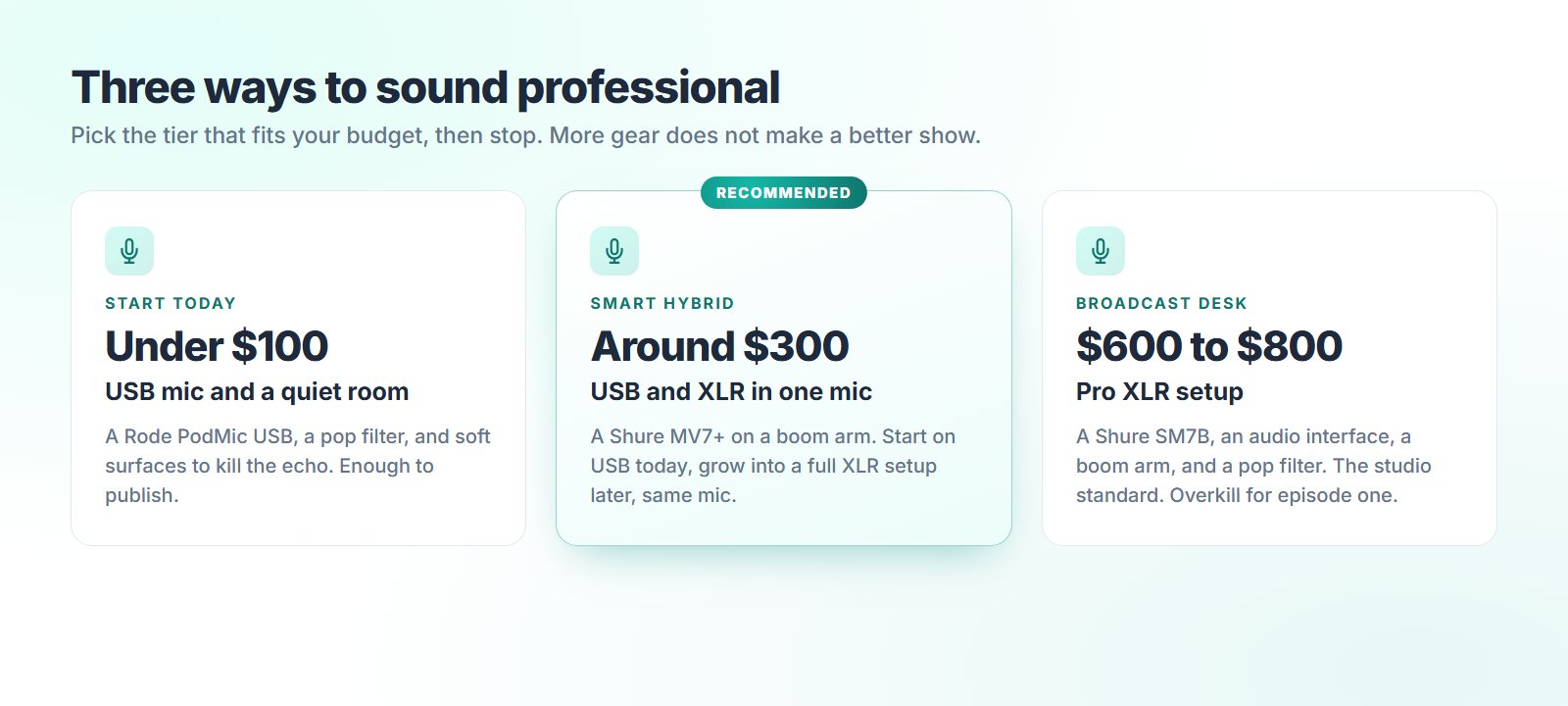
Tier 1: start today (under $100)
A decent USB microphone and a quiet, soft room will get you most of the way. The Rode PodMic USB sits around $99 and sounds far more professional than its price, with strong room-noise rejection. Record in a room with carpet, curtains, or a closet full of clothes nearby, because soft surfaces kill the echo that screams "amateur." Add a $20 pop filter and you are publishing.
Tier 2: the smart hybrid (around $300)
If you can stretch, buy a hybrid USB and XLR microphone so you can start simply now and upgrade your setup later without buying a new mic. The Shure MV7+ is the standout here: it plugs into a laptop over USB today, moves to a proper audio interface when you are ready, and carries the warm broadcast tone of its famous studio sibling. Pair it with a basic boom arm and you have a setup you will not outgrow for years.
Tier 3: the broadcast desk (around $600 to $800)
The professional standard is still the Shure SM7B, the microphone you have seen in front of half the big shows on the internet. It needs an audio interface with strong gain or a small inline preamp, an XLR cable, a boom arm, and a pop filter, which is why the full setup lands closer to $600 to $800. This is the right tier if podcasting is a channel you are accountable for, not a side experiment. It is overkill for episode one.
For video, you do not need a cinema camera. A recent phone on a tripod in good light looks great, and most remote-recording tools capture each person in high resolution anyway. Spend on a key light before you spend on a fancier camera. Soft, even light on your face does more for perceived quality than extra megapixels.
Recording: video-first, audio, and remote guests
Record video if there is any way you can. Edison Research found that 51% of Americans have now watched a podcast, and video is what brings most new people to the medium. More to the point for you, a video recording is the raw material for vertical clips, and vertical clips are the single most effective format for getting a B2B show in front of new buyers on LinkedIn, YouTube, and Instagram.
If video is genuinely the thing stopping you from ever pressing record, then record audio-only and start. An audio show that exists beats a video show that never launches. You can still produce audiograms, carousels, quote graphics, and written posts from audio. You simply give up the highest-reach format, which costs you roughly a third of your potential distribution.
For remote interviews, record locally rather than capturing the call audio. Tools like Riverside and Descript record each person's track separately at full quality on their own device, then upload, so a guest's shaky connection does not wreck the audio. Record separate tracks for each speaker whenever you can, because it makes editing and clipping far cleaner later.
Two habits that save hours downstream: record a few seconds of silence at the start so your editor has clean "room tone" to work with, and have each guest state their name and title at the top. Small things, big time savings when you turn the episode into thirty pieces of content.
Hosting and getting on Apple, Spotify, and YouTube
A podcast host is the service that stores your audio and generates the RSS feed that every app reads. You upload an episode once, and the host pushes it to Apple, Spotify, and the rest. You need one, and the choice is low-stakes as long as you avoid free hosts that take ownership or inject their own ads.
Three solid options in 2026, depending on what you need:
- Buzzsprout is the easiest on-ramp. Simple, reliable, with a free tier to test and paid plans from roughly $12 to $24 a month based on how many hours you upload. Great for a single show where you want zero friction.
- Transistor starts around $19 a month and lets you host unlimited shows on one account, with video hosting included on higher plans. The right pick if you might run more than one podcast or want a team on it.
- Captivate starts around $17 a month and leans into growth features and strong built-in websites. A good middle option if marketing tooling matters to you.
Once your host has one episode, submit the RSS feed to Apple Podcasts Connect and Spotify for Creators. Approval usually takes a few days. Publish your video versions to YouTube as well, because YouTube is now one of the largest places people watch podcasts and it has search and recommendation engines that the audio apps do not.
Do not wait until you have a perfect website to launch. A simple page with the show, an embed, and one clear call to action is enough for version one. The website is a place to send people, not a prerequisite for starting.
The launch: your first five episodes
How you launch decides your first ninety days of momentum. The goal is not a viral debut. The goal is to start with enough runway that you never miss your own schedule in the fragile first month, which is exactly when most new podcasts quietly die.
Bank three to five episodes before you go live. Launch by publishing two or three at once, so a new listener who likes the first has somewhere to go immediately instead of hitting a wall after one episode. Keep the rest in reserve so you stay ahead of your cadence.
For the launch window itself, a simple sequence works:
- Tell your existing network first. Email your list, message the clients and peers who would genuinely want to hear it, and ask a handful to subscribe and share. Warm humans beat cold reach in week one.
- Turn each launch episode into clips and posts immediately, and run them across the platforms where your buyers spend time. This is the distribution layer, and it starts on day one, not month three.
- Invite a guest with an audience for episode two or three. A guest who shares the episode brings their network into your world, which is the fastest honest way to reach new listeners early.
One thing not to do: do not spend your launch energy chasing podcast directory charts. New-and-noteworthy placement feels good and rarely produces a single B2B client. Spend that energy on distribution and on the people who already trust you.
The part everyone skips: the distribution layer
This is the section that separates a podcast that generates leads from one that does not. Everything up to here gets you a published episode. This is the part that gets the episode in front of people who have never heard of you, which is where leads actually begin.
The mechanics are simple to describe and hard to sustain alone. One recording becomes many standalone pieces, posted across thirty days on the platforms where your buyers already scroll. For a B2B show that usually means:
- Short vertical video clips, captioned, cut from the strongest moments, sized for LinkedIn, YouTube Shorts, Reels, and TikTok.
- Carousel posts that turn one idea from the episode into something a buyer would save and share.
- Quote graphics and text posts that deliver value with no click required.
- A long-form written piece or blog post built from the transcript, which earns search traffic the audio never will.
- A posting calendar that spreads it all across the month instead of one frantic launch day.
When this layer exists, one recording works for thirty days instead of three. New people meet your thinking on a platform they already use, some of them subscribe, and a few of them eventually become clients. When this layer is missing, even a great episode reaches the same small group of existing listeners and stops.
I want to be honest about why most solo hosts never build this. It is not a discipline failure, it is a workflow failure. You finish recording on Tuesday, you tell yourself you will cut clips on the weekend, and then you stare at a 45 minute file in an editor and your energy leaves the room.
You post one clip, it gets eleven views, and you do not do it again. The gap between "recorded an episode" and "have thirty days of assets ready to post" is enormous, and it eats the same energy you needed to record the next episode.
This is the whole reason Podcast Growth Studio exists, and we have written the operational manual for it. If you want the step-by-step system for building this layer, read the Content Engine Method, and for the full menu of what one episode can become, read the complete guide to podcast content repurposing. Build this layer, by hand or with help, or the rest of the work mostly stays invisible.
Turning listeners into pipeline: offers and attribution
Reach is not revenue. Once the distribution layer is putting your show in front of new people, you need a way to turn attention into conversations, and a way to know it worked. Two pieces: a clear next step, and attribution.
Give every listener one clear next step
A podcast with no call to action is a billboard with no phone number. Pick one primary action and repeat it: book a call, request a resource, reply to a post, join a list. One action, said plainly, in the episode and in the posts built from it. Three competing asks split attention and convert worse than one.
An offer that consistently works for B2B is a genuinely useful free resource tied to the episode topic, given in exchange for a reply or an email. It is low friction, it self-selects for the right people, and it gives you a reason to start a conversation. A useful resource is enough for cold trust. Save custom production work for paid pilots or booked sales conversations.
Build attribution from day one
The reason so many founders conclude "podcasting does not work" is that the pipeline it creates is invisible to them. A prospect sees a clip, sits on it for six weeks, then books a call and says they found you "somewhere on LinkedIn." That deal is podcast-driven, but nothing in the CRM says so.
Fix it with three properties on every new contact:
- Source channel: tag whether the contact first appeared through the podcast or its content.
- First-touch asset: note what they saw first, a clip, a carousel, a written post, the episode itself.
- Days to call: the time from first touch to first conversation, so you can see the real lag.
Add one habit to support it: ask every discovery call where they first came across you, and write the answer down. Six months of this turns the podcast from a thing you hope is working into a channel you can measure, defend, and scale. Use free UTM links on your contact and about pages so the trackable part is automatic.
Realistic timeline: what to expect month by month
Unrealistic expectations kill more B2B podcasts than bad audio. Here is an honest arc for a show that is run consistently with a real distribution layer behind it. Your mileage varies with your audience size and offer, but the shape holds.
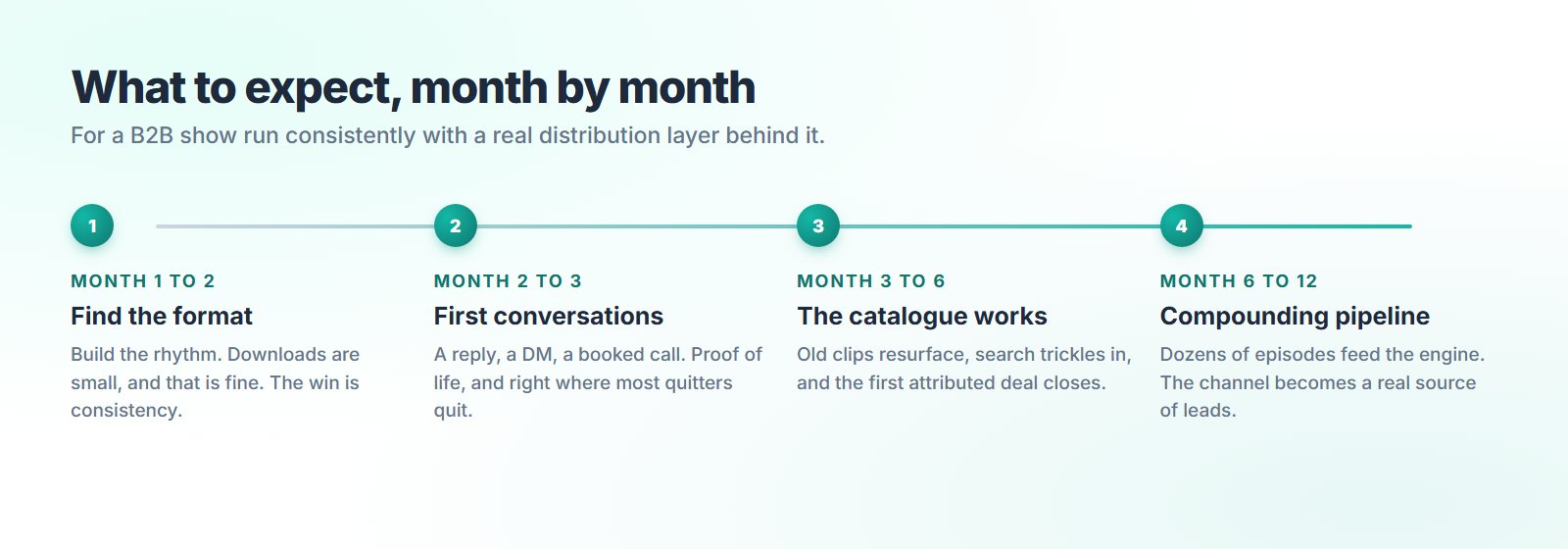
Month 1 to 2. You are finding your format and building the production rhythm. Downloads are small and that is fine. The win this stage is consistency and a distribution layer that actually runs, not numbers.
Month 2 to 3. The first attributable conversations start. Usually a DM or a reply to a clip, sometimes a booked call. This is the proof-of-life moment, and it is also where most quitters quit, right before it arrives.
Month 3 to 6. The back catalogue starts working for you. Older clips resurface, search traffic trickles in, and the first podcast-attributed deal tends to close somewhere in here. Monthly conversation volume becomes a little predictable.
Month 6 to 12. Compounding. You now have dozens of episodes feeding a content engine, a body of search-friendly pages, and a network of past guests who refer you. This is where the channel often becomes one of your better sources of qualified pipeline.
The single biggest predictor of which shows reach month 12 is not talent or budget. It is whether the production and distribution work was sustainable, or whether it burned the host out by month 4. Build for the long arc, not the launch.
The mistakes that kill a B2B podcast early
Most failed B2B podcasts die from the same short list of avoidable errors. Knowing them in advance is cheaper than learning them at episode 20.
- Building a show, not a channel. Publishing to the podcast apps and nowhere else. No clips, no posts, no search pages. The episode reaches only the people who already follow you.
- A topic with no line to the offer. An interesting show that never makes a listener want to hire you. Reach grows, pipeline does not.
- Chasing downloads as the metric. Optimising for a number that does not pay, then quitting because it stayed flat while real conversations were happening uncounted.
- No call to action. Great episodes that ask the listener to do nothing, so they do nothing.
- No attribution. Pipeline the podcast creates stays invisible, so the founder concludes the channel failed and pulls the plug.
- A cadence that cannot survive a busy quarter. Weekly ambition, fortnightly capacity, and a feed that goes quiet the first hard month.
Notice that only one of these is about the recording itself. The rest are about the system around it. That ratio is the entire argument of this guide.
Build it yourself or hand it off
You can run all of this yourself. The setup is learnable and the tools are affordable. The honest constraint is not money or knowledge, it is the recurring time the distribution layer demands, week after week, on top of running your business.
Run it yourself if you have genuine slack in your calendar, you enjoy the production craft, and you are early enough that doing the work teaches you what your show should be. Many strong B2B podcasts start exactly this way.
Hand off the production and distribution if your billable time is worth more than the hours it eats, or if you have tried before and the recordings keep stacking up unused while the posting never happens. That is the gap we close at Podcast Growth Studio. We turn one recording into a 30-day buyer-facing content system, delivered within 7 days, so the show keeps running without the production burden landing on you.
If you are starting from zero and want the whole engine built with you from day one, that is what our Launch Partner package is for: a 90-day podcast launch system that sets up the show and the content engine together, so you come out of the gate with distribution already running instead of bolted on later. You can see how the packages are structured on the pricing section of the home page.
Whichever path you choose, the principle does not change. The recording is the easy part. The system around it is where the leads live.
Frequently asked questions
Do you need a big audience for a B2B podcast to generate leads?
No. Leads come from distribution and a clear offer, not from download counts. Even a small show can create repeated buyer visibility when each recording is turned into clips, carousels, and written posts that reach buyers on LinkedIn and YouTube. Treat downloads as a directional number and sales conversations as the business signal.
How much does it cost to start a B2B podcast in 2026?
Gear runs from about $0 (a good headset and a quiet room) to roughly $800 for a broadcast-quality desk setup. Hosting is $12 to $24 a month on platforms like Buzzsprout, or $17 to $19 on Transistor or Captivate. The real cost is not money, it is the time to turn each episode into 30 days of distribution. That production layer is where most shows quietly stall and where the leads actually come from.
Should a B2B podcast be audio-only or video?
Record video if you can. Video lets you publish vertical short clips for LinkedIn, YouTube Shorts, Reels, and TikTok, which is the single biggest distribution format for B2B discovery. Audio-only still works through audiograms, carousels, quote graphics, and written posts, but you give up roughly a third of your potential reach. If video is the thing stopping you from recording at all, start audio-only and add video later.
Solo episodes or interviews for a lead-generating podcast?
Both work, for different reasons. Solo episodes are faster to produce and position you directly as the expert, which is the cleaner path to leads. Interviews are easier to keep consistent and let you build relationships with potential referral partners and clients you invite as guests. A common pattern is to alternate: solo episodes that map to your offer, plus interviews with people in your buyer's world.
How many episodes should I record before launching?
Bank three to five episodes before you launch. Launching with three lets you publish on day one and stay ahead of your own schedule for the first month, which is when most new podcasts fall off. Recording a small batch also lets you find your format and voice in private before anyone is listening.
How long before a B2B podcast starts generating leads?
With consistent distribution and a clear offer, expect the first attributable discovery call within 60 to 90 days and the first closed deal within 90 to 180 days. Monthly conversation volume tends to stabilise between months 6 and 12. Most hosts who quit do so right before the back catalogue starts compounding.
Resources for further reading
The data and tools referenced above come from legitimate primary sources worth reading in full.
- Edison Research, The Infinite Dial. The definitive primary-source data on US podcast listening behaviour, updated yearly. The source for the 73% reach and video-listening figures above. edisonresearch.com
- The Podcast Host, podcast industry statistics. A regularly updated, well-sourced roundup of listening, gear, and format trends for the current year. thepodcasthost.com
- Buzzsprout podcast statistics. Industry-wide download benchmarks, useful for sanity-checking your own numbers against your category. buzzsprout.com/stats
- Transistor, podcast hosting comparison. A current, detailed comparison of the major hosting platforms and their pricing. transistor.fm
- Apple Podcasts Connect and Spotify for Creators. The official submission portals for getting your RSS feed listed. podcastsconnect.apple.com and creators.spotify.com
- LinkedIn B2B Institute. Research on what actually works in B2B marketing over time, the conceptual backing for why podcasts build trust and pipeline slowly then all at once. business.linkedin.com
- Google Campaign URL Builder. The free tool for generating clean UTM links so you can attribute conversations back to specific content. ga-dev-tools.google
From the PGS blog: the operational manual for the distribution layer is the Content Engine Method. The full reference on what one episode can become is the complete guide to podcast content repurposing. Once your show is running, how to get clients from your podcast covers the conversion and attribution mechanics in depth.
Closing: start the show, but build the channel
Starting a B2B podcast is genuinely easier than it has ever been. A hundred dollars of gear, a quiet room, a host, and a clear topic, and you can publish this month. That part is not the hard part, and it is not the part that produces clients.
The clients come from the system you build around the show: distribution that puts it in front of new buyers, an offer that gives them a next step, and attribution that proves which episode created which conversation. Build the show and skip those, and you get a hobby. Build all of it, and you get a channel that compounds for years.
If you want to see what the distribution layer looks like before you build it yourself, we can do it for you. We turn one episode into a month of finished, ready-to-post content. You can see how it works, and the founding price, on the Content Engine page.
Record the first episode. Then build the machine around it.