
There is a faster way to reach the right audience than building your own show: borrow one that someone else spent years building. That is podcast guesting, and for a coach, consultant, or B2B founder it is one of the highest-return authority and pipeline plays available. You need no show of your own, no gear, and no back catalog. You need a clear point of view and a way to get in the room.
Most people still do it badly. They chase the biggest shows they can find, fire off copy-paste pitches, and treat "I got booked" as the finish line. Then nothing happens, and they conclude guesting does not work. The problem was never guesting. It was targeting the wrong shows, pitching the wrong way, and skipping the part that actually produces results: converting the appearance after the mic turns off.
This is the complete playbook, in the order you should run it. I run Podcast Growth Studio. I spent 7 years in radio, hosted a 200-episode show, and I have sat on both sides of the mic, the one booking guests and the one being booked. Here is what actually gets you on great shows, and what turns each appearance into authority, links, and leads.
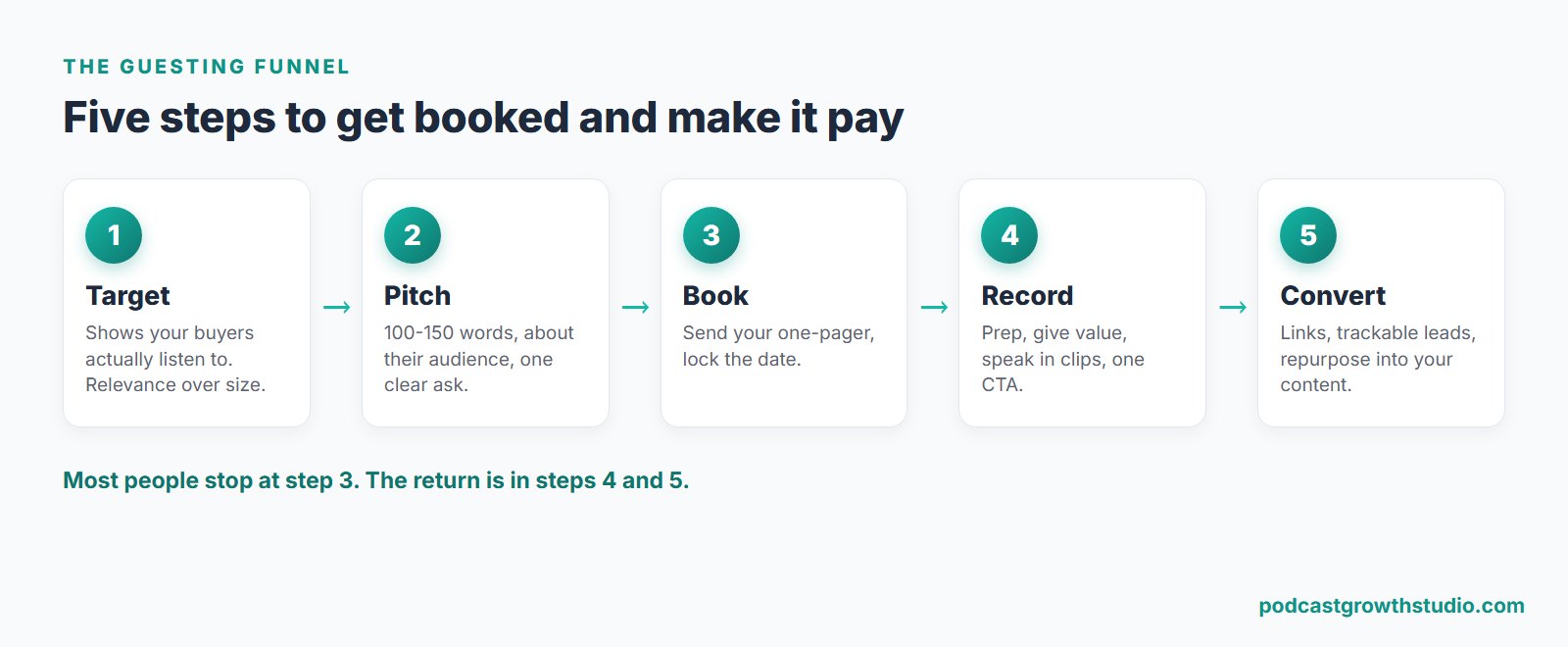
What this playbook covers
- Why guesting is the fastest authority and pipeline play
- Get clear on your goal and your one guest topic
- Build your guest one-pager
- Find the right shows (relevance over size)
- The pitch that gets a yes
- Where and how to pitch
- Nail the interview
- Convert the appearance (the part everyone skips)
- Cadence and realistic expectations
- Frequently asked questions
- Resources for further reading
Why guesting is the fastest authority and pipeline play
When you publish on your own show, you reach the audience you have already built. When you guest, you reach an audience someone else built, pre-warmed by the trust they place in the host. A host introducing you is a borrowed endorsement, and it lands far harder than anything you could say about yourself.
For B2B specifically, the math is compelling. You do not need a huge reach, you need the right room. A 40-minute conversation in front of a few hundred of your exact buyers, with the host implicitly vouching for you, can do more than months of cold outreach. And unlike a social post, the episode is an evergreen asset: it keeps getting found, it earns you a backlink in the show notes, and you can repurpose it into your own content.
This is the deep dive on the "borrowed audiences" idea from our guide to promoting a podcast. If you do have your own show, guesting also feeds it. If you do not, it is the best place to start.
Get clear on your goal and your one guest topic
Before you pitch anyone, decide what a guest spot is for. Authority and audience growth point you toward bigger, broader shows. Pipeline points you toward smaller, tightly relevant shows where your exact buyer is listening. Most B2B operators should optimize for the second, because a booked call is worth more than a download.
Then lock your one guest topic: the single subject you want to be known for and can speak on with genuine authority. Not five topics, one, with a clear point of view. "How service businesses turn a podcast into pipeline" is a topic. "Marketing" is not. A sharp topic makes you easy to book, because the host can instantly see the episode, and easy to remember, because you stand for one thing.
A quick test: can you finish the sentence "I should be on your show to talk about ___, and your audience will walk away able to ___"? If you can, you have a guest thesis. If you cannot, sharpen it before you pitch.
Build your guest one-pager
Make it easy to say yes. A simple guest one-pager, a single page or a short web page, removes friction for the host and signals you are a serious, low-effort booking. Include:
- A two-line bio in the third person, leading with why you are credible on your topic.
- Two or three episode angles you can deliver, each with the concrete takeaway for their audience.
- A few talking points or sample questions so the host can picture the conversation.
- Links to one or two past appearances or strong content, so they can hear or read your voice.
- A high-resolution headshot and how you want to be introduced.
You do not attach this to the first pitch. You keep it ready and offer it the moment a host shows interest, which turns "let me think about it" into a booked date.
Find the right shows (relevance over size)
This is where most guesting goes wrong. People target the biggest shows they can name and ignore the dozens of smaller, perfectly relevant ones where their buyer actually listens. Flip that. Relevance beats reach almost every time.
Where to find shows:
- Search by topic on Listen Notes, Apple, Spotify, and YouTube.
- Follow your peers and competitors. See which shows they have guested on, then target those same shows. They are pre-qualified for your audience.
- Curated lists in your niche ("best B2B marketing podcasts," "top podcasts for consultants") are ready-made target lists.
- Guest-matching platforms like PodMatch and Talks.co connect guests with hosts who are actively looking.
Then qualify each show with three questions. Is this show clearly speaking to my ideal customer? Are recent guests peers of my audience? Would my buyer realistically listen to this? If the answer is not a clear yes on all three, skip it. A tight list of 20 genuinely relevant shows will outperform a list of 200 random ones.
The pitch that gets a yes
The single biggest lever in guesting is the pitch, and the rule is simple: make it about their audience, not about you. Hosts get pitched constantly, and they skip anything long, generic, or self-centered.
Keep it to about 100 to 150 words. The structure that works:
- Prove you know the show. One specific line about the audience, the host, or a recent episode. This alone separates you from the copy-paste pile.
- One line of credibility. Why you are worth trusting on this topic, in a sentence.
- One or two episode ideas, each with the concrete takeaway their listeners get.
- One clear question. "Are you taking guests this quarter?" beats a vague "let me know."
Here is the shape of it, which is also the exact approach behind the cold outreach in our promotion guide:
"Hi [name], [specific thing about the show or a recent episode]. I [one-line credibility]. I think your audience would get a lot from [episode angle], where they would walk away able to [takeaway]. Worth a conversation? I can send a short outline if it helps."
What kills a pitch: a wall of text, an attached media kit nobody asked for, a bio with no audience benefit, and anything that obviously went to fifty hosts at once. When in doubt, cut it shorter and make it more about them.
Where and how to pitch
The channel matters less than the relevance, but a few work best.
LinkedIn is the strongest for B2B. Most hosts of business podcasts are active there, a personalized connection note or message lands in a human inbox, and you can warm them up by engaging with their content first. It is the channel we would lead with for almost every B2B guest campaign.
Direct email works when the host publishes a real address or a guest form. Keep the same short structure. Many quality shows route this through a contact or "be a guest" page rather than a public inbox.
Warm introductions beat everything. If a past guest or a mutual connection can introduce you, your booking odds jump. Ask the peers whose shows you admired who they know.
Guest-matching platforms (PodMatch, Talks.co) are worth it when you want volume and the show fit is good. Treat the matches with the same relevance filter as everything else.
Whatever the channel, send a manageable number, personalize each, and track who you pitched so you can follow up once, politely, after a week or so.
Nail the interview
Getting booked is half the job. A great appearance is what earns the next one and actually moves your audience and pipeline.
Prepare for this specific show. Listen to an episode or two, know the host's style, and have three or four stories or frameworks ready that serve their audience. Preparation is what separates a guest people remember from one they skip.
Lead with value, not your pitch. The fastest way to lose a new audience is to spend the episode selling. Give your best material away generously. Trust is what converts later, and you only earn it by being genuinely useful on air.
Speak in soundbites. Short, quotable, self-contained points are easier to listen to and far easier to clip later, both for the host and for you. A single sharp line can become the clip that travels.
Have one clear call to action. When the host asks where people can find you, give one next step, not five. A simple free resource or a single link beats reeling off every channel you own.
Convert the appearance (the part everyone skips)
This is where the real return lives, and where almost everyone stops too early. The episode going live is not the end. It is the raw material.
Get the links right. Make sure the show notes include the link you want, ideally to a relevant page, not just your homepage. Those show-notes links are real backlinks that build your authority over time, the same reason guesting helps your search visibility.
Make leads trackable. Give the audience a specific next step you can attribute: a unique link or a promo code mentioned on air, or a dedicated landing page. Then you actually know which appearances produced pipeline, which tells you where to guest again. The attribution mechanics are covered in how to get clients from your podcast.
Repurpose the episode into your own content. You were just handed 40 minutes of you sounding like an expert. Pull clips, quotes, and a written post from it for your own channels. One guest spot can become a week of your own content, the exact system in our repurposing guide. This is also what we build for clients: every recording, your show or a guest spot, turned into a month of ready-to-post content.
Keep the relationship. Thank the host, share the episode generously, and stay in touch. Hosts talk to each other, and a great guest gets referred to other shows. Your second and third bookings often come from your first.
Cadence and realistic expectations
Guesting rewards consistency, not bursts. One or two well-chosen, well-prepared appearances a month is a strong, sustainable pace, and it compounds, because every episode keeps working long after it airs.
Set expectations like a campaign, not a lottery. Not every pitch gets a yes, and not every appearance produces a lead the same week. But a focused run of ten to twelve great guest spots over a year, on shows where your buyers actually listen, builds a body of authority, a set of backlinks, and a stream of warm conversations that cold outreach cannot match. Track your pitches, your bookings, and the leads you can attribute, and double down on the shows that work.
Frequently asked questions
How do I get booked as a podcast guest?
Pick shows whose audience is your ideal customer, then send a short, personalized pitch (about 100 to 150 words) that leads with what their listeners will get, not with your resume. Reference something specific about the show, give one line of credibility, propose one or two concrete episode ideas, and end with a single clear question. Relevance and personalization get you booked far more than a big follower count or a long bio.
How do I find podcasts to be a guest on?
Start where your buyers already are. Search Listen Notes, Apple, Spotify, and YouTube for your topic, browse curated lists in your niche, and look at where your peers and competitors have guested, then target those same shows. Guest-matching platforms like PodMatch and Talks.co also connect guests with hosts actively looking. Prioritize relevance over size: a show with a few hundred of the right listeners beats a huge show full of the wrong ones.
What should a podcast guest pitch say?
Keep it to roughly 100 to 150 words. Open by showing you actually know the show (mention the audience, the host, or a recent episode). Add one short line of credibility. Propose one or two specific episode angles with the concrete takeaways their listeners would get. Then end with one clear question, like whether they are taking guests this quarter. Make it about their audience, not about you, and never send anything that reads as copy and paste.
Do I need my own podcast to be a guest on others?
No. Guesting is one of the few audience-building moves that needs no show, no gear, and no back catalog of your own. You borrow an audience the host spent years building. It is the fastest way for a coach, consultant, or founder to get in front of the right people, and many people guest for a year before ever starting a show of their own.
How many podcasts should I guest on?
Aim for consistency over volume: one or two well-chosen, well-prepared appearances a month beats a scattershot blitz. The value compounds, each episode is an evergreen asset that keeps getting found, links back to you, and can be repurposed into your own content. A focused run of ten to twelve great guest spots a year on relevant shows will do more than fifty random ones.
Is podcast guesting worth it for B2B lead generation?
Yes, when you target the right shows and convert the appearance. Pick podcasts your buyers actually listen to, give a clear next step on air, and use a unique link or promo code so you can attribute leads. You also get show-notes backlinks and an episode you can repurpose into your own clips and posts. For B2B, where one client can be worth thousands, a single well-placed guest spot can pay for itself many times over.
Resources for further reading
A few solid outside guides on guesting and guest-matching:
- Buzzsprout, How to Get Booked on Podcasts. A practical walkthrough of finding shows and pitching. buzzsprout.com
- PodMatch. A guest-matching platform that connects hosts and guests actively looking. podmatch.com
- Rephonic, How to Become a Guest on a Podcast. Includes research tactics for finding relevant shows. rephonic.com
From the PGS blog: guesting is the deep dive on the borrowed-audience play in how to promote a podcast in 2026. To turn appearances into booked calls, see how to get clients from your podcast. To repurpose each spot into your own content, read the repurposing guide. And if you are weighing your own show too, start with the 50 questions to ask before you start.
Closing: borrow the audience, then keep it working
Guesting is the rare growth move that costs nothing to start and compounds for years. Pick shows where your buyers actually listen, pitch in a way that makes it about their audience, show up genuinely useful, and then do the part almost everyone skips: convert the appearance into links, leads, and your own content.
Do that consistently, a couple of great appearances a month, and you build authority and pipeline faster than your own show could on its own. The hosts already did the hard part of gathering the audience. Your job is to earn the room and make the most of it.
And every appearance you land is content. If you want the clips, quotes, and posts pulled from each guest spot and each of your own episodes, done for you, that is exactly what we do. You can see how one recording becomes a month of content on the Content Engine page.