
A management consultant in Atlanta records a podcast every other Friday. Eighteen episodes in, average 220 downloads per episode, zero new clients she can attribute to the show. She concludes podcasting is a vanity exercise and starts pulling back the time she gives it. Six months later her marketing assistant tells her the firm has booked five discovery calls in the last quarter where the prospect "mentioned a podcast clip on LinkedIn." None of those prospects could remember which clip. None made it into the CRM as podcast-attributed. Two of them closed. The podcast had quietly generated roughly $80,000 in new revenue. She just could not see it.
This is the gap most B2B podcasts live in. The content is doing more than the metrics show. The metrics do not show it because the attribution layer was never built. The conversion mechanics were never built either, so the leads that do come through arrive smaller than they should be. The host concludes the channel does not work, when the truth is the channel was never finished.
This guide is the system that finishes it. Distribution that produces touchpoints. Attribution that proves the touchpoints landed. Conversion mechanics that turn touchpoints into booked calls. End-to-end, from the moment you hit record to the moment a buyer signs.
It is written for B2B operators who podcast: coaches, consultants, CPAs, lawyers, financial advisors, founders, agency owners. The numbers and frameworks below assume that pattern. If you sell direct-to-consumer products through podcasting, parts of this still apply and parts do not. Use what fits.
What this guide covers
- The honest baseline: what podcasts can and cannot do
- The 3 conversion pathways from podcast to client
- Setting up your podcast to attract clients in the first place
- The distribution layer (the actual gap)
- CRM and attribution: the 3 properties that change everything
- The conversion mechanics that turn attention into calls
- Realistic conversion math by audience size
- Case-shaped examples (CPA, coach, consultant, SaaS)
- The failures that kill the system
- Tools: a short, honest stack
- DIY vs hand it off
- Frequently asked questions
- Resources for further reading
The honest baseline: what podcasts can and cannot do
Most podcast advice flattens two completely different things: how a podcast grows, and how a podcast generates clients. These are different problems, and they have different fixes. Conflating them is why most B2B hosts spend a year improving their content and another year wondering why nothing changed in their pipeline.
Podcasts are bad at discovery. Apple Podcasts and Spotify are libraries, not discovery engines. Almost nobody opens a podcast app and stumbles onto a show they have never heard of. They find new podcasts because something outside the app pointed them there: a clip on LinkedIn, a recommendation from someone they trust, a Google search that landed on a transcript or show notes. If you have no presence outside the podcast app, your show will plateau no matter how good the episodes get. Recording episode 47 to the same 200 listeners is not a growth strategy; it is endurance.
Podcasts are very good at trust. Once someone has listened to even one full episode, you have spent forty-five minutes inside their head. That kind of attention is rare in modern marketing. A founder who has listened to three of your episodes shows up to a sales call differently than one who clicked an ad. They are not asking whether you know what you are talking about; they are asking whether you are the right fit. The trust step is already done. You can spend the call talking about scope and price instead of credentials, which is a different conversation entirely.
This split, bad at discovery, great at trust, is the whole strategic insight behind a working B2B podcast. You do not use the podcast to find people. You use it to deepen relationships with people who found you somewhere else, until they hire you. The discovery happens through the surrounding distribution: clips, posts, carousels, search results, referrals. The trust happens through the recording itself. Together they produce a client. Apart they produce a hobby.
Once you accept that split, the metrics most hosts obsess over stop being useful. Downloads tell you how many existing listeners came back for the latest episode. They do not tell you whether the show generated business. The metric that matters is something most hosts never measure: how many discovery calls in the last 90 days mentioned the podcast, a clip, or any piece of content derived from an episode. If that number is zero, the show is not generating business yet, and the next nine sections will tell you exactly why. If it is six, you have a channel, and this guide will help you double it.
The audience-to-pipeline math is also more forgiving than it looks. A B2B podcast with a modest 2,000 LinkedIn followers built around it, at an average annual contract value of $25,000, can realistically produce two to four discovery calls per month from podcast-derived content. At a typical close rate of 25% to 35%, that is roughly one to one and a half new clients per quarter. Annualised, that is $100,000 to $150,000 in new revenue. From an audience smaller than the average regional LinkedIn personality. Not magic. Just what happens when the system around the show actually exists.
The reason this math is so rarely realised is also boring. Most B2B podcasts publish an episode, post the YouTube link to LinkedIn once, get fourteen likes, and call it distribution. There is no real distribution layer. There is no attribution layer. There is no clear conversion path in any of the content. The recording is the only artefact, and the recording does not move on its own.
The rest of this guide is the answer to each of those gaps in turn.
The 3 conversion pathways from podcast to client
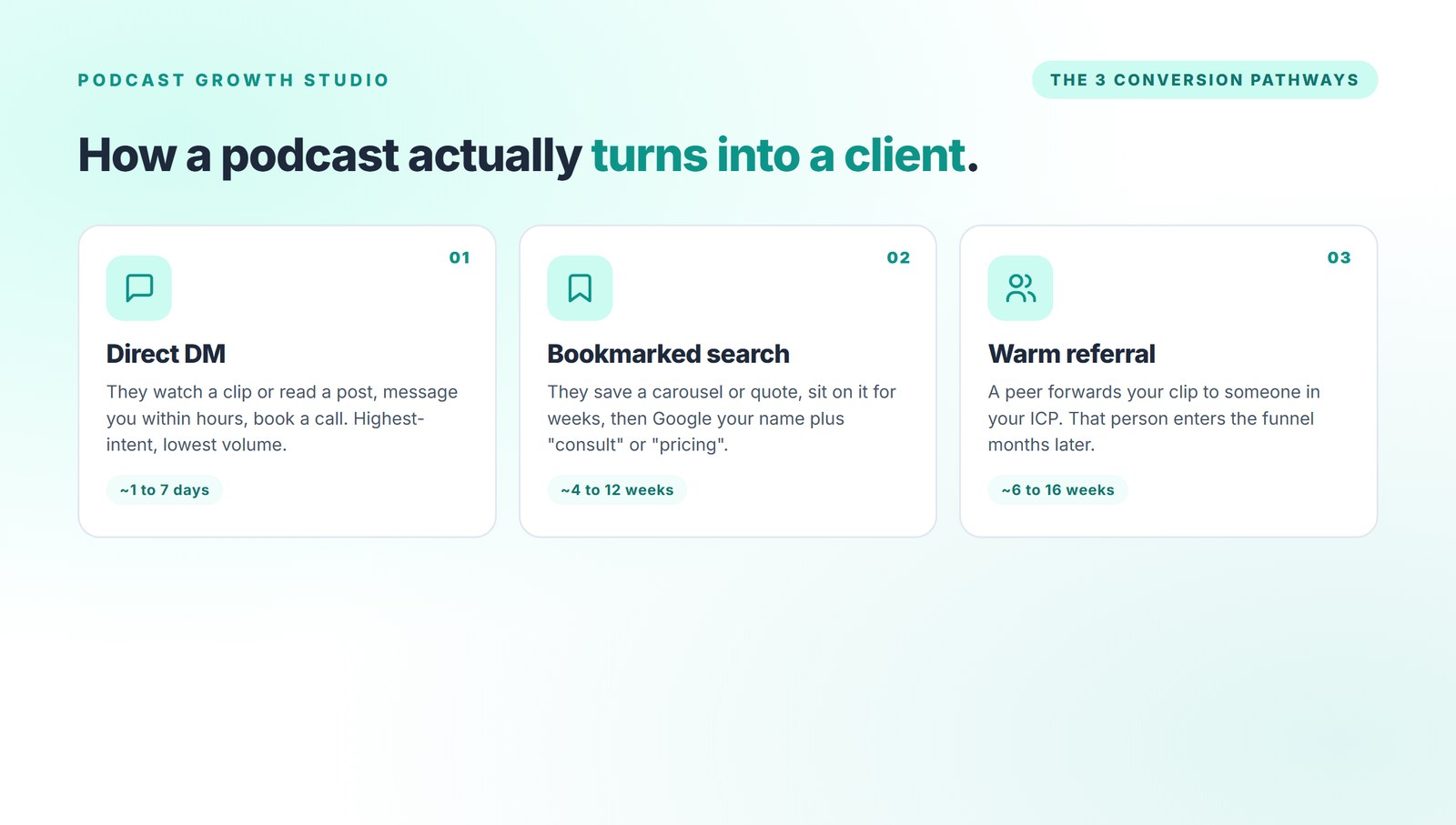
Before you can build the system, you need to understand how a podcast actually turns into a paying client in practice. There are three pathways, and the working B2B podcasts produce all three simultaneously. Most hosts only know about the first one and assume that is the whole picture.
Pathway 1: Direct DM
Someone watches a clip on LinkedIn, reads a written post derived from your episode, or finishes a full episode in the morning. By afternoon they have sent you a message. Some version of, "hey, your take on X was useful, we have been struggling with the same thing, what does working with you look like?" You reply. You send a Calendly link. They book.
This is the pathway every host talks about because it is the most visible. It is also the smallest. Direct DM converts are usually 20% to 30% of total podcast-attributed inbound. They look enormous because every one of them is obvious and trackable. The host then assumes that DM volume IS the lead volume. It is not. It is the tip.
The thing that creates a DM-magnet clip is rarely the content itself. It is the specificity of the implied next step. A clip that ends with a vague "we help companies grow" produces no DMs. A clip that ends with "this is the exact framework we install when we work with consulting firms doing seven figures" produces DMs the same week. The DM is the audience telling you they recognised themselves in the description. Specificity does the work.
What kills DMs: clips that feel like cold-pitch openings, clips that include any version of "DM me to learn more" as the CTA (it reads as desperate), clips that hide the offer instead of acknowledging it exists. The reader of a clip can tell instantly whether you are talking with them or selling at them. They DM the first one. They scroll past the second.
Pathway 2: Bookmarked search
Someone saves a carousel about the framework you used on a client. They do not message you. They do not click your profile. They scroll on with their day. Four weeks later, eight weeks later, twelve weeks later, the problem the carousel addressed becomes urgent in their business. They open Google and type your name, plus "consulting" or "pricing" or "agency" or "process". They land on your About page or your contact form. They fill it out. Their first email to you mentions nothing about the original carousel because they do not even remember it consciously. It just lodged in their head and surfaced when they needed it.
This pathway is the largest by volume in most B2B podcasts and the hardest to attribute. It is responsible for somewhere between 40% and 60% of podcast-influenced leads in the cohorts we track. It is also the reason hosts who measure only DMs conclude the channel does not work. The leads are coming through; they are just not coming through the channel the host is watching.
To make this pathway visible: every link in your profile, every clip caption that includes a URL, every CTA in a carousel needs to carry UTM parameters. Then on your About and Contact pages, Google Analytics or Cloudflare Web Analytics shows the traffic that arrived via podcast-derived UTMs. You will not catch every bookmarked-search lead this way, because some people type your name directly and bypass UTMs entirely. For those, the next layer kicks in: the intake field on your contact form. We will cover both in section five.
Pathway 3: Warm referral
Someone you have never met sees your clip. They are not your buyer, but the next morning in a Slack with their peer, they forward it. Their peer is your buyer. Your buyer reads it, does not act, files it away. Three months later that buyer is talking to a vendor and your firm comes up by reputation. They reach out. They tell you they have been "following you for a while", which usually means they read one post their colleague forwarded and forgot about it consciously.
Warm referrals are the smallest pathway in raw volume (usually 10% to 25% of inbound) and the highest in close rate. A referred buyer arrives with social proof baked in. The deal cycle compresses. Pricing pushback is rare. These are your best clients, and you almost never know which piece of content created them.
The only way to make referrals visible is to ask, on every single discovery call, where the prospect first encountered you. Not as a marketing question, as a curiosity one. "How did you end up on our calendar?" is enough. The answers compound into a real attribution picture over six months, and the patterns will surprise you. Often a guest you almost did not invite turns out to have generated three referrals you never connected to her.
The pattern across all three pathways
The pathways share a structural feature. Every one of them is created by a piece of content that does its job on its own, without context from the rest of your show. The episodes themselves rarely create any of these conversions directly. The clips, the carousels, the written posts, the quote graphics that survive standalone, those are the actual conversion engine. If your distribution layer is just "here is the latest episode, listen now", none of the three pathways will produce much.
The deeper takeaway from understanding all three is that most B2B podcasts are already producing all three. The hosts just see only one. Building the attribution layer in section five is what makes the other two visible, which is what makes you stop second-guessing whether the channel is working and start scaling what already does.
Setting up your podcast to attract clients in the first place
Distribution and attribution cannot save a show that was not set up to attract clients in the first place. A podcast about your hobby, recorded for fun, will produce listeners. It will not produce a pipeline, no matter how good the post-production is. The setup work happens before the recording, in the choices you make about guests, topics, format, and offer alignment. Get those wrong and the rest of the system runs harder for less.
Guest selection as a pipeline tactic
The single highest-leverage choice in a B2B podcast is who you invite as guests. The common framing is to invite "interesting people". The better framing is to invite people who fit your ideal customer profile. Inviting your ideal buyer onto your show is the most underused B2B sales tactic in podcasting. It works because the dynamic of the conversation is structurally different from a sales call. You are not asking for their business. You are asking for their expertise. The conversation builds rapport in a way no cold outreach ever does. Some percentage of those guests become clients in the next six to twelve months, not because you pitched them but because they got a sustained look at how you think.
The honest number across the B2B podcasts we have audited: of guests who are in your ICP, 5% to 15% become clients within twelve months of the recording. That number stays remarkably consistent across niches. On a show that records two episodes a month, that is one to three new ICP-fit guests every month, and one to four of them as clients in the next year. From the act of guest booking alone.
The implication is straightforward. Your guest list should look like your ideal client list, not your aspiration list. Famous people get downloads. Buyers get pipeline. If you can have both, take both. If you have to choose, choose buyers. The "drop big names" instinct is the consumer-podcast playbook; it does not translate to B2B services.
Topic-offer alignment
Every episode topic should pull double duty. It should be something your audience genuinely wants to learn about, and it should sit close enough to your offer that someone interested in the topic is also a candidate for your service. The cleanest test: can you finish the sentence "if you found this episode useful, you might also be interested in our service in [topic-adjacent area]" without it feeling forced? If yes, the alignment is right. If no, the episode is interesting content but probably not pipeline content.
This does not mean every episode should be about your service. It means every episode should sit in a topic neighbourhood that overlaps with your service. A pricing consultant whose podcast covers buyer psychology, deal-structuring frameworks, and case studies of pricing decisions is in the right neighbourhood. The same consultant doing an episode on their favourite hiking trail is in the wrong neighbourhood, no matter how well-recorded. Hiking-trail episodes win goodwill from existing fans and do nothing for pipeline.
What not to record
Four episode types underperform for B2B client acquisition, in our data, and they underperform consistently enough that they are worth avoiding by default. Pure entertainment episodes (story-time, anecdotes, comedy) attract attention but not buyers. Off-brand topics dilute the SEO signal because Google can no longer figure out what your site is about. Generic interview shows ("welcome to the show, tell us your story") feel like every other podcast and do not differentiate. And "thought leadership" episodes that consist of opinion without specifics rarely generate either reach or pipeline; the specificity is what makes content travel.
The episode types that overperform: tactical breakdowns with specific numbers, contrarian opinions on industry orthodoxy, case-shaped narratives ("how we did X for client Y, here is what we learned"), and reactions to live industry news from your specific expertise. All four share a property: someone outside your immediate audience can extract a usable insight from the first three minutes without needing context.
Episode format and length
The B2B podcast research over the last few years has gradually settled on a counterintuitive answer: shorter episodes outperform longer ones for client acquisition, even though the long-form-podcasting culture pushes the opposite. The reason is purely mechanical. Each episode produces a finite pool of standalone ideas (8 to 12 in a 45-minute conversation, 10 to 14 in a 60-minute one, 14 to 18 in a 90-minute one, but with diminishing returns past 60 minutes as attention fades). A 30-minute focused episode produces tighter, more usable ideas per minute, and you can record more of them per quarter. More episodes equals more topical depth equals more pieces of clip-worthy content per hour of effort.
This is not an argument against long-form. If you have a Lex Fridman style 90-minute conversational format and it works for your audience, keep it. But if you are deciding from scratch, start at 30 to 45 minutes. You can always extend later. Going the other way is harder.
The CTA you will refuse to put in
This is the part most B2B hosts hate, but it is the single biggest predictor of pipeline. Every episode needs a clear, specific call to action in the show outro AND in the show notes. Not "follow me on LinkedIn". Not "DM me to learn more". A specific next step: "if you want to see what this looks like in your own business, we offer a one-call audit at [URL]" or "the framework we walked through is documented in detail at [URL]". The CTA exists so that the listener who got value from the episode has a place to convert. Without it, you have given them value and pushed them away from the door at the same time.
The pushback is always the same: "I don't want to be salesy". The pushback is wrong. Salesy is a function of how the offer is framed, not whether the offer is mentioned. "If you are tired of trying to figure this out alone, we offer X" is not salesy. It is helpful. Salesy is "click the link in my bio and DM me now to grab a limited-time spot, only three left, hurry". The B2B audience can tell the difference. Stop confusing them.
The distribution layer (the actual gap)
Most podcasts that fail to generate clients fail here. The recording exists. The episode is published. And then nothing happens, because nothing was built around the recording to push it past the existing audience. Distribution is the gap between "we made a podcast" and "we run a podcast as a business channel".
The shape of what good distribution looks like is documented in detail in our Content Engine Method pillar, and the four-stage system (Source, Multiply, Sequence, Convert) is the operating manual. What matters in the context of this guide is which platforms the leads actually come from for B2B, and what proportion of the distribution effort should go where.
Where B2B podcast leads actually come from
Across the B2B podcasts in our cohort, the pathway distribution is consistent:
- LinkedIn: 60% to 70% of attributed inbound. By a wide margin the single most important platform for B2B podcast distribution. The audience is right, the algorithm rewards saves and comments (which is what good carousels and clips earn), and the conversion path from clip to DM is direct.
- YouTube: 10% to 15%. Mostly via search of long-tail problem queries that the episode addresses ("how to structure pricing for consulting", "B2B podcast distribution"). YouTube favours longer-form content, so the full episode (or trimmed 20-minute versions) performs better here than the 60-second clips that win on LinkedIn.
- Google search / your blog: 8% to 12%. Long-form written derivatives of your episodes (blog posts, transcripts, FAQ-style breakdowns) earn the slow-compounding search traffic. This is the channel that pays back twelve months later.
- Email / newsletter: 8% to 12%, if you have a list. Zero if you do not. A simple weekly email summarising recent episodes and adding context is enough.
- Instagram, X, TikTok, threads: under 5% combined for most B2B niches. Worth posting to opportunistically (the assets you already made for LinkedIn cost almost nothing to cross-post) but not worth optimising for.
The implication is operational. If you have limited bandwidth for distribution, the order is LinkedIn first, YouTube second, blog third, email fourth, the rest opportunistically. Not equal effort across every platform. Disproportionate effort on the platform that actually generates calls.
The asset-to-format-to-platform map
Each episode produces a set of standalone assets. Each asset has a natural platform. The mistakes come from putting the wrong asset on the wrong platform. A few baseline pairings that hold across B2B niches:
- 30 to 75 second vertical clips: LinkedIn native video, YouTube Shorts, Instagram Reels, in that order of return.
- Multi-slide carousels (6 to 10 slides): LinkedIn document posts (highest return), Instagram carousel posts.
- Quote graphics (square): LinkedIn image posts, Instagram feed.
- Written posts (800 to 1,400 characters): LinkedIn native text posts. This format outperforms almost everything else for B2B inbound DM volume.
- Audiograms (waveform video with captions): LinkedIn native video, Twitter/X.
- Podcast trailer (60-second cut): LinkedIn, YouTube Shorts, and pinned to your podcast platform.
- Long-form written post (1,500 to 3,000 words): your own blog, Medium republished, LinkedIn articles. SEO play, search-driven.
If you produce one of each from each episode and sequence them across 30 days, you have a real distribution layer. If you produce three random clips and dump them on Friday, you do not.
Cadence over volume
Three good clips a week, scheduled, consistent, beats fifteen clips dumped sporadically. The LinkedIn algorithm rewards predictability. Your audience subconsciously learns when to expect you. Pattern interruption breaks both signals. The B2B hosts we have audited who post on a clean Tuesday-Thursday rhythm outperform hosts who post nine times one week and zero the next, holding asset quality constant.
For most B2B podcasts, the working baseline cadence is: five posts per weekday (Monday through Friday), one short per day or one carousel on Tuesdays, weekends off. That is 25 posts a month, which one episode at full-kit production easily covers. Saturdays and Sundays are dark by default; the B2B audience is not on LinkedIn looking for thought leadership at 11pm on a Saturday.
CRM and attribution: the 3 properties that change everything
This is the section most B2B podcast guides skip entirely. It is also the section that separates podcasts that produce a tracked, growing, defensible channel from podcasts that produce vibes. Without attribution, you cannot tell which episodes work, which guests drive conversations, or whether the whole effort is worth it. Six months of attribution data turns the podcast from a hobby with a mic into a measured business channel.
The three CRM properties to add
Every B2B podcast needs three custom fields on the contact or deal object in the CRM. Add them today, before you do anything else in this guide:
- Source Episode (text or single-select). Which episode introduced this contact, even if approximately. "Don't know" is a valid answer, but most contacts know at least roughly. Even a guess is more data than nothing.
- First Touch Asset (single-select). What was the first piece of content this contact saw? Options: full episode, short clip, carousel, written post, quote graphic, blog article, audiogram, trailer, other.
- Days to Call (number, calculated automatically). Time in days from first touch (when the asset was published or when they engaged with it) to first conversation. This becomes essential six months in for understanding cycle length.
You can add these in HubSpot under Settings -> Properties -> Contact properties -> Create property. In Pipedrive under Settings -> Custom fields. In Close under Settings -> Contacts -> Custom fields. Same idea in Copper, Pipefy, and any other CRM that supports custom fields, which is all of them.
Once the properties exist, the rule is simple: every new contact that gets a sales call has these three fields filled in before the call ends. The salesperson (or you, if you are the salesperson) asks the questions and types the answers. That is it. The data quality is rough at first. After three months it is good. After six months it tells you which episodes and which guests actually drive revenue, which is the data nobody else in your niche has.
UTM strategy for clip and post links
Every link that goes out in a podcast-derived asset should carry UTM parameters. UTM tags are tiny query strings appended to a URL that let your analytics tool know where the traffic came from. They look like this:
https://yoursite.com/contact?utm_source=linkedin&utm_medium=clip&utm_campaign=ep042-pricing
The three parameters that matter for podcast distribution:
- utm_source: the platform the link was posted on (linkedin, youtube, twitter, email, blog).
- utm_medium: the asset type (clip, carousel, text-post, quote, audiogram, full-episode).
- utm_campaign: the episode identifier (ep042-pricing, or whatever convention you adopt).
Build them once in a spreadsheet, copy-paste from there into every caption that includes a URL. The free Google Campaign URL Builder generates them in five seconds. Once they exist, your analytics tool (Google Analytics 4 or Cloudflare Web Analytics) shows you traffic broken down by source, medium, and campaign. Suddenly you can see which episode drove which contact-form submission, and you stop guessing.
The "how did you hear about us" intake field
UTMs catch traffic that arrives via a clicked link. They miss traffic that arrives via someone typing your name into Google directly, which is most of the bookmarked-search pathway. Catch those with a free-text question on your contact form: "How did you first hear about us?" One line, optional. Most people answer it. The answers will include things like "saw your podcast clip a few months ago" or "a colleague forwarded an episode" or "found you via [guest name]". Those answers are pure attribution gold.
Cross-reference the intake answers with your UTM data once a month. The picture you get is more accurate than either source alone.
The discovery-call attribution question
The third leg: ask every prospect on a discovery call where they first encountered you. Not in a marketing-survey tone, in a genuine curiosity tone. "Out of interest, how did you end up on our calendar?" People answer honestly because they are not being sold to. Type the answer into the CRM in the Source Episode field. Move on.
Six months of this data is enough to tell you:
- Which guests actually drove deals (often surprising, almost never the famous ones).
- Which topics convert (also surprising; thought leadership topics rarely convert; specific tactical topics often do).
- Which platforms produce buyers vs followers (often the platform you spend the least time on produces the highest-quality leads).
- Which season of content compounds in retrospect (year-old episodes that still produce leads are gold; new episodes that produce nothing tell you something is broken in the topic).
None of this is visible without attribution. With attribution, it becomes the basis for every editorial decision you make about the show going forward. You stop guessing and start optimising.
The conversion mechanics that turn attention into calls
Distribution and attribution get attention to your door. Conversion mechanics are what happens at the door. Most podcasts that have good distribution and proper attribution still underperform on calls because the conversion side is leaking. The leaks are usually predictable and fixable.
The CTA hierarchy
Every piece of podcast-derived content should lead the reader through a friction ladder, low friction to high friction:
- Read or watch the content (lowest friction, no commitment).
- Engage in the comments (small friction, you initiate or invite a comment).
- Receive a DM follow-up from you after they comment (you reach out, they did not have to).
- Click a Calendly link in the DM thread (a few clicks, a small ask of time).
- Show up to the discovery call (the goal).
The mistakes happen when hosts try to skip a rung. A clip that ends with "book a call with me, here is my Calendly" is asking for rung five when the reader is on rung one. That is why most cold-DM-style CTAs in podcast content underperform. The CTA inside the content itself should ask for one rung up, no more. A comment, a save, a follow, or a single click on a blog post. The DM and the Calendly come later, after engagement has been earned.
Profile and bio optimisation
When someone watches a clip they like, the next action a fraction of them take is to click your profile. That profile becomes the single most important conversion surface you have, and most B2B hosts have not touched theirs in two years.
The LinkedIn profile checklist for a podcast-driven business:
- Headline: not your job title. The transformation you produce. "I help B2B consultancies turn their podcast into a $300k pipeline channel" beats "Founder, Podcast Growth Studio".
- About: first three lines must clarify who you help, what you do, and the next step. Anything beyond those three lines is fine, but the first three carry the conversion weight because that is what shows above the fold.
- Featured section: pin your podcast trailer, your one best episode, and your highest-converting clip. Three items, max.
- Activity: recent posts must be a mix of clips and value-led written posts, not just clip after clip. Three clips in a row reads as a feed; one clip plus a written breakdown reads as a thinker.
The same logic applies to your podcast platform profile (Apple, Spotify) and your website's About page. Each is a landing for someone who came from elsewhere. Treat it as a landing page, not a resume.
The reply-to-comments protocol
The first hour after a post goes up is the highest-leverage window on LinkedIn. The algorithm uses early engagement as a signal of post quality. Comments matter more than likes. Replies to comments matter more than comments alone, because a back-and-forth signals depth.
The discipline: when you post a clip or carousel, spend twenty minutes in the comments during the first hour. Reply substantively to every comment, not "thanks!". Add a sentence that pushes the thread forward, or asks a clarifying question that invites the commenter to say more. This double-signals: the algorithm sees engagement, and the commenter feels heard. A non-trivial percentage of those commenters convert into DMs and then into calls.
This is also the activity that hosts most resist outsourcing, and they are right to. Replies in your voice are part of the trust layer. A VA replying "great point!" in your name does the opposite of what you want.
The discovery call setup
Friction at the booking layer kills more deals than any other part of the funnel. The setup that works:
- One Calendly link, not a contact form with five fields.
- Three questions on the booking form, no more: name, company, what they want to talk about. Optionally a budget question, but it tends to dampen booking rates more than it qualifies leads. Save the qualification for the call itself.
- A confirmation email that includes your podcast trailer or one best episode link. They will listen to it before the call. They will arrive primed.
- A 24-hour reminder. A 1-hour reminder. Calendly does both natively.
- A call length of 25 to 30 minutes by default. Long enough to be substantive. Short enough that no-shows have less excuse.
The single biggest no-show killer: making the call feel like a low-commitment chat in the booking copy. "A 25-minute conversation about your show" beats "Strategy Session: Discovery Call". The former feels like a meeting. The latter feels like a sales pitch in disguise, and the no-show rate confirms it.
The specific-next-step rule
Every CTA, every reply, every email follow-up should ask for one specific concrete action. "Let's chat sometime" is the worst possible CTA because the reader does not know what to do next. "Want to grab 25 minutes to walk through what this would look like for your firm? Here is my calendar: [link]" is the same intent, made specific, with a measurable next step. Conversion rates between vague and specific CTAs differ by 3 to 5 times in our internal data. Specificity is free. Use it.
Realistic conversion math by audience size
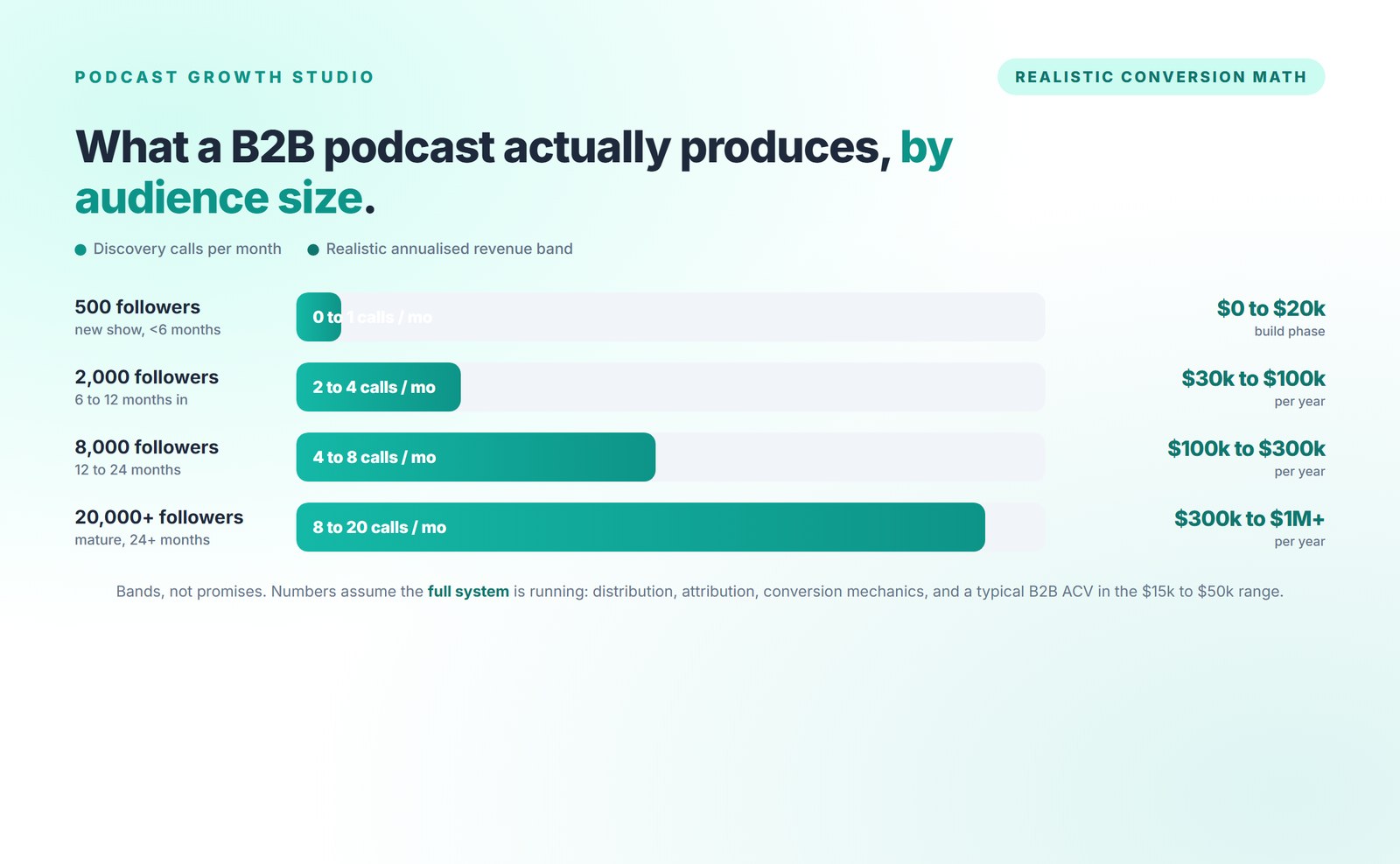
Numbers without context are noise. The bands below are what we see consistently across B2B podcasts in our cohort, segmented by audience size, assuming the full system from this guide is running. These are not promises. They are the band you can plan against.
500 followers / new show / under 6 months
Expect zero to one podcast-attributed discovery calls per month. The system has not had time to compound. Most leads in this phase come through other channels (referrals, network), and the podcast is building the trust layer that will matter in months six through twelve.
The trap at this stage: optimising for the wrong metric. Hosts measure calls and panic when calls are flat. The correct metric to track at this stage is consistency of distribution and quality of the standalone assets, not lead volume. If you are publishing clips and carousels consistently and they are not yet driving calls, you are doing the right thing for the right wrong reasons. Keep going.
2,000 followers / 6 to 12 months in
Two to four podcast-attributed discovery calls per month is realistic. The bookmarked-search pathway is starting to wake up. The first warm referrals are landing. The math at typical B2B ACVs ($15k to $40k) produces one to two new closed deals per quarter, which annualises to roughly $30k to $100k in new revenue directly attributable to the podcast.
This is also the stage where most hosts who quit, quit. The calls are happening, but the revenue feels small relative to the time investment. The data shows it almost always accelerates from here if the system stays consistent. The compounding kicks in at month nine to twelve, often suddenly.
8,000 followers / 12 to 24 months in
Four to eight podcast-attributed discovery calls per month. Two to five closed deals per quarter. At typical ACVs, $100k to $300k in annualised new revenue. The podcast is now a measurable, real channel. The back catalogue is producing residual leads from episodes published six months ago. Search-driven traffic to your blog is climbing if you have built the long-form-derivative content.
This is the stage where podcast strategy starts to influence broader business strategy. You start picking guests because their adjacent network is your target market. You start picking topics because they match what your buyers Google. The podcast stops being a marketing tactic and starts being a core revenue input.
20,000+ followers / mature / 24 months in
Eight to twenty podcast-attributed discovery calls per month. Five to fifteen closed deals per quarter. $300k to $1M+ in annualised new revenue, depending on ACV. At this stage the podcast is often the largest single source of new business for the firm, larger than referrals, larger than paid ads, larger than outbound.
The risk at this stage is over-scaling the podcast and under-scaling delivery. The leads will outrun your capacity to serve them well unless you have built parallel systems for onboarding and operations. Plenty of B2B firms have killed their podcast-driven inbound by drowning in delivery they could not staff for. Watch for the ratio of new client capacity to inbound rate, and either price up or build out as the inbound climbs.
What the bands assume
The bands above hold when the full system is running: a distribution layer producing 20+ pieces a month from each episode, a sequenced posting calendar, attribution properties in the CRM, a clear offer in the content, a working booking flow. Skip any of those and the bottom of the band becomes the ceiling. Skip more than one and the band collapses entirely.
They also assume a typical B2B services ACV in the $15k to $50k range. Higher ACVs (consulting engagements at $80k+, agency retainers, software at $50k+) produce fewer calls but higher revenue per call. Lower ACVs (coaching at $3k to $8k) produce more calls but require more of them to add up. Run the math for your actual ACV; the patterns hold, the magnitudes scale.
Case-shaped examples
The bands above are abstractions. Below are four representative examples of what the math looks like in practice across different B2B profiles. Numbers are calibrated projections based on what we see in this client profile, not single named engagements.
The CPA firm
A regional CPA firm, twelve staff, average engagement value $30k, managing partner records a podcast monthly. Starting profile: 18 months of episodes, 180 average downloads, no distribution beyond a Friday LinkedIn post, no CRM attribution, vague sense that "a few clients have mentioned the show".
System installed: buyer-facing content system per episode (one per month), sequenced 30-day calendar, three CRM properties added, intake field deployed, the partner spends 20 minutes per post window engaging with comments. Two existing back-catalogue episodes are retroactively repurposed as buyer-facing content systems because they were on tax-strategy topics that overlap with the firm's bread-and-butter offer.
90-day outcomes: LinkedIn impressions go from ~25,000 quarterly to ~350,000. Followers gained: ~1,800. Inbound DMs attributable to podcast content: 35. Discovery calls attributable to podcast content: 14. New engagements signed in the 90-day window: 3. Plus 2 retainer expansions from existing clients who said the content "reminded them" to ask about additional services. Annualised new revenue band from the 90-day period: roughly $180k to $250k. Production cost over the window: well inside the firm's existing marketing budget. ROI in the 8x to 12x range when the method runs cleanly.
The executive coach
An executive coach with $6k programs, 12-month engagements typical, podcast started two years ago. Starting profile: 8,000 LinkedIn followers, 1,200 average podcast downloads, posts the YouTube link plus occasional quote graphics, no real distribution layer, no attribution beyond gut feel.
System installed: buyer-facing content system per episode, focus on the carousel format (carousels work disproportionately well for coaching-adjacent audiences because the multi-slide breakdown signals depth), CRM properties added, profile completely rewritten to focus on the specific buyer pain. Guest selection refocused: instead of inviting "interesting leaders", the coach starts inviting potential corporate clients (HR leads, learning and development directors). Conversation is the discovery process.
90-day outcomes: LinkedIn engagement up 6x. Followers gained: ~2,400. Inbound DMs: 48. Discovery calls: 18, including 4 with guests from earlier episodes who came back as buyers. New engagements signed: 5, at $6k each, with two of those expanding into team-coaching contracts at $25k. Annualised new revenue: $130k to $180k. The compounding effect of the back catalogue is the biggest surprise; episodes from 6 to 12 months ago are still producing one call per month each.
The management consultant
A management consultant with $50k average engagement value, 9-month average sales cycle, podcast started 18 months ago. Starting profile: 2,000 LinkedIn followers, 380 average downloads, monthly cadence, posts the YouTube link and one short on a good week.
System installed: buyer-facing content system per episode, biased toward the written long-post format (long-form derivatives win the search-driven discovery for consulting buyers who research before they buy). CRM properties added with particular attention to Days to Call, because consulting cycles are long and the attribution data only matters if it spans the cycle. Profile and About page rewritten to clarify the specific niche (post-acquisition integration, not "strategy consulting").
90-day outcomes: LinkedIn impressions up 8x. Followers: +1,100. Inbound DMs: 22. Discovery calls: 9 (lower count, higher quality). One engagement signed in the 90-day window at $60k, with two additional engagements in active negotiation that closed in months 4 and 5 at $45k and $80k. Annualised new revenue from the 90-day cohort: ~$185k once trailing closes are counted. The lesson: high-ACV consulting has long attribution tails. The 90-day metric understates what is actually happening; the 180-day and 270-day metrics are what tell the real story.
The SaaS founder
A B2B SaaS founder, product priced at $2k per month, podcast started one year ago to position the founder as a category expert. Starting profile: 5,000 LinkedIn followers, 600 downloads, irregular distribution.
System installed: buyer-facing content system per episode plus a focus on the audiogram format and the trailer (SaaS buyers respond better to "watch the founder speak" than to typical clip culture). CRM properties added on the marketing automation side (HubSpot), with attribution wired into trial signups and demo bookings.
90-day outcomes: LinkedIn followers +3,200. Free trial signups attributed to podcast: 28. Trial-to-paid conversion was higher than baseline for this cohort (38% vs the company's typical 22%), because podcast-warmed trials arrive with more context. Paid customers added in the window: 11. At $2k per month and a typical 14-month average customer lifetime, that is roughly $300k in lifetime revenue from the 90-day window alone.
The SaaS case shows the highest velocity in this set, partly because product-led companies have shorter cycles than services and partly because the founder's existing audience was warm. Not every SaaS founder will see this rate. Most see something between the consulting and coaching profiles above, scaled to the product's ACV.
The failures that kill the system
Six failure modes account for almost every "podcast doesn't work for us" outcome we see. They are predictable, common, and fixable. They are worth knowing in advance because each one is the kind of thing you only see after you have already paid the cost.
Failure 1: Recording without an offer
The "I'll figure out the business model later" pattern. The podcast launches, episodes pile up, the host eventually realises they have an audience but no offer for that audience. Building the offer after the audience is already there is harder than building the offer first and recording into it. The host now has to retrofit a service onto an audience that did not arrive looking for one.
The fix is structural. Before episode one, write down what you sell, who you sell it to, and how. Every topic decision flows from there. Episodes that do not connect back are entertainment, which is fine, but they are not the show that generates clients.
Failure 2: Hiding the offer
The pattern: the host is uncomfortable mentioning the service inside the content. The CTA on every episode is some version of "follow me on LinkedIn". The website hides the offer two clicks deep, behind a "work with us" button that leads to a generic contact form. Buyers cannot find the door even when they are looking for it.
The fix is also structural. The offer goes in the show outro, in the show notes, in the website's primary navigation, and in the bio. Not "available upon request". A specific service, with a specific outcome, at a specific (or specified-on-call) price point.
Failure 3: No CTA in any content
The pattern: clips and posts are pure value, no ask. The audience consumes, appreciates, and moves on. There is no friction-ladder, no next step, no concrete invitation. The host hopes the value alone will convert. It rarely does.
The fix: every five posts can include one post with a soft CTA. Not every post needs a CTA; one in five is the safe ratio. The other four are pure value. The one-in-five CTA post can be as soft as "we wrote up the full framework here, link in comments" or "if you want this run for your show, the Content Engine page has the current scope." Soft works. The absence of any CTA is what fails.
Failure 4: Treating CTAs as salesy
The cousin of failure three. The host knows they should add CTAs, but every CTA they write feels uncomfortable, so they soften it to the point of vagueness. "If you ever want to chat, my DMs are open" is not a CTA. It is an apology with a phone number attached.
The fix is a vocabulary swap. "Salesy" is a function of how the offer is described, not whether the offer exists. "Here is exactly what we do for firms like yours, and here is the link" is not salesy. It is helpful. The audience can tell when they are being respected versus pitched, and they reward the former.
Failure 5: Quitting at week six
The most common failure in absolute volume. The host starts strong, posts daily for a week or two, sees minimal results, gradually drops to twice a week, then once a week, then stops. The system never had time to compound. The first attributable calls usually appear at week 8 to 12. The host who quits at week 6 is quitting at the exact wrong moment.
The fix is a commitment-mechanism, not a willpower-fix. Build a 90-day calendar before you publish episode one. Schedule the posts in Buffer or Taplio at the start of the month. Treat the calendar as a contract with yourself. If your willpower oscillates (which is normal), the scheduled calendar holds the line.
Failure 6: Random posting without a calendar
The host produces good assets but ships them in random order on random days. The audience does not know when to expect content. The algorithm does not learn the cadence. Engagement is volatile. The host concludes engagement is unpredictable and stops trying to predict it.
The fix is a posting calendar built around a deliberate weekly arc, not a random queue. The arc is documented in the Content Engine Method pillar; the short version is week one hooks, week two educates, week three proves, week four converts. The same arc repeated monthly gives the audience predictable rhythm and the algorithm a clear signal.
Tools: a short, honest stack
The tool list for a podcast-to-clients system is shorter than most podcast advice suggests. The temptation is to add tools until something works. The pattern that works is the opposite: pick the smallest stack that covers the system and run it for six months before adding anything.
- CRM: any that supports custom fields. HubSpot (the free tier is enough for most B2B podcasts), Pipedrive, Close, Copper. Pick the one you will actually log into. The three custom properties matter more than the platform.
- Analytics: Cloudflare Web Analytics for cookieless baseline traffic, plus Google Analytics 4 for deeper UTM and conversion tracking. Running both gives you a complete picture; running only one means missing the half of your audience that opts out of the other.
- Search Console: Google Search Console for the search-driven leg of the bookmarked-search pathway. Free, verified once, then checked monthly.
- Scheduling: Buffer for cross-platform scheduling, or Taplio for LinkedIn-heavy stacks (better LinkedIn analytics, native carousel scheduling).
- Booking: Calendly for discovery calls. Three questions on the form, no more.
- Recording and editing: Descript for the transcript-driven editing workflow. The transcript also feeds your written derivatives and your blog posts.
Total tool cost for a starting B2B podcast: $0 to $150 a month, depending on which paid tiers you choose. Most B2B podcasts overpay for tools and underinvest in time. Invert that.
DIY vs hand it off
The honest framework: not every host should outsource, and not every host should run the system themselves. The right answer depends on your billable rate, your existing distribution muscle, and how much of the work you actually enjoy.
Run it yourself if
- Your time is worth under $200 an hour, or you have 12 to 15 hours a week of genuine slack.
- You enjoy production work. This matters; the system requires consistency for 90 days before the math compounds, and if you resent the work you will quit at day 40.
- You are early in your podcast and the voice and brand are still being defined. Doing the work yourself for the first 90 days teaches you what your show actually is.
- You have one team member who is naturally good at short-form writing.
Hand it off if
- Your billable rate is over $300 an hour. The math stops supporting DIY almost immediately.
- You have tried distribution twice, fallen off the wagon, and the recordings keep stacking up unused.
- The podcast is a measured channel you are accountable for, not a personal project.
- You want the first content kit ready within 7 days, not months later.
The middle path
Some hosts choose the ideas themselves and hand off production and planning. They keep editorial control without owning every production task. If that split fits you, discuss it on a fit call.
If you want to see what one episode can yield without committing, we offer a free Repurposing Calculator that estimates what you are leaving unpublished and how much DIY production it would take to close the gap. The calculator is a useful checkpoint before you decide which path to take.
Frequently asked questions
Does podcasting actually work for B2B client acquisition?
Yes, but not in the way most people think. Podcasts are bad at discovery and excellent at trust. They generate clients when the recording is paired with three things: a distribution layer that puts standalone clips and posts in front of buyers outside the podcast app, an attribution layer that lets you see which content created which conversation, and a conversion mechanic that turns attention into a booked call. Without those three the podcast generates downloads, not clients.
How long before a podcast starts generating clients?
For a B2B podcast with consistent distribution and a clear offer, expect the first attributable discovery call within 60 to 90 days and the first closed deal within 90 to 180 days. Hosts who quit before month 4 almost always quit right before the system starts compounding. Realistic monthly call volume takes 6 to 12 months to stabilise.
Do I need video for my podcast to get clients?
No. Audio-only podcasts can still generate clients through audiograms (waveform video with captions), written posts derived from the transcript, carousels, quote graphics, and long-form blog posts. You lose access to vertical short-form video as a distribution format, which costs roughly 30% of potential reach, but the other formats do the heavy lifting. If you want maximum efficiency, record video. If video is a blocker that stops you from recording at all, audio-only with strong written distribution still works.
How many followers do I need before my podcast generates calls?
There is no minimum. There is a minimum quality of system. A 500-follower account with a tight system, a clear offer, and consistent distribution can produce one discovery call a month within 90 days. A 50,000-follower account with no system, no offer, and inconsistent posting produces nothing. Follower count is a multiplier on a working system, not a substitute for one.
What CRM properties do I need to attribute pipeline back to my podcast?
Three custom properties: Source Episode (which episode introduced the contact, even if approximately), First Touch Asset (clip, carousel, text post, quote graphic, or full episode), and Days to Call (time from first touch to first conversation). Six months of this data turns the podcast from a hobby with vibes into a measured channel. The properties work on HubSpot, Pipedrive, Close, Copper, and any other CRM that supports custom fields.
Should I gate my podcast content behind email signups?
No. The podcast and the derivative content (clips, carousels, posts) should be fully open, with no email gates. The gate slows everything down: distribution, sharing, search ranking, conversion. Capture emails on a separate offer (a free tool, a downloadable resource, a course) that lives alongside the podcast rather than being the entry to it. Open content gets shared and ranked; the gated bonus picks up the most-engaged readers.
Is podcasting better than ads, SEO, or email for B2B?
Different jobs. Ads are fast and expensive per lead. SEO is slow and compounds. Email is owned but only works if you already have a list. A podcast is unusual: it is slow like SEO, builds trust like in-person speaking, produces evergreen assets that feed all the other channels (your blog, your social, your newsletter), and creates a reason for ideal buyers to spend an hour inside your head. It is rarely the best ROI in the first 90 days. It is often the best ROI by month 18 when the back catalogue compounds. Most successful B2B founders run podcasting alongside one or two other channels, not as the only thing.
How do I know if my podcast topic is right for client acquisition?
Two tests. First, can you draw a clean line from any episode topic to a service you sell? If episode 12 is about pricing strategy and you sell pricing consulting, the line is clear. If episode 12 is about your hiking trip, the line is missing. Second, would your ideal buyer Google one of your episode topics if it became a real problem in their business? If yes, the topic earns search-driven discovery. If no, the topic only serves your existing audience. The right podcast for clients does both: every episode ties to your offer and at least half the episodes tie to a searchable problem.
Resources for further reading
The data and frameworks above lean on external research worth reading in full. Some of these are paywalled or require an email signup; all are legitimate primary sources.
- Edison Research, The Infinite Dial annual report. The definitive primary-source data on podcast listening behaviour in the US, updated yearly. Free download. edisonresearch.com
- LinkedIn B2B Institute. Research collaboration with the Ehrenberg-Bass Institute on what actually works in B2B marketing. Their "long-term vs short-term" effectiveness research is the conceptual foundation behind why podcasts work for trust over time. business.linkedin.com/marketing-solutions/b2b-institute
- HubSpot, State of Marketing report. Annual benchmarks across channels, including podcast adoption and B2B content effectiveness. hubspot.com/state-of-marketing
- Buzzsprout, podcast statistics. Industry-wide download benchmarks updated regularly. Useful for sanity-checking your own download numbers against your category. buzzsprout.com/stats
- Google Campaign URL Builder. The free tool for generating clean UTM parameters. ga-dev-tools.google/campaign-url-builder
- Marketing Charts, B2B benchmarks. Independent aggregator of B2B marketing performance data across sources, useful for putting your own podcast metrics in context. marketingcharts.com
From the PGS blog: the operational manual for the distribution layer in this guide is the Content Engine Method pillar. The complete reference on what one episode can become is the complete guide to podcast content repurposing. If your show is plateauing and you suspect the content is fine but the distribution is broken, the why your podcast is not growing piece is the diagnostic.
Closing: build the channel, not just the show
The single sentence version of this entire guide: most B2B podcasts that fail at client acquisition fail because they were never built as a channel, only as a show. The show is the trust layer. The channel is the show plus the distribution that makes it visible, plus the attribution that makes it measurable, plus the conversion mechanics that make it produce calls. All four together.
None of the four are exotic. None of them require more than a few hundred dollars a month in tools. What they require is the discipline to build all four at once, not three of four, and then to run them consistently for 90 days before judging. The hosts who do that produce the conversion numbers in section seven. The hosts who do not, do not, regardless of how good the recordings are.
If you want to see what a working distribution layer looks like before committing to building one yourself, we can build it for you: we turn one episode into a month of finished content, the whole Content Engine. It is the cleanest way to see whether the gap in your show is really the content, or really everything that happens after you hit publish.
Most of the time, the show is already good enough. It just was never finished as a channel.