
Most advice about growing a podcast is a pile of tactics with no order. Post clips. Get guests. Ask for reviews. Run ads. All of it can work, and none of it works reliably, because tactics without a system are just guessing with extra steps.
This guide is the system. It is built around one idea: a podcast does not grow because you did more things. It grows because a few specific loops start to compound, and your job is to find the loop that is broken at your size and fix that one. A show with 30 downloads an episode and a show with 3,000 have completely different problems, and the worst thing either can do is follow the same generic checklist.
So we will do this in order. What growth actually means and the one number that lies to you. The flywheel that makes growth compound. The real benchmarks so you know where you honestly stand. Then a stage-by-stage playbook, because the move that takes you from 0 to 100 is not the move that takes you from 1,000 to 10,000. Then retention, plateaus, cadence, and a 90-day plan you can start on Monday.
For context: I run Podcast Growth Studio. I spent 7 years in live radio, hosted a 200-episode show, and our team has produced content that generated more than 350 million views for clients. Growth is the work we do every week. This is the model I would hand a friend who asked me where to start.
One note before we begin. This guide is about the growth system. For the channel-by-channel detail of where and how to publish, the companion piece is how to promote a podcast in 2026. Read this one to understand what to work on. Read that one for the exact tactics on each platform.
What this guide covers
- What "growth" actually means, and the one number that lies to you
- The podcast growth flywheel: why growth compounds or stalls
- The real benchmarks: how many downloads is actually good
- Stage 1: from 0 to 100 downloads (build the foundation)
- Stage 2: from 100 to 1,000 (build the machine)
- Stage 3: from 1,000 to 10,000 (build the engine)
- Retention: the growth lever almost nobody works on
- The four growth plateaus and how to break each one
- The sustainable cadence that keeps you in the game
- Your 90-day podcast growth plan
- Frequently asked questions
- Resources for further reading
What "growth" actually means, and the one number that lies to you
Ask ten podcasters how their show is doing and nine will quote you a single number: total downloads. It is the worst number to grow by, because it only ever goes up. Publish a hundred episodes and your all-time total climbs whether your show is getting healthier or quietly dying. A number that cannot fall cannot tell you the truth.
Real growth is the trend in three things, in this order.
Reach. How many new people meet your show this month who did not know it last month. This is the top of everything. If reach is flat, nothing downstream can grow for long.
New listeners. How many of those people actually press play on a full episode. Reach without conversion is just impressions.
Recurring listeners. How many of those new listeners come back for the next episode. This is the number that compounds, and it is the one almost nobody tracks.
Notice what this does. It turns "grow my podcast" from a vague wish into a diagnosis. If your downloads per episode are flat, the cause is in one of those three layers, and you can find out which. That single reframe is worth more than any tactic in this guide, because it tells you which tactic you even need.
From here on, when this guide says growth, it means downloads per episode trending up over a quarter, driven by reach and retention you can see. Not your all-time total. Throw that number in a drawer.
The podcast growth flywheel: why growth compounds or stalls
Podcasts that grow are not working harder than podcasts that stall. They have a loop where each turn makes the next turn easier, and shows that stall have a loop that leaks at one point and never closes.
The loop has five steps, and it looks like this.
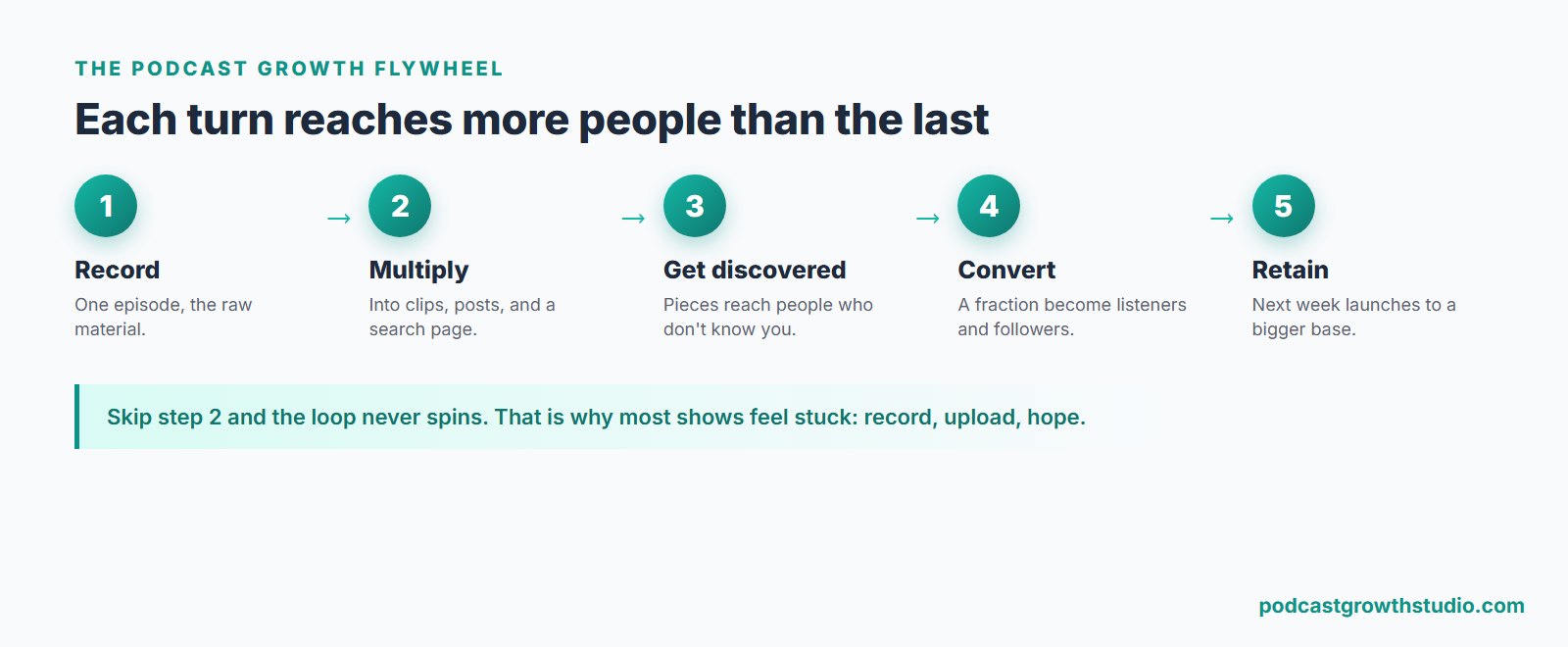
One: you record an episode. The raw material. Good substance matters, but it is the start of the loop, not the whole thing.
Two: you multiply it into many pieces. Clips, a written post, a quote graphic, an episode page with the transcript. One recording becomes ten front doors instead of one. This is the step most shows skip, and skipping it is why their loop never spins.
Three: those pieces get you discovered. A clip reaches someone who has never heard of you. A search result answers a question. The pieces do the finding, so you are not relying on people to stumble onto a 45-minute file from a stranger.
Four: a fraction of those people convert into listeners of the full show, and into followers who will see the next one.
Five: you retain them, so next week's episode launches to a bigger base than last week's. Then the loop repeats, and because your base is larger and your back catalog of clips keeps working, each turn reaches more people than the last.
That is compounding. The reason most shows feel stuck is that their loop is really just step one and a publish button. Record, upload, hope. There is no multiply step, so there is no discovery, so there is no new reach, so the only listeners are the ones who already found you. The flywheel never turns, and effort feels like pushing a boulder instead of spinning a wheel.
Everything in the stage playbook below is about getting your specific flywheel to spin, then removing whatever is slowing it. The operational version of the multiply step is laid out in our guide to podcast content repurposing and the Content Engine Method, which is the exact workflow we run for clients.
The real benchmarks: how many downloads is actually good
You cannot tell if you are growing if you do not know what normal looks like, and the internet gives you a wildly distorted picture. The shows you see talked about are the top fraction of one percent. Measuring yourself against them is like a local runner comparing their time to the Olympics. Here is what the actual distribution looks like.
The most widely cited benchmark comes from Buzzsprout, which hosts hundreds of thousands of shows and measures downloads in the first 7 days after an episode goes live. As of their current global stats, the tiers run roughly like this:
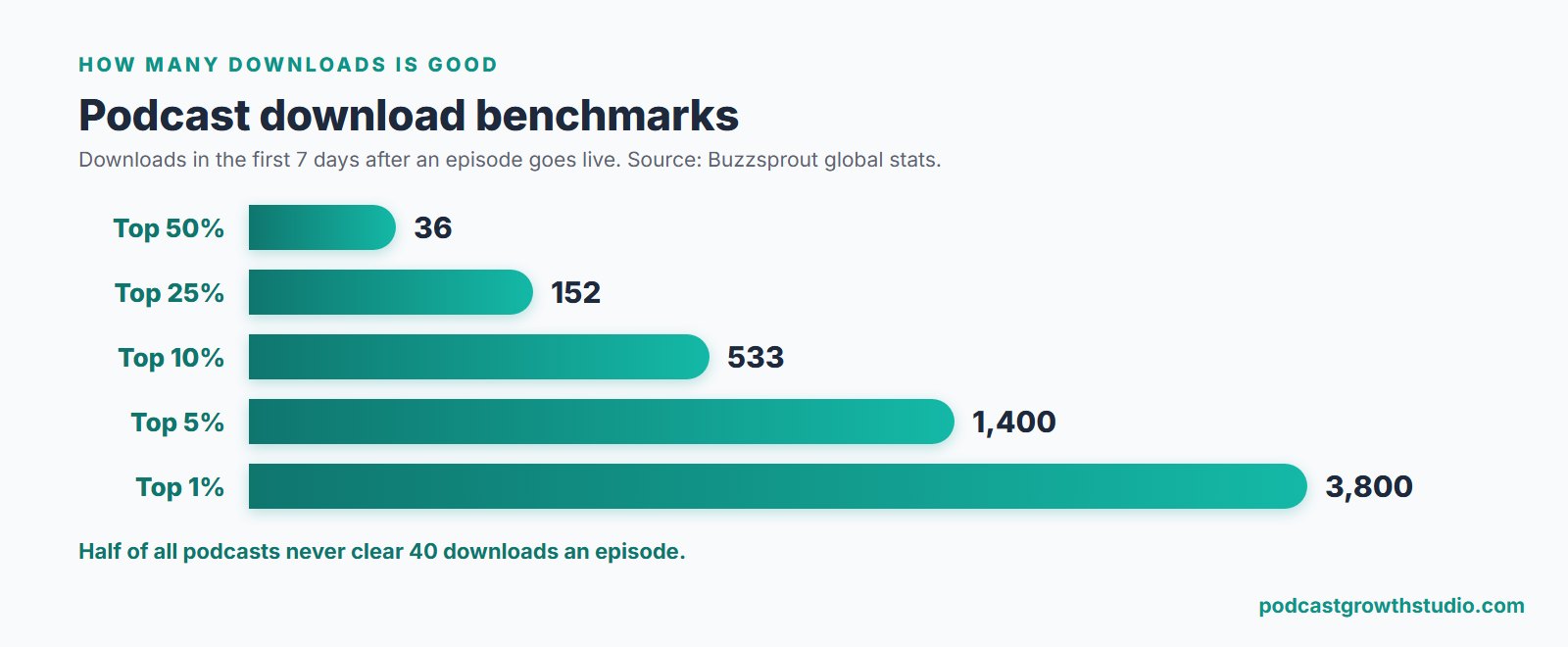
- About 36 downloads in the first week puts you in the top 50% of all podcasts.
- About 152 downloads puts you in the top 25%.
- About 533 downloads puts you in the top 10%.
- About 1,400 downloads puts you in the top 5%.
- About 3,800 downloads puts you in the top 1%.
Read those again, because they change how you should feel about your numbers. Half of all podcasts do not get 40 downloads an episode. If you are pulling a few hundred, you are already ahead of three quarters of everyone publishing. The bar for being a genuinely successful niche show, especially a B2B show where 500 of the right listeners is a real pipeline, is far lower than the noise online suggests.
This matters for your sanity and your strategy. For sanity, it stops you quitting at episode twelve because you are not pulling celebrity numbers. For strategy, it tells you that the goal is rarely "go viral." It is "climb one tier." Going from 40 to 152 downloads an episode roughly moves you from the top half to the top quarter of all podcasts, and that is an achievable quarter of focused work, not a miracle.
A caveat worth stating plainly: these are global numbers across every genre. Comedy and true crime live at very different scales than a niche B2B interview show. So use the benchmark to locate yourself, then ignore it and race only against your own last quarter. The trend in your own numbers is the only scoreboard that can actually coach you.
Stage 1: from 0 to 100 downloads (build the foundation)
At this stage you have almost no audience and almost no data, and that is fine. The goal here is not growth, it is foundations and reps. The single most common reason shows never escape this stage is that they quit, so your real job is to still be publishing in three months.
The one lever that matters: publish consistently and make the show legible. Strangers cannot evaluate a show with three episodes and a vague title. So nail the basics that promotion will later amplify. A title and description a stranger understands in three seconds. Cover art that reads at thumbnail size. An open that tells people who the show is for in the first 20 seconds. If you have not locked your name yet, our free podcast name generator and episode title generator are quick ways to pressure-test options.
Where your first listeners come from. Not algorithms, not search. People you can reach directly. Your email contacts, your existing social following however small, and a personal ask to twenty people who would genuinely find it useful. This feels unscalable because it is, and that is correct for the stage. You are not building reach yet, you are building proof and rhythm.
Start the multiply habit now, badly. Cut one clip per episode, even a rough one. The point is not reach yet, it is building the muscle and the workflow so that when the show is worth promoting hard, the system already exists. A show that learns to repurpose at episode 5 is years ahead of one that tries to start at episode 50.
What to ignore. Ads, elaborate funnels, sponsorships, fretting over which host platform is marginally better. None of it matters at 40 downloads. If you want to start a business-focused show on the right footing, the foundations specific to that are in how to start a B2B podcast that generates leads.
Stage 2: from 100 to 1,000 (build the machine)
You have proof now. People listen, you have a back catalog, and you have a feel for which episodes land. This is the stage where most shows either build a real distribution machine or plateau forever at a few hundred downloads. The difference is whether you systematize the multiply step.
The one lever that matters: turn one episode into many pieces, reliably, every week. This is the repurposing engine, and at this stage it stops being optional. Every recording should produce a predictable set of assets: several short-form video clips, a written post or two, a quote graphic, and an episode page with the transcript for search. Not occasionally. Every single time, like a production line.
The reason this is the lever at this stage is simple. At 100 to 1,000 downloads, your bottleneck is reach, and clips are the only thing that buys reach without a budget. A good 40-second clip on YouTube, LinkedIn, Instagram, or TikTok can reach more strangers in a day than your full episode will all month, because those platforms actively show your clip to people who do not follow you. Listening apps never do that.
Make it a system, not a mood. The shows that win here treat content production like payroll: it happens on a schedule whether or not anyone feels inspired. Pick the number of clips you can produce every week without fail and protect it. If producing them yourself is the thing that keeps not happening, this is exactly the bottleneck we built the studio to remove, and you can see the workflow in the repurpose one episode into 30 days of LinkedIn content guide.
Begin borrowing audiences. Guesting on other shows in your niche and swapping promos with peers at a similar size is the highest-leverage reach you can get at this stage, because you are tapping audiences that are already warm to your exact topic. One good guest spot can outperform months of cold posting.
Stage 3: from 1,000 to 10,000 (build the engine)
At a thousand-plus downloads an episode you are in the top 10% and the rules change again. Brute-force posting got you here, but it will not get you to ten thousand. Now growth comes from optimization and compounding surfaces, not just from doing more.
The one lever that matters: double down on what already works and go video-first on discovery. You now have enough data to see your patterns. Which clips drove the most new listeners. Which topics pulled the most search traffic. Which guests brought their audience with them. At this stage growth is about feeding the winners, not spreading effort evenly across everything.
The biggest single discovery surface to commit to is YouTube. By 2025 it had become the platform US listeners use most for podcasts and the number one place people discover new shows, with research from Cumulus Media and Signal Hill Insights finding 44% of new-show discovery happened there, roughly twice Spotify and five times Apple. At this stage, treating YouTube as a core home rather than an afterthought is often what unlocks the next zero. The platform-by-platform detail is in the promotion guide.
Build owned compounding assets. Search-optimized episode pages, an email list you actually mail, and a back catalog organized so new listeners binge it. These are the assets that keep working while you sleep, and at scale they quietly become a large share of your downloads.
If the show is for business, shift the goal. At this size a B2B show should be measured in pipeline, not downloads. The mechanics of turning a healthy audience into booked calls are in how to get clients from your podcast. Ten thousand of the wrong downloads is worth less than five hundred of the right ones.
Retention: the growth lever almost nobody works on
Here is the leak that quietly caps most shows. Everyone obsesses over getting new listeners and almost nobody works on keeping the ones they get. But growth is reach times retention, and if retention is poor you are pouring water into a bucket with a hole in it. You can pour faster forever and the level never rises.
Retention shows up in two places, and both are fixable.
Within an episode. Your hosting analytics show how far the average listener gets before dropping off. The most brutal drop is almost always in the first minute. If you open with a long musical intro, throwing-to-break chatter, or three minutes of housekeeping before anything of value, you are training new listeners to leave. Fix the open: start with the single most interesting thing in the episode, then introduce yourself. A strong first 30 seconds does more for growth than another posting channel.
Across episodes. This is whether last week's new listener comes back this week. It is driven by consistency (they know when you publish), by a reason to return (a format or a recurring promise they value), and by simply asking, a clear "follow the show so the next one finds you" beats silence. New versus returning listener ratio in your analytics is the number to watch here.
Why this is the lever nobody works on: it is invisible. A bad clip is obvious. A retention leak hides inside your analytics and never shows up as a thing that went wrong, only as growth that mysteriously will not happen. Open your hosting dashboard, find your average drop-off point, and treat fixing it as seriously as you treat getting new reach. It is often the single fastest win available, because you have already done the hard work of getting the listener and are losing them for free.
The four growth plateaus and how to break each one
Almost every stuck show is stuck for one of four reasons. The mistake is responding to a plateau by doing more of everything. The fix is to diagnose which plateau you are on, because each has a different cause and a different lever. Use the three-layer model from the start of this guide: reach, new listeners, recurring listeners.
Plateau 1: reach is flat. You are reaching the same number of new people every month. Your distribution stopped expanding. The fix is a new discovery surface or a new borrowing habit: add a platform you are not on, start a weekly guesting push, or commit to clips if you were not making them. More episodes on the same dead channels will not move this.
Plateau 2: reach grows but downloads do not. Your clips and posts get views, but those views are not turning into listeners. This is a conversion problem. The clips are entertaining but give no reason to hear the full thing, or the call to action is missing. The fix is tighter clip selection (moments that open a loop the episode closes) and an explicit, simple next step on every piece.
Plateau 3: downloads grow but recurring listeners do not. New people try the show and do not come back. This is the retention leak from the last chapter. The fix is your open and your consistency, not more promotion. Promoting harder into a leaky show just wastes the reach.
Plateau 4: everything is flat and you are exhausted. This is the burnout plateau, and it is the most common of all. You scaled effort past what you can sustain, and quality and consistency both slipped. The fix is counterintuitive: do less, but reliably. Cut to a cadence you can hold, systematize or hand off the production, and protect consistency above everything. A diagnostic deep-dive on stalled growth is in why your podcast isn't growing (and it's not the content).
The sustainable cadence that keeps you in the game
Growth is a game you lose by quitting, and most people quit for a boring reason: they set a pace they could not hold. So the cadence question is not "what is optimal," it is "what can I still be doing in 12 months."
For the large majority of shows, the answer is weekly. It is frequent enough to build a listening habit and to keep feeding the platforms a steady supply, and slow enough that a normal person with a job can sustain it. Daily and several-times-a-week schedules look impressive and quietly kill more shows than they grow, because the quality drops and the host burns out. A reliable weekly show beats an erratic daily one every time.
Two rules make a cadence survivable. First, batch. Record several episodes in one sitting so a bad week does not break your streak. Second, separate the jobs. The creative work of recording and the production work of editing and repurposing are different muscles, and trying to do all of it yourself every week is the fast road to plateau 4. As soon as you can, systematize the production side or hand it off, so your only non-negotiable is showing up to record.
Pick the cadence you can defend against a bad month, then treat it as the one promise you do not break. Everything in this guide compounds only if the wheel keeps turning.
Your 90-day podcast growth plan
Here is how to turn all of this into action. Ninety days, organized so you fix the right layer first instead of scattering effort. Adjust to your stage, but do them in this order.
Days 1 to 7: diagnose. Find your real numbers. Downloads per episode over the last quarter (the trend, not the total), your average in-episode drop-off point, and your new versus returning ratio. Locate yourself on the benchmark tiers. Decide which of the four plateaus you are actually on. Do not change anything yet. You cannot fix what you have not measured.
Days 8 to 30: fix retention first. It is the cheapest win and it protects every bit of reach you add later. Rewrite your open so the first 30 seconds lead with value. Lock a publishing day and tell your audience what it is. Add a clear "follow the show" ask to every episode. You are sealing the bucket before you pour faster.
Days 31 to 60: build the multiply engine. Stand up the repurposing system. Commit to a fixed number of clips per episode and an episode page with a transcript, produced every week without exception. This is the step that turns one recording into many front doors, and it is the lever for most shows. If producing it yourself is the bottleneck, decide now whether to systematize or hand it off.
Days 61 to 90: expand reach on purpose. Now that the show retains listeners and produces assets, widen the top of the funnel. Commit hard to one discovery surface (YouTube for most), start a weekly guesting or cross-promotion habit, and double down on whichever clips and topics your data already shows are working. For the exact platform tactics, work alongside the promotion guide.
At day 90, measure the same numbers you took on day 1. If the trend is up, you have found your working loop, and the next 90 days are about spinning it faster. If a number is still flat, it tells you exactly which layer to work next. That is the whole point of a system: it does not just tell you what to do, it tells you what to do next.
Frequently asked questions
How many downloads is a good number for a podcast in 2026?
Use Buzzsprout's widely cited benchmark, measured as downloads within 7 days of an episode going live. Around 36 downloads puts you in the top half of all podcasts. About 152 puts you in the top 25%. Roughly 533 reaches the top 10%, and about 3,800 reaches the top 1%. The headline most people miss is how low those bars are. Half of all shows do not clear 40 downloads an episode, so if you are getting a few hundred you are already ahead of most. Judge yourself against where you were last quarter, not against the handful of celebrity shows you see online.
How long does it take to grow a podcast?
Think in episodes published and quarters elapsed, not weeks. Most shows need roughly 20 to 30 published episodes and five to six months of consistent distribution before a stable base of recurring listeners forms and growth starts to compound off the back catalog. The shows that fail almost always quit inside the first 90 days, right before the curve bends. Commit to a fixed number of episodes before you judge results, not a calendar date.
Why isn't my podcast growing even though the episodes are good?
In almost every case the problem is not the content, it is distribution and retention. A great episode that only lives in Apple and Spotify has no way to reach anyone who does not already follow you, because those apps are libraries, not discovery engines. And if new listeners drop off in the first minute, no amount of promotion will stick. Fix the front end (clips and search that bring strangers in) and the retention end (a strong open that keeps them) before you blame the substance.
How often should I publish to grow my podcast?
Weekly is the sweet spot for most shows, because it is frequent enough to build a habit in listeners and feed the algorithms a steady supply, but sustainable enough that you will not burn out. Consistency matters more than frequency. A show that reliably publishes once a week for a year beats one that posts three times a week for a month and then disappears. Pick the cadence you can hold for 12 months and protect it.
What is the single biggest lever for podcast growth?
Turning every episode into short-form video clips and publishing them where people discover new shows, led by YouTube. Listening apps do not surface you to strangers, but a strong 40-second clip on YouTube, LinkedIn, Instagram, or TikTok can reach thousands of people who have never heard of you, and send a fraction of them to the full episode. The clip is the front door. If you only change one thing, build a reliable system for producing and publishing clips from every recording.
How do I break through a podcast growth plateau?
First diagnose which plateau you are on. If reach is flat, your distribution stopped expanding, so add a new discovery surface or a guesting and cross-promotion habit. If reach grows but downloads do not, your clips are not converting viewers into listeners, so tighten the call to action and the episode hook. If downloads grow but recurring listeners do not, retention is leaking, so fix your open and your consistency. Each plateau has a different cause, and the fix is to work the specific stage you are stuck in rather than doing more of everything.
Resources for further reading
The benchmarks and audience data in this guide come from legitimate primary sources worth reading in full.
- Buzzsprout Global Stats. The live, widely cited benchmark for podcast downloads by percentile, measured in the first 7 days. The source for the tier figures above. buzzsprout.com/global_stats
- Edison Research, The Infinite Dial 2025. The definitive primary-source data on US podcast listening and reach. edisonresearch.com
- Cumulus Media and Signal Hill Insights, Podcast Download, Spring 2025. The source for YouTube leading podcast discovery. signalhillinsights.com
- Listen Notes data, via Barrett Media. The count of active podcasts at a new all-time high in 2025, the context for how much competition you are growing against. barrettmedia.com
From the PGS blog: for the channel-by-channel tactics, read how to promote a podcast in 2026. For the operational multiply step, see the complete repurposing guide and the Content Engine Method. To diagnose a stall, read why your podcast isn't growing. And for the real numbers behind the industry, see our 2026 podcast statistics.
Closing: work the loop you are actually on
Growing a podcast is not about effort, and it is not about luck. Half of all shows never clear 40 downloads an episode, and the ones that pull ahead are rarely the ones working hardest. They are the ones working the right layer: sealing retention before adding reach, building a multiply engine instead of just publishing, and fixing the one plateau they are actually on instead of doing more of everything.
You do not need a bigger audience to start. You need the loop to spin, the leak sealed, and a cadence you can hold past the point where most people quit. That is where it compounds.
If you want to see what the multiply engine looks like before you build it yourself, we can do it for you. We turn one episode into a month of finished, ready-to-post content. You can see how it works, and the founding price, on the Content Engine page.