
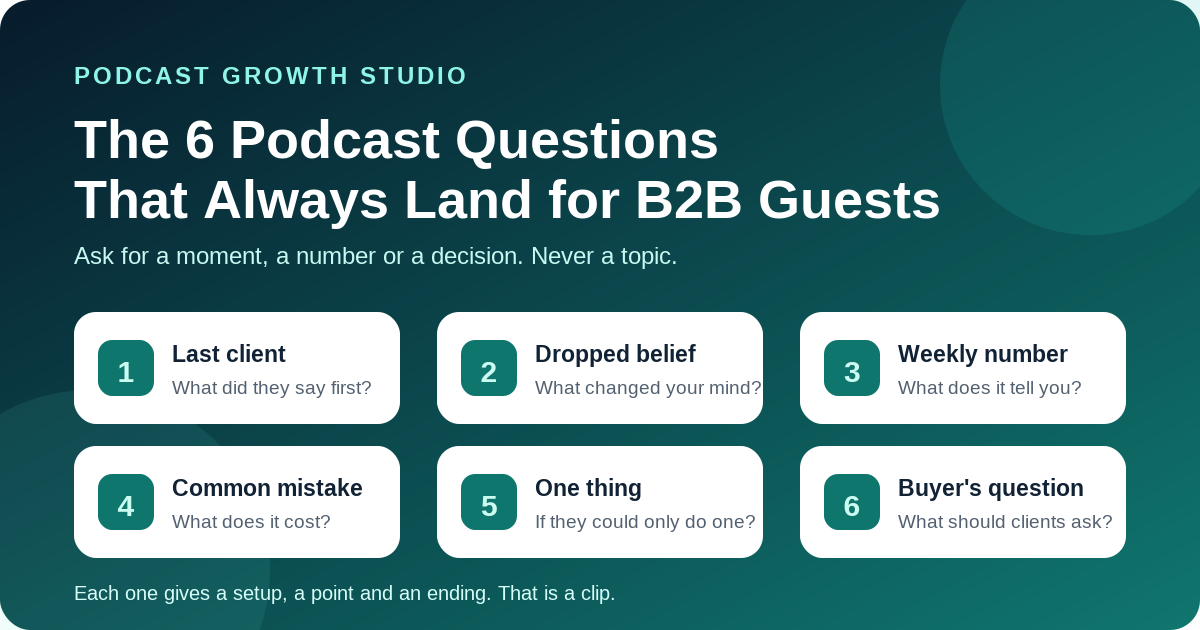
The podcast interview questions that land for B2B guests ask for one specific moment, number or decision, not an opinion about a topic. Six that work almost every time: the last time a client brought them the problem, the belief they dropped, the number they watch weekly, the mistake they see most, what they would do under a fixed constraint, and the question they wish clients asked. Each one produces an answer with a setup, a point and an ending, which is exactly what a clip needs.
You know the feeling. The guest is a sharp consultant with twenty years of client stories, you open with "tell us about your journey," and eight minutes later you have a career summary nobody will clip, quote or remember. The guest was good. The question was not.
Editorial note: the research in this post comes from Pew Research Center, LinkedIn's marketing blog and NPR's training materials, all checked on November 25, 2026. The six questions and the interview routine are the ones we use at Podcast Growth Studio when we cut clips from B2B interviews. They are working rules, not a study.
Why do most B2B podcast questions produce filler instead of clips?
Because they ask for a topic instead of a moment. "What are your thoughts on cash flow planning?" invites a lecture. "What did the last client who ran out of cash say in your first meeting?" invites a story with a point.
Listeners come for the specific. Pew Research Center's survey of 5,132 US adults (fielded December 5-11, 2022, published April 18, 2023) found that half or more of people who had listened to a podcast in the past year named entertainment, learning and having something on in the background as major reasons for listening (Pew Research Center, checked November 25, 2026). Among listeners 65 and older, learning was the most common major reason, at 61%. A career summary teaches nothing. A worked example does.
Buyers listen the same way. LinkedIn's marketing blog, citing the 2024 Edelman-LinkedIn B2B report on expert content, says 73% of B2B decision-makers find an organization's expert content a more trustworthy way to assess its capabilities than marketing materials (LinkedIn Marketing Blog, March 20, 2025, checked November 25, 2026). That trust comes from watching someone reason through a real situation. Your questions decide whether that happens on tape.
Radio interviewers learned this long ago. NPR's training guide for producers tells hosts to make sure questions are open-ended and cannot be answered with a yes or a no, to mix fact questions with feeling questions, and to use prompts like "What happened when …?" (NPR Training, checked November 25, 2026).
Which six podcast interview questions always land for B2B guests?
These six. Swap the bracketed part for the guest's field and ask them in roughly this order, because each one builds on the energy of the last.
| # | The question | What it pulls out | Follow-up that gets the clip |
|---|---|---|---|
| 1 | "Walk me through the last time a client came to you with [problem]. What did they say first?" | A real scene with a person in it, not a definition | "What did you say back?" |
| 2 | "What did you believe about [topic] three years ago that you no longer believe?" | A change of mind, which signals experience | "What changed it?" |
| 3 | "What is the one number you look at every week, and what does it tell you?" | A specific metric and the reasoning behind it | "What does a bad week look like on that number?" |
| 4 | "What is the mistake you see most often in [situation], and what does it cost?" | A pattern the guest has seen many times, with a price on it | "When did you last see it?" |
| 5 | "If a client could only do one thing this quarter with [constraint], what would you have them do?" | A decision under pressure, which forces a ranking | "Why that one and not [the obvious alternative]?" |
| 6 | "What question do you wish clients asked before they hired you?" | The guest's real buying criteria, in buyer language | "What happens when they do not ask it?" |
Notice what the six have in common. Each contains a limit: the last time, three years ago, one number, most often, only one thing, one question. The limit is what stops the guest from summarising and makes them choose.
How do you ask the questions so the answer is clip-ready?
Ask one question, stop talking, and follow up on the first specific thing the guest says. The question gets you into the territory. The follow-up and the silence get you the clip.
Here is the routine we would use:
- Send the topics and two of the six questions in advance, not all six. The guest arrives with an example in mind and still answers live. A guest with the full list writes answers and reads them.
- Ask one question at a time. A stacked question ("How did you start, and what changed, and where is it going?") lets the guest answer the easiest part and skip the rest.
- Wait. NPR host Rachel Martin's advice is to not be afraid of silence, because sometimes the best follow-up is to say nothing, especially after the person has just revealed something important (NPR Extra, November 20, 2013, checked November 25, 2026). The second half of the answer is usually the better half.
- Ask for the number. "Roughly how much did that cost them?" turns a vague story into a line people repeat.
- Ask for the short version. "If you had to say that in one sentence to a new client, what would you say?" That sentence becomes the clip's ending and often the post's first line.
- Mark the time. When an answer lands, note the timestamp while recording. It tells whoever cuts the clips where to look first.
What does a landed answer sound like?
A landed answer has a person, a number and a line you could quote. Here is an illustrative example, with a made-up guest, to show the difference between a question that produces filler and one that produces a clip.
The guest is a fractional CFO for design firms. The host's first attempt is "What do you think about cash flow forecasting?" The answer runs four minutes and covers why forecasting matters, the tools available and the importance of discipline. True, general and unusable.
The host then asks question 1: "Walk me through the last time a firm owner came to you about cash. What did they say first?" The answer: "She said, 'We just had our best quarter and I cannot make payroll on Friday.' Revenue was up 40% and she had funded all of it with her own cash, because every new client paid on 60-day terms." The host waits. The guest adds: "Growth was the problem. We changed the terms on new work to 50% up front and the gap closed in two months."
Then the follow-up: "If you had to say that in one sentence?" The guest: "Fast growth on slow terms is how profitable firms go broke."
That is a 45-second clip with a hook (best quarter, cannot make payroll), a reason (60-day terms) and an ending (one sentence a buyer will repeat). It is also a carousel, a quote graphic and a text post. One question, four pieces of content.
Which interview mistakes kill good answers?
The most expensive mistake is the journey question, because it spends the guest's freshest ten minutes on background. These are the others we see most when cutting episodes:
- Answering your own question. "I imagine most of your clients struggle with pricing, is that right?" The guest says yes and you have nothing. Ask the open version and let them fill it.
- Stacking. Three questions in one breath gets one weak answer. One at a time.
- Moving on too fast. The guest gives a general answer and you go to the next card. The specific was one follow-up away.
- Saving the best question for the end. Energy drops in the last ten minutes. Put question 1 inside the first five.
- Reading the questions. A read question gets a read answer. Know the six well enough to ask them in your own words.
- Skipping question 6. "What question do you wish clients asked?" is the one that turns a listener into an enquiry, because it tells them how to buy. Hosts skip it because it feels salesy. It is not. It is useful.
Frequently asked questions
How many questions should I prepare for a B2B podcast interview?
Prepare 6-8 and expect to use 3-4. A 30-45 minute interview with good follow-ups rarely gets past four planned questions, and the follow-ups are where the best answers come from. The rest are a safety net for a guest who gives short answers.
Should I send podcast questions to guests in advance?
Send the topics and two or three of the questions, not the full list. Guests who see every question tend to write answers and read them, which sounds flat. Guests who know the topics and the first specific question arrive with a real example in mind and still answer live.
How long should a podcast answer be to work as a clip?
The usable part of an answer is usually 30-90 seconds: the setup, the point and the line that lands it. Long answers are fine in the episode, but ask for the one-sentence version at the end so the clip has a clean ending.
What questions should I avoid asking a podcast guest?
Avoid questions that ask for a topic instead of a moment: tell us about your journey, what are your thoughts on AI, what advice would you give. Also avoid stacked questions, questions a yes or no can answer, and questions you answer yourself before the guest speaks.
Ask for the moment, not the topic
Put the six questions on one card, lead with question 1 inside the first five minutes, and follow up on the first specific thing you hear. For choosing which answers become clips, see the 3-test rule for choosing podcast clips, and for what happens after the clips go out, see how to get clients from your podcast. If you want the clips, carousels and posting plan made from each episode for you, see The Content Engine.
Podcast Growth Studio (PGS) is a studio that turns one B2B podcast episode into a month of LinkedIn content: captioned clips, carousels, quote graphics and a posting plan, for coaches, consultants, CPAs, advisors and founders who podcast.