
Most podcasts do not fail in the editing. They fail in the planning, or the lack of it. The average show is abandoned within its first ten episodes, and almost always for reasons that were decided long before the microphone was ever switched on: no clear audience, no real angle, a format the host could not sustain, and no honest look at the time it would take.
The fix is boring and it works. Answer the right questions before you record, not after. A podcast is one of the best authority and pipeline tools a coach, consultant, or founder can build, but only if it is planned like one.
So this is the planning guide I wish more people used. Fifty questions, grouped into the twelve areas that actually decide whether a show survives. You do not need a perfect answer to all fifty. You need to have honestly faced them, because the ones you skip are the ones that come back as the reason you quit.
I run Podcast Growth Studio. I spent 7 years in live radio, hosted a 200-episode show, and our team has turned client episodes into more than 350 million views. These are the questions I walk every new host through. Work through them with a notebook open, and by the end you will know whether to hit record, and exactly what to record.
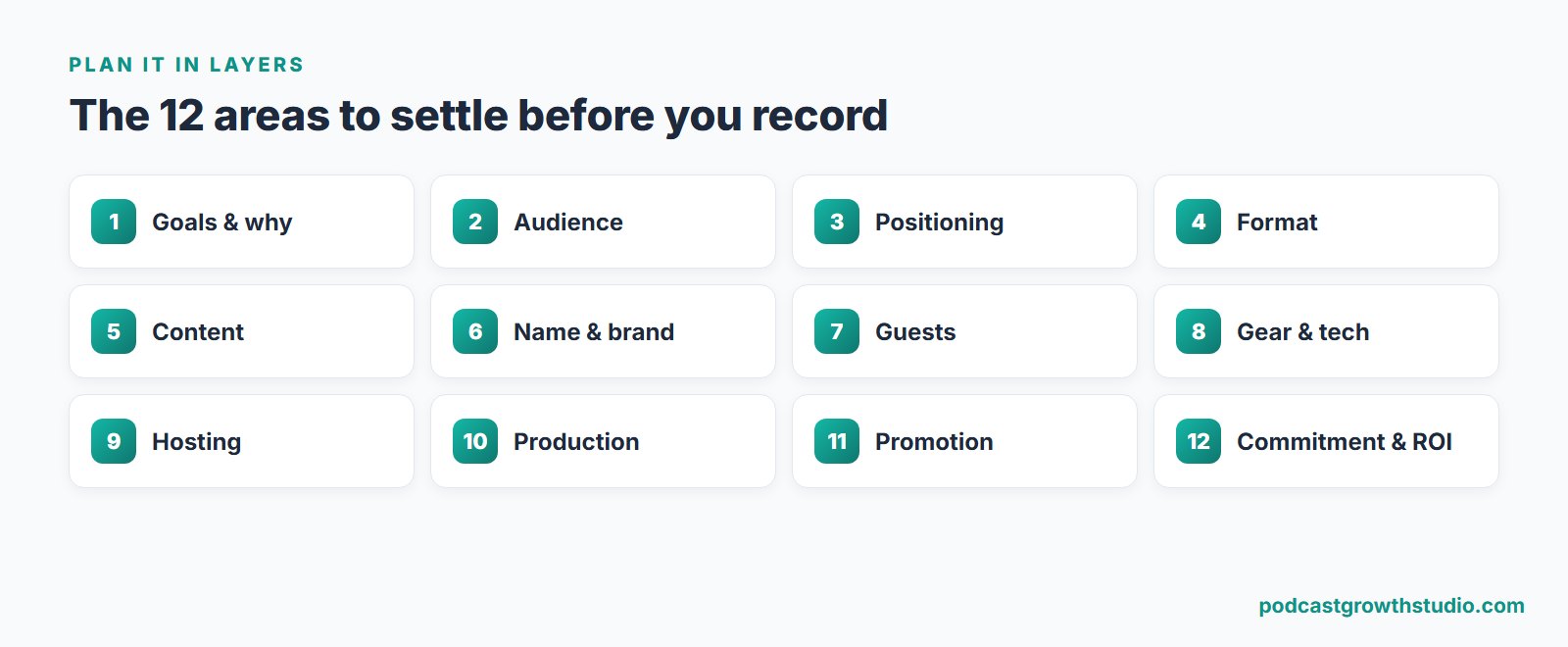
The 12 areas this guide covers
- Start with why: goals
- Your audience
- Positioning and angle
- Format and structure
- Content and topics
- Name and brand
- Guests
- Gear and tech
- Hosting and distribution
- Production and workflow
- Promotion and growth
- Commitment, money, and ROI
Start with why: goals
If you get this section wrong, no amount of production polish saves the show. Be honest here, especially about the difference between wanting to have a podcast and wanting to do the work of one.
1. Why do you want to start a podcast, and why a podcast specifically rather than a newsletter or a YouTube channel? If the honest answer is "because everyone has one," stop and find the real reason. A podcast is a big time commitment, so the why has to be strong enough to carry you past episode ten.
2. What does success look like in 12 months? Downloads, booked calls, authority, relationships with guests, or all of it. Name the number or the outcome now, because you cannot steer toward a goal you have not defined.
3. If the show never went viral but reached 300 of exactly the right people, would it still be worth it? For most business podcasts the answer is yes, and that reframe takes the pressure off chasing vanity numbers. If the answer is no, your goal may be fame, not results, and that changes everything.
4. Is this a marketing channel for a business, a creative project, or both, and who is funding the time? A show that has to produce pipeline is planned differently from a passion project. Decide which this is before you design anything else.
Your audience
A show for everyone is a show for no one. The clearer your one listener, the easier every later decision becomes.
5. Who is the one person this show is for, in a single sentence? Not a demographic, a person. "A second-year SaaS founder who just hired their first salesperson" beats "entrepreneurs."
6. What do they already listen to, and what would make them switch to you? You are competing for hours they already spend elsewhere. Know what you are up against and what you offer that those shows do not.
7. What problem, question, or desire does every episode speak to? The best shows are obsessed with their listener's world, not the host's. If you cannot name the recurring itch you scratch, the topics will wander.
8. Where does your listener actually spend time? LinkedIn, YouTube, Apple, a niche community. This decides where you promote and which platform you treat as home, and as of 2026 that home is increasingly YouTube.
Positioning and angle
There are a lot of shows on your topic. Positioning is how you become the one worth subscribing to.
9. What is your point of view, the thing you believe that not everyone in your space agrees with? A strong POV is the difference between a show people remember and background noise. It should guide every episode.
10. What makes your show different from the ten others on the same topic? If the honest answer is "nothing, but I will do it well," that is not enough. Find the angle only you can take.
11. Is your topic narrow enough to own but broad enough for 100 episodes? Too narrow and you run dry by episode fifteen. Too broad and no one knows what you are about. The naming choices that flow from this are covered in our guide to naming a podcast.
12. In one line, why should someone listen to you on this subject? Your experience, your access to guests, your results. If you cannot finish the sentence "listen to me because…", your audience will not be able to either.
Format and structure
Format is mostly a question of what you can sustain, not what sounds impressive.
13. Solo, co-hosted, or interview, and which can you actually keep up every week? Interviews need booking and scheduling. Solo needs you to be interesting alone. Co-hosting needs a reliable partner. Pick for sustainability.
14. How long will episodes be, and is that right for your topic and audience? There is no magic number. Twenty to forty minutes suits most, but the real rule is to go as long as the value lasts and not one minute longer.
15. What is the repeatable structure of an episode? A cold open, a short intro, the body, and one clear call to action. A template you reuse every week makes recording faster and the show feel professional.
16. Will you record video, audio only, or both? Video is more work but it opens up YouTube discovery and short clips, the formats that drive the most reach. If video is the thing stopping you from publishing at all, start audio and add a camera later.
17. Seasons or an ongoing weekly show? Seasons let you plan, batch, and rest between runs. Ongoing builds habit faster. Either works, but decide so you can plan the calendar.
Content and topics
A show is a content machine. Make sure you have fuel before you build the engine.
18. Can you list 20 episode topics right now, without straining? This is the single best gut-check for whether your idea has legs. If you cannot, the niche or the angle needs work before anything else.
19. Which topics are evergreen and which are timely, and what is your mix? Evergreen episodes keep earning downloads for years and help you get found in search. Timely ones build relevance now. You want both.
20. What will your trailer or first episode say to set expectations? Episode zero tells a new listener who the show is for, what they will get, and how often. It is your promise, so make it clearly.
21. How will you find topics every week once the obvious ones are gone? Audience questions, guest stories, your own client work, comments and search. Decide your topic-sourcing system now, because the obvious ideas run out around episode twelve. A free episode title generator helps you shape the ones you have.
Name and brand
Your name and art are the front door. Most people judge the show before they ever press play.
22. Does your show name tell a stranger who it is for in about two seconds? Clever names that explain nothing cost you listeners and search visibility. If you are stuck, our free podcast name generator is a fast way to react to options.
23. Is the name available as a domain, on the major platforms, and free of trademark conflicts? Check Apple, Spotify, YouTube, the .com, and social handles before you commit, so you are not forced to rebrand at episode thirty.
24. Does your cover art read clearly at thumbnail size? Most people first see your art the size of a postage stamp. If the title is unreadable that small, it is not done.
25. What is your one-line show description that makes the right person hit follow? Lead with who it is for and what they get, not your life story. This single line does a lot of your discovery work.
Guests
Guests can be rocket fuel or a scheduling anchor. Decide on purpose.
26. Will you have guests, and if so, what do they add that you cannot deliver solo? Guests bring expertise, stories, and their own audience. If they only add logistics, a solo or co-hosted format may serve you better.
27. Who are your first ten dream guests, and do you have any path to reach them? Make the list now. A show with its first ten guests already mapped launches with momentum instead of a cold start.
28. How will you prepare for and structure interviews so they are more than chats? Research, a clear arc, and a few questions only this guest could answer. Preparation is what separates an interview people finish from one they skip.
29. What is in it for the guest, and how will you make it easy for them to say yes and to share? Reach, good clips of themselves, a smooth process. When you make guests look great and hand them ready-to-post assets, they bring their audience to you.
Gear and tech
Gear matters far less than people fear. Do not let it become the reason you stall.
30. What is your microphone budget, and do you know a good one does not need to be expensive? A solid USB mic under a hundred dollars beats a phone and is enough to start. Audio quality matters, but spending more does not.
31. Where will you record, and is the space quiet and consistent? A small room with soft furnishings beats a big echoey office. Consistency of space keeps your sound steady episode to episode.
32. What recording software or platform will you use, especially for remote guests? Remote interviews need a tool that records each person locally so quality does not depend on the connection. Decide this before you book a guest.
33. Who is editing, you or someone else, and with what tools? Editing is the task that most often piles up and kills momentum. AI tools have made it far faster, and our roundup of the best AI tools for podcasters covers what actually works.
34. If you go video, what is your camera and lighting plan? A clean webcam and one good light source is enough to start. As with audio, the basics done consistently beat expensive gear used poorly.
Hosting and distribution
This is the plumbing that gets your show onto the apps people use.
35. Which podcast host will you use to store your files and generate your RSS feed? Your host is where episodes live and the RSS feed is what carries them to every app. Pick one early, since it is the backbone of distribution.
36. Where will the show be published, and is YouTube part of the plan? Apple and Spotify are essential libraries, but YouTube now leads discovery, where people go to find new shows. Plan to be on all three.
37. Do you have a home base you control? A simple website or episode pages you own give you a place to send people, capture emails, and rank in search, none of which you control inside a podcast app.
38. What is your plan for show notes, transcripts, and titles that help episodes get found? Searchable text turns each episode into something Google and AI search can surface. It is the cheapest discovery you will ever build.
Production and workflow
The show lives or dies on the system behind it, not on motivation.
39. How many hours does one finished episode really take, end to end? Add up recording, editing, show notes, art, and promotion. Most people badly underestimate this, and the gap between the guess and the reality is where shows quietly die.
40. Will you batch-record so one bad week does not break your streak? Recording several episodes in one sitting builds a buffer. A buffer is what keeps a busy month from becoming a missed month.
41. Who does what, and what happens when you are busy or sick? Map record, edit, publish, and promote to a person or a plan. A show that depends entirely on you having a good week is fragile by design.
42. What is the one part of the workflow most likely to make you quit, and how will you remove it? For most hosts it is everything after recording. That is exactly what a done-for-you partner solves: our Content Engine turns one recording into a month of finished content so the only job you keep is showing up to record.
Promotion and growth
Publishing is not promoting. Plan how strangers will actually find the show.
43. How will someone who has never heard of you discover the show? Listening apps do not surface you to strangers. Discovery comes from clips, search, guesting, and shares, so plan those rather than hoping the app does the work.
44. What will you turn each episode into so it works beyond the feed? Clips, carousels, quote graphics, a newsletter. One recording should become a week or a month of content, the exact system in our podcast repurposing guide.
45. What is the single call to action at the end of every episode? One clear next step, follow the show, join the list, book a call, beats five vague ones. Decide it now so every episode points somewhere.
46. How will you ask for follows, ratings, and shares without being awkward? A simple, specific ask in every episode compounds over a year. The shows that grow are the ones that actually ask.
47. What does month three look like if growth is slow, and will you keep going? Most hosts quit right before it compounds. Decide your commitment now, because the early flat stretch is normal, not a sign to stop. Our guide on how to grow a podcast shows what to work on in that stretch.
Commitment, money, and ROI
The last and most honest section. This is where you decide if you can really do this.
48. How many episodes will you commit to before judging results? Twenty to thirty is the honest number. A show needs a real body of work and a few months of distribution before you can fairly say whether it is working.
49. What is your monthly budget in both time and money, and is it sustainable for a year? Add up the hours and the dollars and ask if you can hold that pace for twelve months. If not, scale the format down now rather than burning out later.
50. If this is for your business, what is the path from listener to client, and how will you know it worked? Map the journey from episode to booked call, and decide how you will attribute it. Downloads are not the goal, conversations are. Our guide on how to get clients from your podcast covers the full system.
Frequently asked questions
What should I consider before starting a podcast?
Before you record, get clear on five things: why you are doing this and what success looks like, exactly who the show is for, your angle and what makes it different, the format and length you can sustain, and how much time and money you can realistically commit for a full year. Most shows that fail did not answer these first. Everything else, gear, hosting, artwork, follows from them.
How do I plan a podcast?
Plan it in layers, not all at once. Start with strategy (why, who, and your point of view), then format (solo, co-host, or interview, plus length and episode structure), then content (can you list 20 episode topics now), then the practical layer (name, artwork, gear, hosting), and finally the system that keeps it alive (production workflow, promotion, and a commitment of 20 to 30 episodes before you judge results).
How much does it cost to start a podcast?
You can start for under 100 dollars with a decent USB microphone and free recording software, plus a few dollars a month for podcast hosting. The real cost is not gear, it is time: a single finished episode can take three to six hours end to end once you include recording, editing, show notes, and promotion. Budget the hours honestly before you budget the dollars.
Do I need a niche for my podcast?
Yes. A clear niche is how a stranger decides in two seconds that the show is for them, and how you show up in search. The trick is a topic narrow enough to own but broad enough for 100 episodes. If you cannot list 20 episode ideas without straining, the niche may be too narrow. If anyone could host it, it is too broad.
How often should I publish a podcast?
Weekly is the sweet spot for most shows: frequent enough to build a listening habit, sustainable enough that you will not burn out. Consistency matters more than frequency. A show that publishes reliably once a week for a year beats one that posts three times a week for a month and then disappears. Pick the cadence you can hold for twelve months and protect it.
How do I know if my podcast idea is good?
Three quick tests. One: can you name the single person it is for in one sentence. Two: can you list 20 episodes you would genuinely want to make. Three: do you have a point of view, something you believe that not everyone in your space agrees with. If you can pass all three, the idea is strong enough to start. If not, sharpen it before you spend money on gear.
Resources for further reading
The companion guides to this planning checklist, all from the PGS blog:
- The how-to. Once you have answered these questions, how to start a B2B podcast that generates leads walks through the build itself.
- Naming. Section six in depth: how to name a podcast, plus the free name generator.
- Gear and tools. The best AI tools for podcasters in 2026 for recording, editing, and repurposing.
- Growth and promotion. How to grow a podcast and how to promote a podcast in 2026.
- Repurposing. The complete repurposing guide for turning one episode into a month of content.
Closing: plan it like it matters, because it does
You do not need a perfect answer to all fifty of these. You need to have looked each one in the eye, because the questions you avoid before launch are the ones that end the show after it. The hosts who are still publishing at episode fifty are almost never the ones with the best gear. They are the ones who planned the why, the who, and the workflow before they ever hit record.
If, working through this, you realized the part most likely to stop you is everything after recording, the editing, the clips, the posts, that is the exact bottleneck we built the studio to remove. We turn one episode into a finished month of content, so the only job you keep is the one you actually enjoy. You can see how that works on the Content Engine page, or get in touch if you want to talk it through.