
Podcast Interview Questions That Produce Better Clips: 12 Questions for B2B Hosts
Good podcast interview questions invite specific problems, examples, decisions and next steps. To record answers that can become useful clips, ask one clear question at a time, follow up on missing context and let the guest finish the idea. Choose the excerpt after reviewing the full answer.
A question such as “Tell us about your business” gives the guest a wide starting point. “What does a founder usually try before asking you for help?” gives the conversation a clearer direction. Neither guarantees a strong clip. The difference is the kind of detail you are inviting.
This guide gives B2B hosts 12 questions to adapt for consultants, founders and other subject experts. Use them as a menu. You do not need to ask all 12 or turn the interview into a script-reading exercise.
Download the interview-prep checklist
FREE INTERVIEW RESOURCE
Get the interview-prep checklist by email
12 questions, follow-up prompts and a recording-to-editor checklist. Save the plain-text file and adapt it for your next guest.
Prepare around one listener and one problem
Before recording, write one sentence naming the person the episode should help. “A consultant deciding whether to hire an editor” is more useful than “business owners.” Then name the decision or problem that person faces.
Pick 4 or 5 questions from the list below that explore that problem from different angles. Send the guest the topic and broad questions in advance. Leave room for follow-ups based on what they actually say. The goal is preparation, not a rehearsed endorsement.
StoryCorps' conversation guidance also recommends sharing questions ahead of time, asking open-ended questions and following the conversation rather than reading a fixed script.
- Listener: Who needs this conversation, and what are they trying to do?
- Central question: What should they understand by the end?
- Example: Which experience can the guest discuss publicly?
- Boundaries: Are any names, claims or subjects off limits?
- Next action: What can a listener do with the answer?
For a new show, our podcast planning guide covers the wider setup. This article focuses on the questions inside a single interview.
12 podcast interview questions for better source material
The format suggestions below are editorial possibilities. The recorded answer determines whether a clip, carousel, quote or written post is justified. A question alone does not establish that an episode contains any particular number of assets.
1. What problem makes someone look for help with this?
Follow-up: What happened just before they realised they needed help?
Start with the buyer's situation. A precise problem gives a short clip enough context to make sense outside the episode.
Potential format: Clip. A familiar situation followed by a clear explanation.
2. What does that problem look like on an ordinary working day?
Follow-up: Walk me through one moment when it shows up.
Ask for a scene, a task or a conversation. Concrete detail makes an abstract discussion easier to follow. Let the guest anonymise examples where needed.
Potential format: Written post. A short scene, its consequence and the lesson.
3. What do people usually try first, and why does it fall short?
Follow-up: When is that first approach actually the right choice?
This can reveal a useful correction. The follow-up keeps the answer honest by asking where the common approach still works.
Potential format: Clip or carousel. The tempting approach, its limits and a better next step.
4. Can you walk us through a specific example?
Follow-up: What did you know at the time, and what did you do next?
Move from general advice to an actual sequence. Do not push the guest to reveal private client details. Ask permission before using names or identifiable results.
Potential format: Clip. A complete story with the decision and context intact.
5. What are the steps you use to solve it?
Follow-up: What must happen before someone moves to the next step?
Listen for an order of operations. If the speaker skips a step, ask about it during the interview. An editor should not have to invent the missing link later.
Potential format: Carousel. One stage per slide, with the reason for the sequence.
6. How do you choose between the two main options?
Follow-up: What would make you choose the other option?
Invite a decision rule rather than a universal winner. Name the options in the question and ask the guest to repeat them naturally in the answer.
Potential format: Decision carousel. The options, criteria and conditions for each choice.
7. What is one mistake someone can check for today?
Follow-up: What should they inspect, and what should they change if they find it?
Turn a warning into a practical check. A useful answer explains what to look for and what to do, without overstating the consequences.
Potential format: Checklist or clip. One observable warning sign and a clear correction.
8. What changed your mind about this?
Follow-up: What evidence or experience made you reconsider?
A change of view creates a natural story. Keep the earlier view, the reason for changing it and the current position together when selecting an excerpt.
Potential format: Clip or written post. A before-and-after argument with the turning point.
9. What is the trade-off people overlook?
Follow-up: Who would be better off taking a different approach?
Ask for the cost, limitation or condition attached to the advice. This protects against turning a qualified recommendation into a promise.
Potential format: Clip. The benefit, the trade-off and who the advice fits.
10. What question should a buyer ask before hiring help?
Follow-up: What would a useful answer sound like?
This fits a commercial audience because it helps someone evaluate a decision. Ask for evidence and scope, not a disguised claim that only the guest can do the work.
Potential format: Carousel or written post. The buyer's question and what to look for in the response.
11. How would you explain the central idea in one sentence?
Follow-up: What context would you add so that sentence is not misleading?
A concise explanation can become a quote candidate. Do not force a slogan. Preserve the actual wording and include the qualification if removing it changes the meaning.
Potential format: Quote candidate. An exact, attributable sentence that still makes sense alone.
12. What should someone do after listening to this conversation?
Follow-up: What is the smallest useful first step?
Close with an action the listener can take. The answer may point to a checklist, a conversation or a decision. It does not have to sell something.
Potential format: Closing clip or post. One next action linked to the episode's central problem.
Worked example: one answer, 3 possible assets
This is an invented teaching example. It is not a client quote or a measured result. Imagine a conversation about briefing an editor.
Host: “What should a consultant agree with an editor before handing over an episode?”
Before you hand an episode to an editor, agree on three things: who the content is for, what each piece needs to explain, and who approves it. If the audience is unclear, the editor has to guess which moments matter. If the approver is unclear, feedback can pull the edit in different directions.
Useful follow-up: “What would you write in the brief so the editor can act on those three decisions?” That question invites practical detail rather than another summary of the same point.
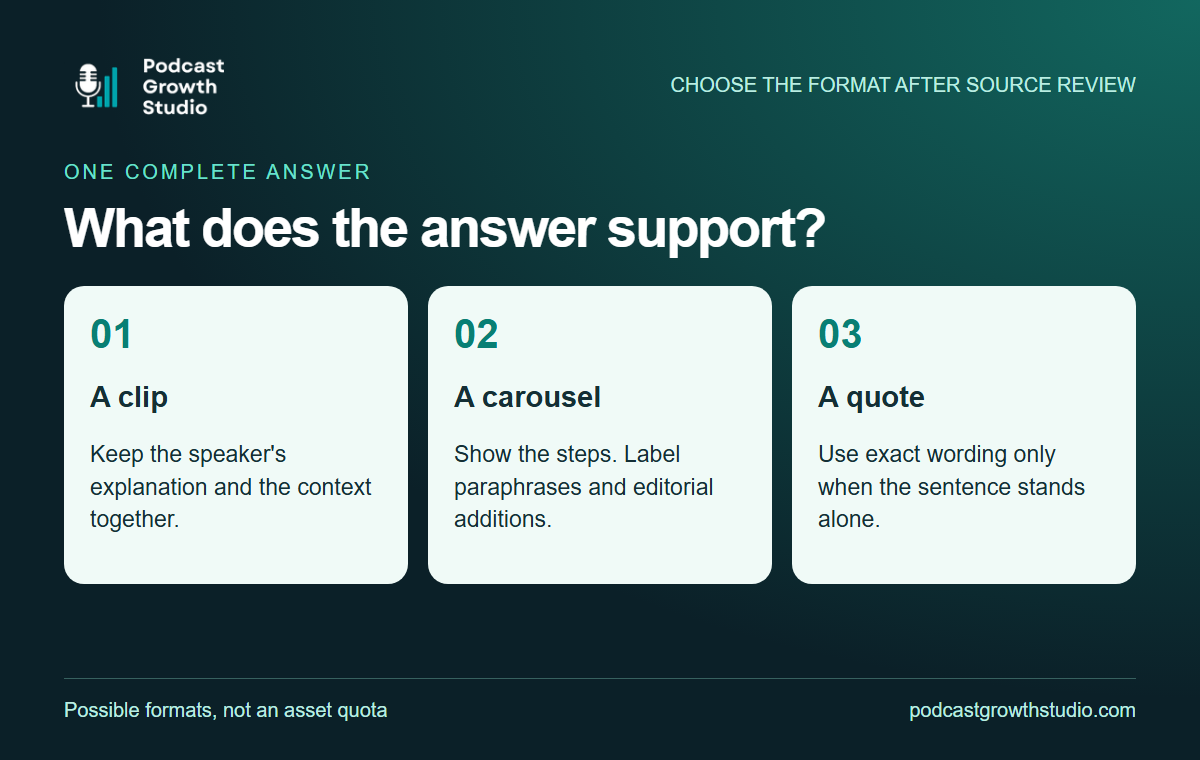
Clip: keep the explanation together
Use the answer from “Before you hand an episode” through the explanation of conflicting feedback if the recorded delivery supports it. The opening names the task. The middle lists the decisions. The ending explains why they matter. Review the actual recording before setting cut points. There are no real timestamps in this invented example.
Carousel: explain the 3 decisions
A possible structure is: cover, audience, purpose, approver, and a final brief checklist. Those slide headings paraphrase the example. They are not direct quotations. If you add a sample brief, label it as your editorial example instead of attributing new wording to the guest. Our podcast carousel templates show how to develop this structure.
Quote: preserve the wording
The opening sentence is a quote candidate because it names the task and the 3 decisions. Check the real transcript against the audio before using a quotation from an actual interview. If the full sentence is too long for a readable graphic, choose a different format or label a shorter rewrite as a paraphrase.
Record answers that an editor can use responsibly
Ask one question, then listen. Stacking a question about the problem, the solution and the guest's biggest lesson can leave the guest answering only the final part. Follow-up questions work best when they respond to a gap in the answer.
When the guest says “that approach” or “what we discussed earlier,” ask them to name the approach again if it would help a new listener. Do this naturally after they finish. Do not interrupt every answer to force a clip opening.
Ask for clarification when a claim is stronger than its support. “Which project was that?” and “Was that the result you measured or your interpretation?” are useful questions. If the evidence is unavailable, preserve that uncertainty in the eventual content.
After recording, give the editor a compact brief:
- The intended audience and the episode's central question.
- The recording and transcript, with speaker names checked.
- Candidate passages, with timestamps only where verified.
- Any permissions, confidential sections or claims awaiting evidence.
- The agreed formats, asset counts and approval contact.
Then apply the 3-Test Rule for choosing podcast clips. If you use AI to organise the transcript, follow our source-checking workflow and review its suggestions against the recording.
Frequently asked questions
Should I send podcast questions to the guest before recording?
Share the topic, intended audience and broad questions so the guest can prepare relevant examples. Keep space for spontaneous follow-ups. Confirm any private topics or approval requirements before recording.
How many interview questions should I prepare?
For this workflow, start with 4 or 5 main questions and keep the rest as optional follow-ups. That is a planning suggestion, not a rule about episode length. A detailed answer may make several planned questions unnecessary.
Should every answer become a short clip?
No. Some answers depend on the wider conversation. Others are clearer as a written explanation or carousel. Choose the format that preserves meaning and gives the audience a complete idea.
Can these questions guarantee more views or leads?
No. They help you ask for specific, usable source material. Audience fit, the answer itself, editing, distribution and the offer all affect what happens after publication.
Sources and editorial approach
StoryCorps: Tips for a Great Conversation supports the interviewing techniques used here: preparation, follow-up questions and adding context for listeners. It does not establish that a question will produce more views or leads.
The 12 B2B prompts, format suggestions and fictional worked example are PGS editorial recommendations, not research findings or client results.
Turn the conversation into a content plan
Start with the interview-prep checklist, choose the questions that fit your guest and record the answers fully. Build your publishing plan from the ideas the conversation actually supports.
Download the free checklist, then use the 30-day content calendar to organise approved assets.
Want help turning a recorded episode into clips, carousels and quote graphics? Explore the PGS Content Engine or tell us about your podcast.