
Podcast marketing is the most misunderstood phrase in this whole industry. Most people hear it and picture a small, sad list of chores: post a clip, ask for a review, beg three friends to share. That is a fraction of podcast marketing, and honestly it is the least important fraction. It is the part you do last, and it is the part that matters least if everything before it is missing.
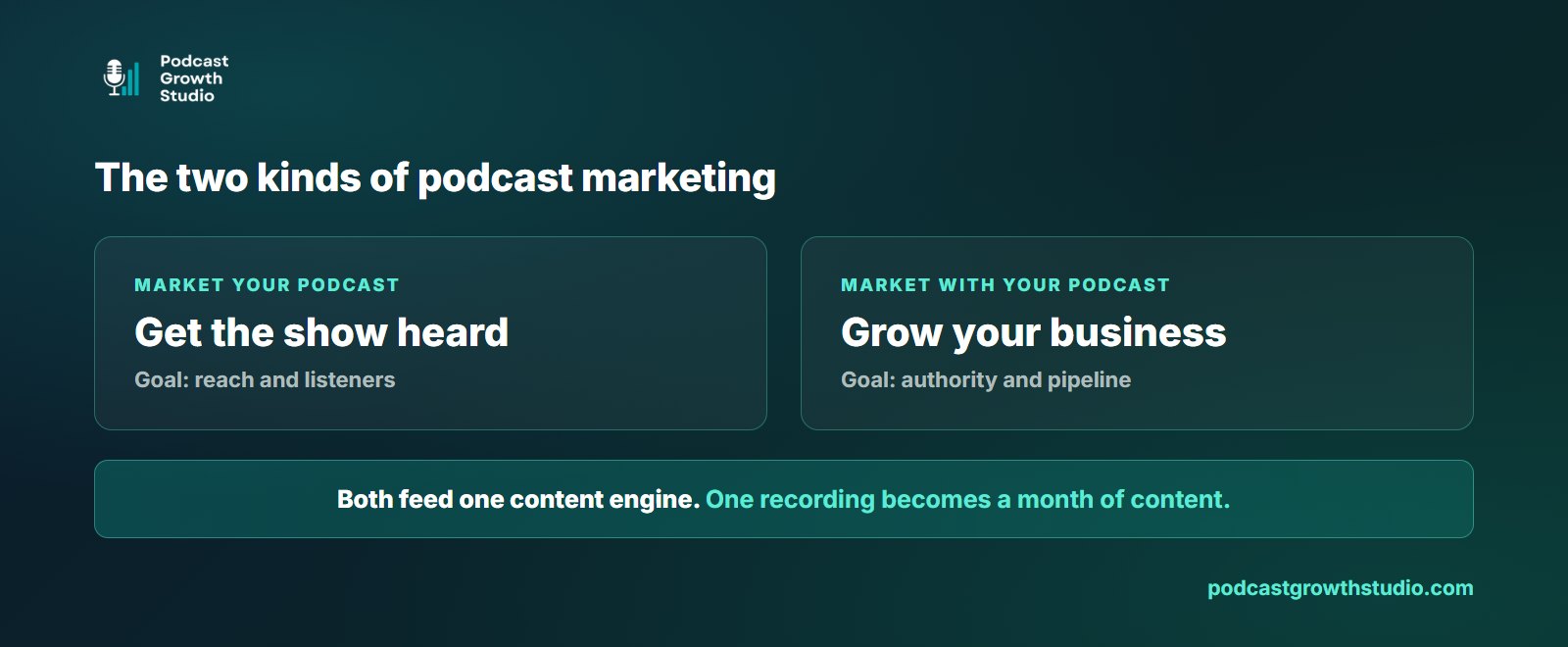
There are really two kinds of podcast marketing, and confusing them is why most of it quietly fails. The first is marketing your podcast, getting the show in front of the right people so it gets heard. The second is marketing with your podcast, using the show as an engine to grow a business. They are not the same job, they need different plans, and almost nobody decides which one they are doing before they start. This guide treats them as one system, because for most people who are serious about a show, they are.
So this is the strategy guide, not the tactics list. We will start with what podcast marketing actually is and the three questions that decide everything downstream. Then the five pillars of a system that works, how to market a show before it launches and the weekly rhythm once it is live, how a business turns the show itself into a marketing channel, what all of this costs, the mistakes that waste the work, and how to measure whether any of it is paying off. The channel-by-channel detail lives in the companion pieces, and I will point you to them as we go.
For context: I run Podcast Growth Studio. I spent 7 years in live radio, hosted a 200-episode show, and our team has produced content that has generated more than 350 million views for clients. Marketing podcasts is the work we do every week. This is the model I would hand a friend who asked me where to even begin.
What this guide covers
- What podcast marketing actually is, and the two kinds people confuse
- Start with strategy: the three questions before any tactic
- The five pillars of a podcast marketing system
- Marketing before you launch: the pre-launch runway
- The ongoing weekly marketing system
- Podcast marketing for business: the show as a channel
- What podcast marketing actually costs
- Five podcast marketing mistakes that waste the work
- How to measure podcast marketing
- Your podcast marketing plan
- Frequently asked questions
- Resources for further reading
What podcast marketing actually is, and the two kinds people confuse
Here is a definition worth keeping. Podcast marketing is the system of work that gets the right people to find your show, press play, come back, and, if the show exists for a business, take an action that matters. Notice it is a system, not a task. Notice it covers finding, converting, retaining, and acting, not just shouting about a new episode.
The most useful thing I can do early is separate the two kinds, because they pull in different directions.
Marketing your podcast is about reach and listeners. The goal is more of the right people hearing the show. If your podcast is the product, because you sell ads or sponsorships, this is the whole game, and the metric is downloads and audience size.
Marketing with your podcast is about using the show to grow something else, usually a business. Here the show is not the product, it is the top of a funnel. The goal is authority, relationships, and pipeline, and a show with 400 of exactly the right listeners can be worth more than one with 40,000 of the wrong ones.
The reason this distinction matters so much is that it changes what good looks like. Chase downloads when your real goal is clients and you will optimize for the wrong things, make the wrong content, and feel like you are failing while sitting on a working asset. Decide which kind you are doing, then read the rest of this guide through that lens.
One more reframe, because it is the one that makes modern podcast marketing click. In 2026, podcast marketing is mostly content marketing. The recording is raw material. The marketing is what you make from it, the clips, the posts, the search-ready pages, and where you put those pieces. A show that publishes an audio file and stops has not marketed anything. It has just stored a file in an app that does not hand it to strangers.
Start with strategy: the three questions before any tactic
Every pile-of-tactics problem traces back to skipping strategy. Before you pick a single channel, answer three questions honestly, because the answers decide every tactic that follows.
One: what is the show actually for? Not the vague answer, the real one. Is it built for ad revenue, where audience size is the point? For authority in a niche? For booked calls and pipeline? A show chasing sponsorship money and a show chasing client work are marketed in almost opposite ways, and the most common failure I see is a founder running a downloads-first playbook on a show that was only ever meant to bring in five good clients a year. Decide the goal first. It is the question that ranks all the others.
Two: who is it for, and where do they already pay attention? You market where your people already are, not where you personally enjoy posting. If your ideal listener lives on LinkedIn, a beautiful TikTok strategy is wasted effort. Name the person, then go find the three places they already spend attention, and meet them there. Everything gets easier when you stop marketing to everyone.
Three: why this show and not the thousand others on the topic? This is positioning, and it is the difference between a show a stranger can describe in one sentence and one they forget the second it ends. A clear promise, a specific angle, a format with a reason to exist. If you have not locked the name and the promise yet, our guide to naming a podcast and the free podcast name generator are quick ways to pressure-test it. A show no one can describe is a show no one can recommend, and word of mouth is still one of the strongest forces in this medium.
Answer those three and the tactics stop being a guessing game. You will know what to make, who to make it for, and where to put it. Skip them and no amount of clever posting will save you, because you will be optimizing a machine with no idea what it is supposed to produce.
The five pillars of a podcast marketing system
A podcast marketing system that actually works rests on five pillars. Most stalled shows have one or two and wonder why the whole thing feels stuck. They are listed here in order, because each one depends on the one before it.
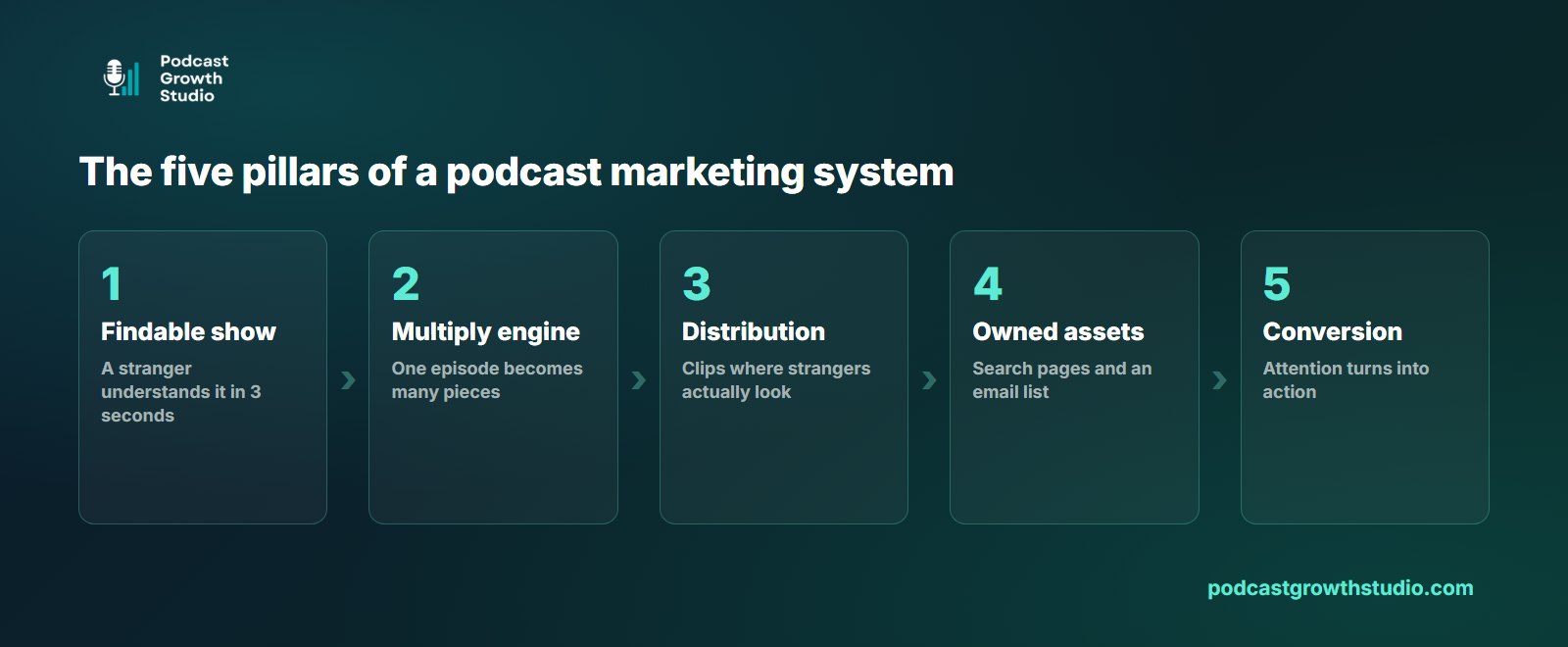
Pillar one: a show people can find and understand. Before any promotion, the show itself has to be legible to a stranger. A title and description they get in three seconds. Cover art that reads at thumbnail size. An open that says who it is for in the first 20 seconds. Audio clean enough that nobody leaves over the sound, which matters more than which microphone you bought, as our podcast equipment guide explains. Promotion amplifies whatever the show already is. Amplify something a stranger cannot understand and you just spread confusion faster.
Pillar two: the multiply engine. This is the core of modern podcast marketing, and the pillar most shows skip. Every recording should become many pieces: several short video clips, a written post or two, a quote graphic, and an episode page with the transcript for search. One episode becomes ten front doors instead of one. This is the engine that feeds every channel, and without it you have nothing to distribute but a single long audio file. The full workflow is in our complete repurposing guide and the Content Engine Method, which is the exact process we run for clients.
Pillar three: distribution across discovery surfaces. Now you put those pieces where strangers actually find new shows. The headline fact of 2026 is that discovery has moved to video and social, and away from inside the listening apps. Research from Cumulus Media and Signal Hill Insights found that 44% of people who found a new podcast did so on YouTube, roughly twice Spotify and five times Apple. So the clips go out, led by YouTube, and the apps become where people subscribe, not where they discover you. The platform-by-platform tactics are the entire subject of our guide to promoting a podcast in 2026.
Pillar four: owned assets that compound. Rented attention on social disappears the moment you stop posting. Owned assets keep working. The two that matter most are search-optimized episode pages, which pull in people Googling your topic for years, and an email list you actually mail, which is the one audience no algorithm can take from you. These are slow to build and they quietly become a large share of a mature show's reach. Do not skip them because they are not exciting.
Pillar five: conversion. Reach is pointless if nothing happens with it. For an audience show, conversion means turning a viewer of a clip into a subscriber of the show. For a business show, it means turning a listener into a booked call or a lead. Either way, every piece of content needs one clear, simple next step, and for business shows there has to be a path from attention to pipeline that you can actually see. The mechanics of that are in how to get clients from your podcast.
Read top to bottom, these five are a sequence, not a menu. A findable show with no multiply engine has nothing to distribute. Distribution with no conversion is a leaky bucket. Build them in order and each one makes the next one work.
Marketing before you launch: the pre-launch runway
Most people start marketing a podcast on the day episode one goes live. The shows that get traction start weeks before, and the gap between those two approaches is enormous. Launching to silence is demoralizing, and a show that lands with no listeners in week one often does not survive to week ten.
The pre-launch runway is simple. Build a small launch list of people who have told you they want to know when it is out, so day one is not a cold start. Bank three to five episodes before you publish, so a busy fortnight cannot break your streak in the first month, which is exactly when most shows quit. Line up your first few guests early, because guesting is borrowed audience and the right early guest brings their people with them. And start teasing: behind-the-scenes clips, the premise, a trailer. You are warming an audience so the show launches to a room with people already in it.
This is also the cheapest marketing you will ever do, because you are talking to people who already know you before the algorithm has any say. If you are still in the planning stage, the full pre-launch checklist is in our 50 questions to ask before you start a podcast, and the business-specific version is in how to start a B2B podcast that generates leads.
The ongoing weekly marketing system
Once the show is live, podcast marketing becomes a weekly rhythm, and the shows that win treat that rhythm like payroll rather than a mood. It happens on a schedule whether or not anyone feels inspired, because the single biggest predictor of a show's growth is not talent, it is whether the work keeps happening every week without drama.
The weekly loop has five moves, and it is the operating version of the five pillars. Record the episode. Multiply it into the week's clips, posts, and an episode page. Distribute those pieces across your chosen surfaces, video first. Engage, by replying to comments and showing up in the conversations the clips start, because reach that you ignore does not compound. And measure, glancing at what worked so next week leans into it. That is the whole machine, repeated.
The honest problem is that this is a lot of work, and it is the same amount of work every single week, forever. This is exactly where most shows break. The host can record, but the production line of editing, clipping, writing, and posting is a different job, and trying to do all of it personally on top of a real business is the fast road to burnout and a show that fades. So the real ongoing decision is not which tactic, it is who does the multiply step. Do it yourself, systematize it with a small team, or hand it off. We built our one episode into 30 days of content workflow precisely because this is the step that quietly kills good shows.
Podcast marketing for business: the show as a channel
If you are a coach, consultant, agency, or B2B founder, this section is the reason a podcast is worth your time at all. Done right, the show is not a hobby that might pay off someday. It is a marketing channel that does three jobs at once, and few other channels do even one of them as well.
It builds authority. Forty minutes of someone's attention, voluntarily given, builds trust that a feed post cannot touch. People who listen to a few episodes arrive at a sales call already half sold, because they feel like they know you.
It opens doors. This is the most underrated move in B2B podcasting. Inviting a dream client, a partner, or an industry name onto your show is a warm, flattering reason to start a relationship with someone who would have ignored a cold email. The episode is the excuse. The relationship is the point. The full version of this is in how to get booked as a podcast guest, which works in both directions.
It produces a month of marketing content. One recording feeds the entire multiply engine, so the show doubles as your content team. For a small business that cannot staff a daily content operation, that is the whole appeal: you talk for 40 minutes and a month of LinkedIn, email, and clips comes out the other side.
The mindset shift is to stop measuring a business show in downloads and start measuring it in pipeline. A show that books you two good calls a month is a serious channel even if the download numbers look small. The complete system for this, including how to attribute leads back to the show, is in how to get clients from your podcast and the Content Engine Method.
What podcast marketing actually costs
People expect the answer to be a dollar figure. The truer answer is that the real cost of podcast marketing is not money, it is consistent production, and that is the thing most shows run out of first. You can market a podcast for almost nothing in cash, but it will cost you several hours every week, forever, and that is the bill that goes unpaid.
There are three honest paths, and the right one depends on what your time is worth.
Do it yourself. Cash cost near zero, time cost high. You record, edit, clip, write, and post everything. This works at the start and for people whose time is genuinely free, but it is also where the most shows stall, because the production work loses to client work every single week until the show quietly stops.
Hire piecemeal. You bring in an editor and a clipper, often for a few hundred dollars a month each, and keep the strategy yourself. This buys back time and raises consistency, with the tradeoff that you are now managing freelancers and stitching their work together.
Done for you. A service takes the whole multiply step off your plate and turns each recording into a month of finished, ready-to-post content. The cost is higher than a single freelancer but lower than the show silently dying, and it removes the exact bottleneck that kills most shows. That is what we built. You can see how it works, and the founding price of 299 dollars a month, on the Content Engine page.
Whichever path you pick, decide it on purpose. The worst outcome is the accidental fourth path, where you meant to do it yourself, ran out of time by episode eight, and let the marketing quietly stop while telling yourself the show just did not work.
Five podcast marketing mistakes that waste the work
These are the five I see most often, and each one wastes effort that was almost going to pay off.
One: marketing the episode instead of the ideas. A clip captioned "great new episode out now" markets nothing, because nobody cares that an episode exists. A clip of a sharp, standalone idea markets the show, because it is useful or interesting on its own and earns the click. Promote the value inside the episode, never the fact of the episode.
Two: relying on the listening apps for discovery. Apple and Spotify are libraries, not discovery engines. They will not hand your show to anyone who is not already looking for it. Treating "we are on all the apps" as a marketing plan is the single most common mistake, and it is why so many good shows are invisible.
Three: no multiply step. Record, upload, hope. With no clips and no posts, there is nothing to distribute and no way for a stranger to find you. This is not a small gap, it is the absence of the entire engine.
Four: inconsistency. The silent killer. An audience cannot build a habit around a show that appears whenever the host has time. A reliable weekly show beats a brilliant erratic one every time, because marketing only compounds when it keeps happening.
Five: no goal and no measurement. If you never decided what the show is for, you cannot tell whether the marketing is working, so you cannot improve it. You just post into the dark and burn out. This loops straight back to the three strategy questions, which is why they come first.
How to measure podcast marketing
You cannot improve what you do not measure, and most podcasters measure the one number that lies to them: all-time total downloads. It only ever goes up, so it can never tell you whether the show is getting healthier or quietly dying. Throw it in a drawer. What you measure depends on which kind of marketing you are doing.
If the goal is audience, watch downloads per episode as a trend over a quarter, not the total. Watch reach from your clips, the people seeing you who did not before. And watch the ratio of new to returning listeners, which tells you whether you are keeping the people you work so hard to find. For where you honestly stand against real benchmarks, our guide to growing a podcast lays out the actual download tiers, and the industry-wide numbers are in our 2026 podcast statistics.
If the goal is business, downloads are a weak proxy and pipeline is the real scoreboard. Track booked calls and leads you can attribute back to the show, even if that attribution is as simple as asking every new lead how they found you and writing it down. Two good calls a month from a small show beats ten thousand downloads that never turn into a conversation. The attribution mechanics are in how to get clients from your podcast.
The point of measuring is not a tidy dashboard. It is to tell you what to do next. A flat trend in a specific number points you straight at the pillar that is broken, so you fix that one instead of doing more of everything.
Your podcast marketing plan
Here is how to turn all of this into something you can start on. The mistake is trying to stand up all five pillars at once. Do them in order, because each makes the next one work.
First, decide the strategy. Answer the three questions: what the show is for, who it is for, and why it exists over the alternatives. Write the answers down in one paragraph. Everything else points back to this.
Then make the show findable. Fix the title, description, art, and open so a stranger understands it in seconds. This is pillar one, and it is fast.
Then build the multiply engine. Commit to a fixed, sustainable set of pieces from every episode, several clips and a search-ready episode page, produced every week without exception. This is the lever for most shows, and it is the step to systematize or hand off if it is the thing that keeps not happening.
Then expand distribution on purpose. Commit hard to one discovery surface, YouTube for most, start a weekly guesting or cross-promotion habit, and double down on the clips and topics your early data already shows are working. The exact channel tactics are in the promotion guide.
Then close the loop with conversion. Add one clear next step to every piece of content, and for a business show, build the visible path from a listener to a booked call.
That order is the plan. Strategy, then a findable show, then the engine, then distribution, then conversion. Work it in sequence and you are building a machine. Jump around and you are back to a pile of tactics with no order, which is where we came in.
Frequently asked questions
What is podcast marketing?
Podcast marketing is the system of work that gets the right people to find your show, press play, come back, and, if it is a business show, take an action that matters. It has two halves that people confuse. The first is marketing your podcast: getting the show heard. The second is marketing with your podcast: using the show to grow a business. In 2026 most of it is content marketing. The recording is raw material, and the marketing is what you make from it and where you put it.
How do I market my podcast with no audience and no budget?
Start with the two cheapest levers. First, borrow audiences: guest on shows your ideal listener already follows, and swap promos with creators at your size. Second, turn every episode into short clips and publish them where strangers can find them, led by YouTube. Listening apps do not show your show to people who do not already follow you, but a strong 40-second clip can reach thousands who have never heard of you. Neither costs money, both cost consistency, and consistency is the actual scarce resource.
What is the best way to market a podcast in 2026?
Build a multiply engine and lead with video on YouTube. The single biggest lever is turning each episode into many pieces of content, then publishing the video clips where discovery actually happens. Research from Cumulus Media and Signal Hill Insights found that 44% of people who discovered a new podcast did so on YouTube, roughly twice the rate of Spotify and five times Apple. The episode is the raw material. The clips and posts are the marketing, and they are what bring new people in.
How much does podcast marketing cost?
The bottleneck is rarely money, it is consistent production. You can market a podcast for almost nothing if you do the clipping, writing, and posting yourself, but that is where most shows quietly stall because the work does not get done every week. The realistic paths are three: do it yourself for free but slowly, hire piecemeal help like an editor and a clipper for a few hundred dollars a month each, or use a done-for-you content service that turns each episode into a month of finished content. Our founding Content Engine offer starts at 299 dollars a month.
Is podcast marketing the same as podcast promotion?
No. Promotion is a part of marketing, not the whole of it. Promotion is the tactical layer: where and how you publish a given episode, the clips, the posts, the cross-promotion. Marketing is the strategy that sits above it: who the show is for, what it promises, how you turn it into content, and what action you want a listener to take. Promotion without strategy is a pile of tactics with no order. Decide the strategy first, then the promotion tactics have somewhere to point.
Can a podcast really be a marketing channel for a business?
Yes, and for many B2B businesses it is one of the best, because it does three jobs at once. It builds authority with a quality of attention that a social post cannot match. It opens doors, since inviting a dream client or partner onto your show is a warm reason to start a relationship. And it produces a month of marketing content from a single recording. For a coach, consultant, or founder, the show is not the product. It is the top of the funnel, and it should be measured in pipeline, not downloads.
Resources for further reading
The audience and discovery data in this guide comes from legitimate primary sources worth reading in full.
- Edison Research, The Infinite Dial 2025. The definitive primary-source data on US podcast listening and reach. edisonresearch.com
- Edison Research, The Podcast Consumer 2025. The share of people who now watch podcasts as video, and how consumption is shifting. edisonresearch.com
- Cumulus Media and Signal Hill Insights, Podcast Download, Spring 2025. The source for YouTube leading new-podcast discovery at 44%. signalhillinsights.com
- Buzzsprout Global Stats. The live, widely cited benchmark for podcast downloads by percentile. Useful for judging where audience marketing honestly stands. buzzsprout.com/global_stats
From the PGS blog: for the channel-by-channel tactics, read how to promote a podcast in 2026. For the growth system and real benchmarks, see how to grow a podcast. For the multiply engine, the complete repurposing guide and the Content Engine Method. And for turning a business show into pipeline, how to get clients from your podcast.
Closing: build the system, not the pile of tactics
Almost everyone who says podcast marketing is not working for them is not actually doing podcast marketing. They are doing the last and smallest piece of it, the promotion, with no strategy above it and no engine behind it, and then wondering why posting clips into the void changed nothing.
The work that pays off is the boring, ordered system. Decide what the show is for. Make it findable. Build the engine that turns one recording into many pieces. Put those pieces where strangers actually look. Close the loop so attention turns into something real. Do it every week, past the point where most people quit. That is the whole thing, and it is far more doable than the chaos most people mistake for marketing.
If the part that keeps breaking is the engine, the weekly grind of turning episodes into content, that is the exact bottleneck we remove. We turn one episode into a month of finished, ready-to-post content, so the marketing keeps happening whether or not your week cooperated. You can see how it works, and the founding price, on the Content Engine page.